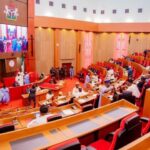
 In a landmark move to bolster Nigeria’s capital market and attract foreign investment, the Senate has passed the Investments and Securities Bill (ISB) 2024. The legislation, which repeals the Securities and Exchange Commission (SEC) Act of 2007, was unanimously approved during Wednesday’s plenary session.
During the debate, Senate Chief Whip Tahir Monguno highlighted the bill’s role in protecting investors and eliminating fraudulent activities within the capital market. The Chairman of the Senate Committee on Capital Market, Senator Osita Izunaso, emphasized that the ISB 2024 seeks to transform the market by fostering transparency, reducing systemic risk, and aligning regulatory frameworks with global standards.
According to Senator Izunaso, the bill introduces mechanisms to regulate derivatives, manage systemic risks, and combat Ponzi schemes. “The ISB establishes the SEC as the apex regulatory authority, ensuring fair and efficient capital market operations, protecting investors, and facilitating capital formation,” he stated.
The legislation also seeks to modernize Nigeria’s capital market through innovative regulatory provisions. It addresses insider trading, market abuse, and unauthorized trade practices, thereby safeguarding the market’s integrity. Izunaso remarked, “This bill is designed to position Nigeria’s capital market as a globally competitive player, strengthening its ability to drive national economic transformation.”
Senate President Godswill Akpabio hailed the bill’s passage as a milestone, stating that the reforms would encourage increased investment by minimizing risks for market participants.
The Director-General of SEC, Dr. Emomotimi Agama, commended the Senate’s efforts, noting that the ISB 2024 proposes harsher penalties for operators of Ponzi and pyramid schemes, including a minimum fine of ₦20 million or a 10-year prison sentence, or both. He stressed that the bill fortifies investor protections and enhances global competitiveness.
Notable updates in the ISB include provisions for the Investor Protection Fund (IPF) to cover losses beyond brokerage firm negligence or bankruptcy, such as cases arising from deregistration. Agama also pointed out that the bill introduces regulatory frameworks for Commodity Exchanges and Warehouse Receipts, key steps in advancing Nigeria’s commodities sector and diversifying its economy.
“This bill’s passage is pivotal for Nigeria’s journey toward establishing a world-class capital market,” Agama concluded, emphasizing the market’s role in economic diversification and growth.
Expert further affirmative statement endorsed the ISB2024 passed by the Senate which has introduced several measures aimed at modernizing financial market regulations. These updates focus on strengthening transparency, enhancing market efficiency, and adapting to emerging technologies like cryptocurrencies and artificial intelligence (AI).
Expert Insights:
1. Increased Transparency: The bill emphasizes robust disclosure requirements for publicly traded companies. This aligns with the Securities and Exchange Commission’s (SEC) goal of fostering comparability and consistency in financial reporting.
2. Adaptation to Technological Change: The legislation includes provisions to regulate the role of crypto assets and AI in capital markets. It seeks to establish clear guidelines for these technologies, reducing uncertainty for investors and issuers.

3. Focus on Enforcement: The SEC plans to implement stricter oversight of market participants, targeting high-impact violations to deter malpractice. This is expected to enhance investor confidence and market integrity.
Case Studies:
Shareholder Proposals and Corporate Governance: One key area involves the bill’s impact on shareholder rights, with new rules encouraging greater investor engagement. This has been compared to recent SEC actions that supported increased shareholder influence on climate-related decisions.
Regulation of Private Funds: Similar measures in the past have led to improved transparency and accountability in private equity and hedge fund operations. The bill’s approach is expected to have comparable outcomes, boosting trust in private capital markets.
Analyses by professional firms like Fenwick and Ernst & Young.share more details on the implications and ongoing developments of the ISB 2024.
With the ISB 2024 now passed by Senate, it is set to become a cornerstone of Nigeria’s financial architecture, fostering investor confidence and propelling the nation’s economy toward sustainable development.
Discover more from Ameh News
Subscribe to get the latest posts sent to your email.