A Vision for Maritime Growth
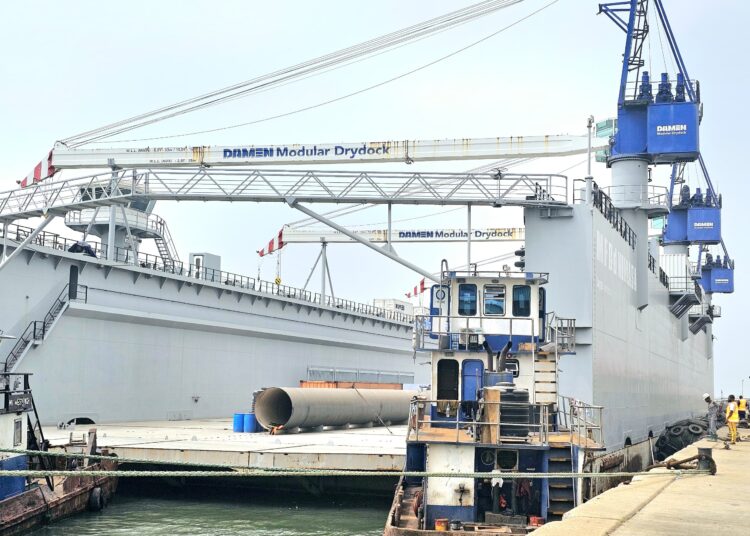 In 2018, the Nigerian Maritime Administration and Safety Agency (NIMASA) made a bold move, acquiring a state-of-the-art modular floating dock for ₦50 billion (approximately $1 billion). The facility was expected to revolutionize ship maintenance, boost local dry-docking capacity, and significantly reduce capital flight, all while positioning Nigeria as a leading hub for maritime operations in West Africa.
With a well-structured operational plan, the floating dock was set to align perfectly with the Blue and Marine Economy strategy, which forms a critical part of President Bola Ahmed Tinubu’s vision for a $1 trillion economy. The dock was not only intended to generate billions in annual revenue but also to create thousands of jobs, attract foreign investments, and strengthen Nigeria’s standing as a maritime powerhouse.
The Stagnation: A Billion-Dollar Asset Left Idle
Instead of fulfilling its potential, the floating dock remained unused for years, abandoned due to bureaucratic bottlenecks, administrative delays, and a lack of clear strategic direction. What was once envisioned as a game-changer for Nigeria’s maritime industry quickly became a symbol of waste and inefficiency—a “Humpty Dumpty” investment that crumbled before it could deliver economic value.
While the floating dock sat idle, Nigerian shipowners continued to spend over ₦180 billion annually on foreign dry-docking services, primarily in Ghana, South Africa, and Europe. The funds that could have boosted local businesses and created employment in Nigeria instead fueled economic growth in neighboring countries, weakening Nigeria’s position in the regional and global maritime landscape.

The Turning Point: Deployment Finally Underway
After years of policy inertia, according to the report, NIMASA has finally announced plans to deploy the floating dock for commercial operations. The agency recently relocated the dock to a jetty at Standard Flour Mills in Apapa, Lagos, ahead of its final transition to the Continental Shipyard, where it is expected to be stationed permanently.
Speaking on the development, former NIMASA Director-General, Dr. Bashir Jamoh, provided assurances that the project was back on track:“We are moving slowly but steadily to our destination… Very soon, Nigeria will begin saving foreign exchange with the commencement of operations of our dock.”
To facilitate the deployment, the report continued, the Nigerian Ports Authority (NPA) has leased out key operational spaces at the Continental Shipyard, including:
- The Dolphin Jetty
- Waterfront slipway for docking operations
- Administrative offices
- Construction, welding, and mechanical workshops
- A civil maintenance unit
With the installation of 50-ton cylindrical spuds to anchor the dock, stakeholders are cautiously optimistic that the long-awaited facility may finally become operational.
A Critical Gap in Nigeria’s $1 Trillion Economy Drive
While the deployment is a welcome step, the years of delay have already cost Nigeria billions. The maritime sector remains underutilized, despite its potential to serve as a major economic driver. If properly managed, the floating dock could:
✅ Save ₦180 billion annually by reducing capital flight.
✅ Generate significant revenue for both government and private operators.
✅ Create thousands of jobs across the shipbuilding and repair industry.
✅ Enhance Nigeria’s competitiveness as a leading maritime hub in Africa.
✅ Conserve foreign exchange and strengthen Nigeria’s currency reserves.
The key question remains: Will this deployment mark the beginning of sustained progress or will it be another case of policy inconsistency and mismanagement?
To ensure long-term success, industry stakeholders urge the government to fully commit to the project. Some maritime experts recommend privatization under a Public-Private Partnership (PPP) model, allowing private sector efficiency and transparency to drive operations while ensuring government oversight.
The Time for Action Is Now
For Nigeria to realize its $1 trillion economic ambition, strategic infrastructure like the NIMASA floating dock must not be left dormant. Maritime assets should be seen as critical tools in economic diversification, job creation, and industrial growth.
While the recent deployment announcement offers a glimmer of hope, the real impact will only be felt if concrete actions follow words. For too long, Nigeria has missed opportunities in the maritime sector—this floating dock cannot afford to become another failed promise. The government and private stakeholders must act decisively to ensure that this long-overdue investment finally delivers on its promise.
Stay informed, Stay ahead with The Ameh News
Discover more from Ameh News
Subscribe to get the latest posts sent to your email.