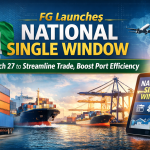
For over a decade, Nigeria’s maritime industry has struggled to fully implement a Single Window system, a digital platform that simplifies trade by enabling seamless communication among all stakeholders. The delays have largely been due to institutional resistance, inter-agency competition, and lack of political will.
A look at successful models in countries like Singapore, South Korea, and Ghana shows that collaboration, not agency dominance, is the key to success. In these countries, maritime agencies, customs, and private sector players worked together under a unified government-backed framework, ensuring efficiency, transparency, and cost reduction.
In Nigeria, the Nigerian Ports Authority (NPA), Nigeria Customs Service (NCS), and Nigerian Shippers’ Council (NSC) have made individual efforts to drive digital trade facilitation, but progress has remained fragmented. The Port Community System (PCS) initiated by the NPA in 2023 is a step forward, but without full cooperation from other agencies, the benefits remain limited.
For the Single Window to succeed, Nigeria must:
- Establish a multi-agency governance framework to prevent control by a single entity.
- Ensure data integration across Customs, ports, shipping lines, and logistics firms.
- Learn from Ghana’s experience, where a public-private partnership led to a 45% reduction in cargo clearance time.
- Invest in automation and capacity building to prevent system failures.
A well-implemented Single Window will enhance trade competitiveness, curb corruption, and boost Nigeria’s maritime economy. To achieve this, all agencies must embrace it as a national project, not a sole mandate.
Furthermore, implementing a Single Window system offers significant advantages for trade facilitation, revenue generation, and national development. Successful case studies from other countries highlight the transformative impact of this system.
1. Faster Cargo Clearance & Trade Efficiency
- Singapore’s Single Window system reduced cargo clearance time from 4 days to just 10 minutes.
- In Ghana, the system led to a 70% reduction in customs processing time.
- Nigeria’s fragmented system still causes delays of 7-14 days for cargo clearance.
2. Cost Savings for Businesses & Government
- Ghana’s integrated trade platform cut port-related costs by 35%.
- Nigeria’s traders currently spend millions of dollars annually on demurrage due to delays.
- A seamless system would reduce logistics costs and improve government revenue.
3. Transparency & Anti-Corruption Measures
- South Korea’s Single Window eliminated manual interference, reducing corruption in cargo clearing.
- Nigeria’s maritime sector loses billions to bribery and document falsification—a centralized digital system will curb these losses.
4. Enhanced Trade Competitiveness & Foreign Investment
- Nigeria ranks lower than Ghana in the Ease of Doing Business Index, partly due to inefficient trade procedures.
- A Single Window will boost investor confidence, attract more shipping lines, and improve trade flows.
5. Strengthened Inter-Agency Collaboration & Security
- Ghana integrated Customs, Ports, and Revenue authorities into a single digital network, reducing cargo theft and smuggling.
- Nigeria needs a unified regulatory framework to prevent data silos and agency turf wars.
For Nigeria to become a leading maritime hub in Africa, the Single Window system must be treated as a national priority, not the mandate of one agency. Political will, inter-agency cooperation, and private sector participation are critical for its success.
Stay informed. Stay ahead with The Ameh News
Discover more from Ameh News
Subscribe to get the latest posts sent to your email.