Basic AVSEC STP 123 Training Now Mandatory for All Security Staff Across Nigeria’s Aviation Sector
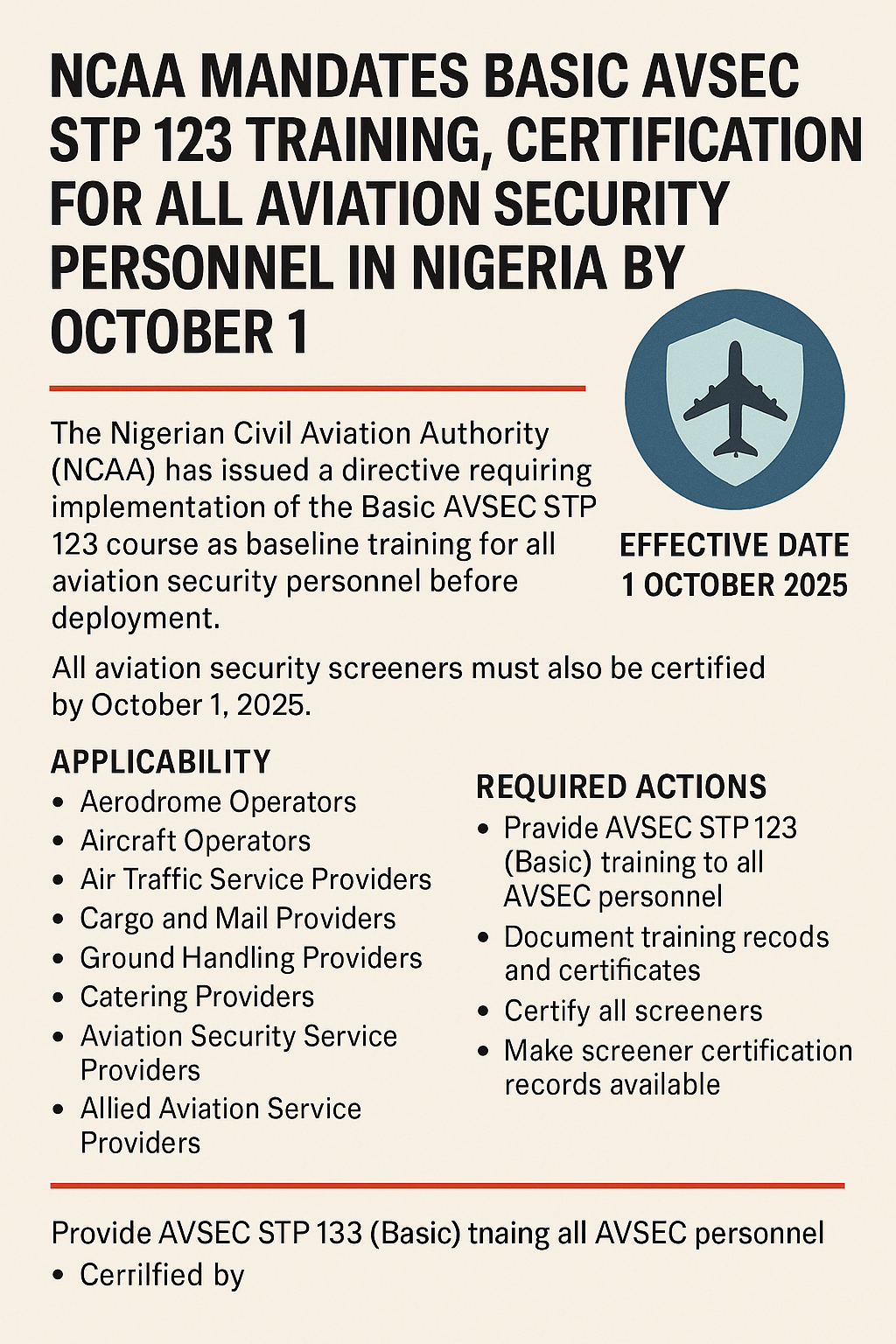
In a decisive regulatory action aimed at enhancing national aviation security standards, the Director General of Civil Aviation (DGCA), Capt. Chris Najomo, has mandated the implementation of the Basic AVSEC STP 123 course as a baseline training requirement for all aviation security personnel in Nigeria.
This directive, formalized through All Operators Letter DGCA/AVSEC/AOL/25/003 and Circular Ref: NCAA/DAVSEC/HQ/OD/6/1/33, aligns Nigeria’s aviation security framework with international best practices as outlined in ICAO Annex 17, Standard 3.4.1.
Key Directive Highlights
- Effective Date: October 1, 2025
- Scope: Applies to all Aerodrome Operators, Aircraft Operators, Air Traffic Service Providers, Cargo and Mail Providers, Ground Handling Companies, Catering Firms, AVSEC Service Providers, and all other Aviation Allied Service Providers.
- Training Requirement: All personnel involved in aviation security must complete the AVSEC STP 123 (Basic) course before deployment.
- Certification Requirement: All security screeners must be formally certified, especially those using X-ray machines or other screening equipment.
Objective: Secure Skies Through Competence and Compliance
According to the NCAA, this policy aims to ensure that all aviation security personnel are adequately trained and certified to implement security measures effectively under the National Civil Aviation Security Programme (NCASP) and corresponding airport-level security frameworks.
“The aviation sector is one of the most sensitive components of national infrastructure. With this directive, we are ensuring that every security personnel operating within our airports meets the standard of professionalism and readiness expected globally,” said DGCA Capt. Chris Najomo.
Implementation Actions for Operators
To comply with the directive, all stakeholders are required to:
- Train all current and future AVSEC staff using the AVSEC STP 123 (Basic) course as the entry-level standard.
- Document training processes and retain certificates as evidence for NCAA audit and inspection.
- Certify all screening personnel under the National Civil Aviation Security Certification Programme (NCASCP).
- Present certificates during any NCAA audit or inspection visits as proof of compliance.
Nationwide Oversight and Support
The NCAA has activated its regional compliance offices to provide technical support and monitoring. Key contact points include:
- Flight Standards Group: +234 916 101 1220
- Consumer Protection Call Center: +234 916 201 6222
- Regional Offices: Abuja, Lagos, Kaduna, Kano, and Port Harcourt
- Email: info@ncaa.gov.ng
- Website: www.ncaa.gov.ng
A National Commitment to Safer Skies
This directive represents a major milestone in Nigeria’s journey toward a safer and more professional aviation sector. With a firm deadline set for October 1, 2025, the NCAA has made clear that non-compliance will not be tolerated and that security through competence is the only acceptable standard moving forward.
For stakeholders, the countdown has begun—and the message is clear: train, certify, comply.
Stay informed, Stay ahead with The Ameh News
Discover more from Ameh News
Subscribe to get the latest posts sent to your email.