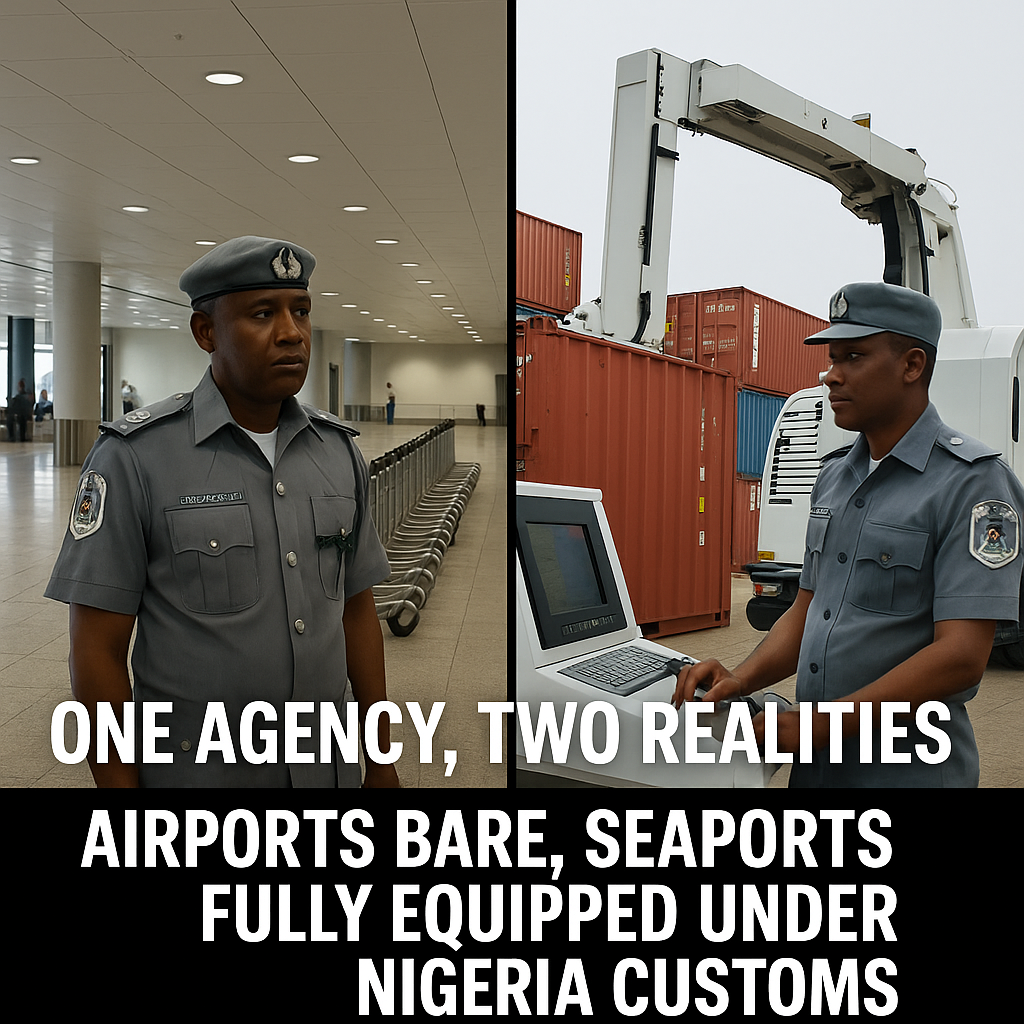
 The Nigeria Customs Service (NCS), the nation’s foremost border control agency, is operating under a striking duality: at Nigeria’s airports, customs officers carry out critical clearance operations without owning basic inspection equipment such as scanners, while at seaports, the same agency boasts of modern scanning infrastructure and advanced digital platforms.
This dual operational standard has raised growing concerns among trade stakeholders and security experts who fear that inconsistent infrastructure may hamper trade facilitation efforts, compromise national security, and create avoidable inefficiencies.
Airports: Manual Checks, Delays, and Dependence
At Nigeria’s international airports—including Murtala Muhammed International Airport in Lagos and Nnamdi Azikiwe International Airport in Abuja—customs operations are conducted largely without customs-owned scanners. Instead, the Nigeria Customs Service depends on equipment owned and managed by other government agencies or private concessionaires, creating bottlenecks and gaps in operational independence.
Customs officers often resort to manual inspection of cargo and passenger luggage, a process that not only slows down clearance time but also heightens the risk of errors and exposure to smuggling activities. “We operate blind most of the time,” said a customs officer at MMIA who spoke on condition of anonymity. “When scanners fail or access is delayed, we have no choice but to rely on physical checks.”
Despite handling high-value cargo such as pharmaceuticals, electronics, and diplomatic goods, airports remain significantly under-equipped—an irony that has become a cause for concern among freight forwarders and aviation stakeholders.
Seaports: Scanners, Platforms, and Promised Efficiency
In stark contrast, Nigeria’s major seaports, particularly the Port Terminal Multi-services Limited (PTML), Apapa, and Tin Can Island ports in Lagos, are rapidly undergoing modernization. Scanners are being deployed or upgraded, and the new indigenous digital platform, B’Odogwu, has been successfully piloted to streamline cargo processing.
PTML Area Controller, Comptroller Saidu Yusuf, recently revealed that the B’Odogwu platform processed over 16,000 declarations and generated more than ₦120 billion in revenue in just three months. “The platform is fast-tracking cargo clearance and reducing human contact,” he said, noting that its expansion to other ports is underway.

In addition, the Comptroller-General of Customs, Adewale Adeniyi, has announced plans to procure seven new high-performance scanners for port operations, reinforcing Customs’ technological grip at seaports. These systems, owned and managed directly by Customs, give the agency control over timelines, data security, and compliance enforcement.
One Agency, Two Systems
This glaring divide in operations has sparked debate over why the same agency applies different management standards depending on location. Experts argue that operating two systems within a single national border agency undermines efficiency, transparency, and the country’s trade competitiveness.
“It’s a contradiction that the Nigeria Customs Service owns and manages equipment at seaports but operates like a tenant at airports,” said Emmanuel Obayagbona, a maritime analyst. “You can’t run one organization on two incompatible systems and expect seamless coordination.”
Stakeholders in the aviation and logistics sectors are urging the federal government and the Ministry of Finance to allocate resources for the procurement and installation of customs-owned scanners and digital infrastructure at all airports. They argue that aligning airport operations with seaport standards is critical for securing Nigeria’s borders and improving the country’s Ease of Doing Business index.
The Way Forward
As Nigeria aims to diversify its economy and enhance non-oil revenue through trade, ensuring uniformity in customs operations is no longer optional. The modernization drive must go beyond seaports to include airports, dry ports, and border posts—creating a cohesive and technology-driven Customs service nationwide.
For now, the Nigeria Customs Service stands as one agency operating two realities—efficient and equipped at the ports, but under-resourced and over-reliant at the airports.
Key Takeaways from the above Story:
1. Operational Disparity: The Nigeria Customs Service (NCS) operates with full equipment ownership at seaports, including scanners and digital platforms, but lacks such infrastructure at airports, relying on equipment owned by third parties.
2. Trade and Security Risks: The absence of customs-owned scanning equipment at airports hampers efficient cargo clearance and increases vulnerability to smuggling and security threats.
3. Seaport Modernization: Seaports like PTML, Apapa, and Tin Can Island have seen significant improvements, including the deployment of the indigenous B’Odogwu platform and upcoming scanner installations, enhancing clearance speed and revenue collection.
4. One Agency, Two Systems: The differing operational standards within a single government agency reflect systemic inefficiencies and raise concerns over fairness, transparency, and coordination.
5. Stakeholder Concerns: Industry experts and freight operators are calling for urgent investments in airport customs infrastructure to align operations across all points of entry.
6. Call to Action: To improve national trade facilitation and border security, the federal government must standardize equipment ownership and technological deployment across all customs command locations—airports, seaports, and land borders alike.
Stay informed, Stay ahead with The Ameh News
Discover more from Ameh News
Subscribe to get the latest posts sent to your email.