NNPC Ltd Executives Say Port Harcourt Refinery is on Track to Deliver Energy Security and Economic Revival
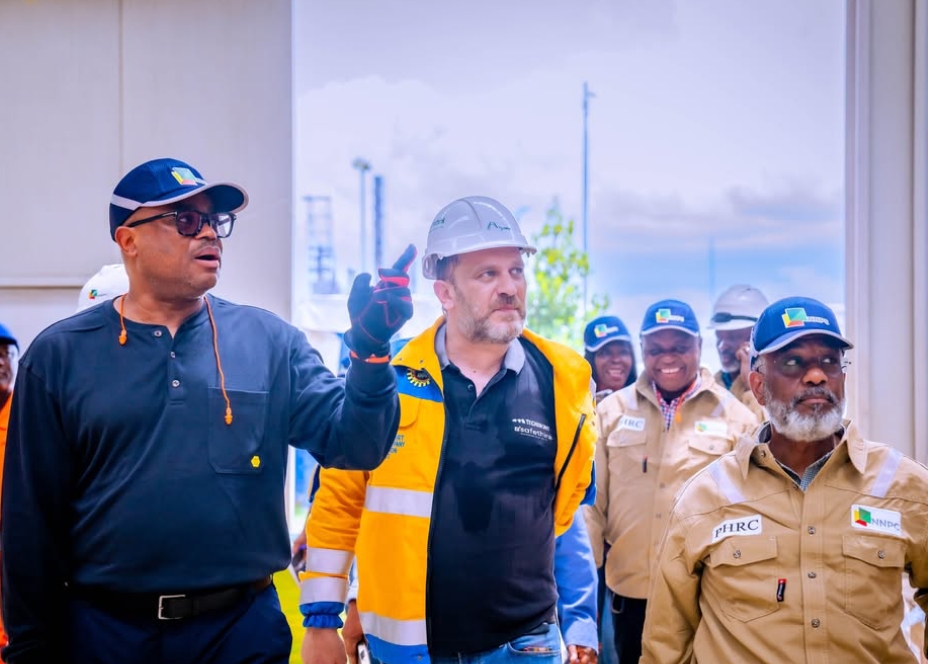 In a renewed push to fast-track Nigeria’s energy independence, Chairman of the Board of the Port Harcourt Refining Company (PHRC) and Executive Vice President, Upstream, NNPC Limited, Mr. Udy Ntia, led a high-powered team on a strategic facility tour of the Port Harcourt Refinery earlier today.
He was joined by the Executive Vice President, Downstream, Mr. Mumuni Dagazau, as they assessed the progress of the multi-billion-dollar rehabilitation of the facility—an effort seen as central to the federal government’s plan to reduce fuel importation and stabilize domestic energy supply.
The visit comes amid rising public expectations and intense scrutiny of Nigeria’s refinery overhaul projects. The Port Harcourt Refinery, a two-plant complex with a combined processing capacity of 210,000 barrels per day, has long been the focal point of national conversations around oil sector reform and infrastructure recovery.
Inspection of Critical Units
During the tour, the NNPC executives inspected key components undergoing restoration, including the crude distillation units, water treatment systems, power generation sections, and the central control facility. They also interacted with project engineers, safety officers, and local technical teams working on-site.
According to sources present at the visit, discussions focused on the rehabilitation timeline, quality control mechanisms, safety benchmarks, and alignment with national energy objectives.
Speaking during the inspection, Mr. Ntia reaffirmed the NNPC’s commitment to delivering a fully functional refinery that meets both operational and environmental standards.
“We owe Nigerians a refinery that works—not just in theory but in practice,” Ntia said. “This tour is about more than oversight. It’s about reinforcing our collective responsibility to deliver results.”
His counterpart, Mr. Dagazau, described the refinery’s revival as pivotal to job creation, fuel affordability, and long-term macroeconomic stability.
“This is not just about refining fuel. It’s about refining our future. Every bolt we fix here represents a family that will benefit, a business that will grow, and a nation that will rise,” he stated.
Progress and Projections
The PHRC rehabilitation project, managed in phases, has reached significant milestones since the contract was awarded to Italian engineering firm Tecnimont in 2021. Industry insiders say Phase 1 of the rehabilitation is nearing 85 percent completion, with several units already undergoing preliminary commissioning.
While no exact date for resumption of operations was given, senior engineers at the site hinted at potential test runs beginning in the first quarter of 2026, subject to final quality and safety verifications.
NNPC Ltd has consistently maintained that it will prioritize safety and performance over speed. The tour underscored that position, with executives emphasizing the importance of thorough system testing before any commercial operations resume.
Local Impact and Economic Significance
Beyond engineering, the rehabilitation of the Port Harcourt Refinery is already having socio-economic ripple effects in Rivers State and surrounding areas. The project has created hundreds of direct and indirect jobs, reactivated local service chains, and injected life into the industrial corridor of Eleme where the refinery is located.
Local workers and community stakeholders expressed optimism during the visit, with some describing the presence of the NNPC leadership as a morale booster.
“When the top executives come down to the site, it shows they care. We are no longer forgotten,” said a senior technician, who asked not to be named.
Strategic Energy Planning
Nigeria, despite being one of Africa’s top oil producers, imports more than 90% of its refined petroleum products—a situation that continues to pressure foreign reserves and destabilize pricing.
The PHRC rehabilitation is a cornerstone of the government’s plan to reverse this dependency. Alongside the 650,000 bpd Dangote Refinery and smaller modular plants, the Port Harcourt facility is expected to play a key role in meeting local fuel demand and potentially supplying West African markets.
NNPC officials also used the opportunity to evaluate pipeline integrity, storage infrastructure, and integration plans with the national distribution grid.
A Nation Watches and Waits
For millions of Nigerians, the story of the Port Harcourt Refinery reflects the broader national struggle to harness oil wealth for local development. The facility, once a symbol of industrial pride, became a casualty of decades of neglect. But its ongoing revival signals a new chapter—one of recovery, reform, and responsibility.
Today’s facility tour may have lasted only hours, but the message was clear: leadership is present, progress is visible, and the promise of energy security is still alive.
Follow The Ameh News for continued coverage of Nigeria’s refinery rehabilitation projects and energy sector updates.
Discover more from Ameh News
Subscribe to get the latest posts sent to your email.