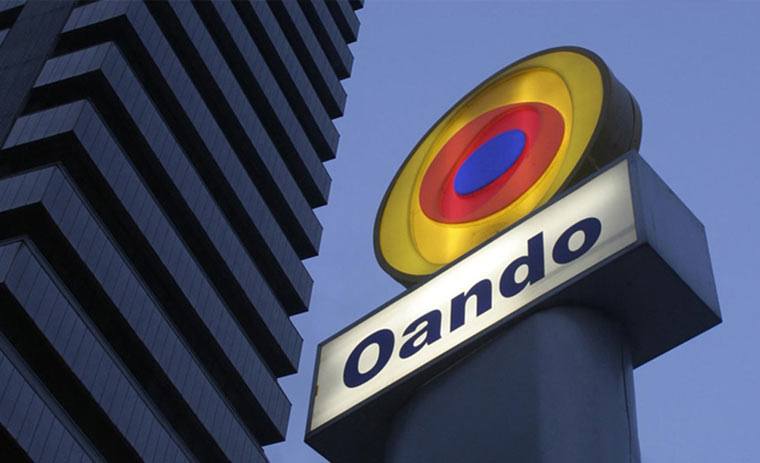
 Oando PLC, Nigeria’s leading integrated energy company listed on both the Nigerian Exchange Group (NGX) and the Johannesburg Stock Exchange (JSE), has reported a 267% surge in profit-after-tax to N220 billion for the full year ended December 31, 2024. The strong earnings followed a 44% jump in revenue to N4.1 trillion, up from N2.9 trillion in 2023, according to the company’s audited financial statements released this week.
The improved performance was largely driven by increased crude oil output and the successful acquisition of Nigerian Agip Oil Company (NAOC), which significantly strengthened Oando’s upstream operations.
“Our acquisition and integration of NAOC in 2024 marked a turning point in our decade-long growth journey,” said Group Chief Executive Wale Tinubu. “It resulted in our assumption of operatorship of the OML 60–63 assets, and the doubling of our working interest from 20% to 40%—a move that expanded our 2P reserves from 500 million to nearly 1 billion barrels of oil equivalent.”
Upstream Gains Offset Market Headwinds
Oando’s daily production rose by 3% year-on-year to 23,727 barrels of oil equivalent per day (boepd). Crude oil production saw a notable 27% rise to 7,558 barrels per day (bpd). However, the company experienced a 35% drop in natural gas liquids (NGL) production to 156 bpd, and a 5% decline in gas output to 16,013 boepd.
The company’s proved and probable (2P) reserves jumped by 95% to 983 million boe, representing a 188% reserves replacement ratio—a key indicator of growth in upstream assets post-acquisition. Operational uptime was also strong at 86%, reducing deferred production and supporting consistent off-take.
Downstream Declines Reflect Industry Shifts
Despite the upstream gains, Oando’s trading arm experienced a downturn. Crude oil trading volumes declined by 37% to 20.7 million barrels, while refined product volumes fell by 64% to just over 599,000 metric tonnes. The company attributed the declines to structural shifts in Nigeria’s oil market and soft domestic demand amid macroeconomic challenges.
Renewables and Energy Transition Initiatives
In its renewable energy division, Oando made measurable strides. The company’s electric mass transit programme covered over 121,000 kilometres in 2024, transporting more than 205,000 passengers. The programme displaced an estimated 163,546 kg of CO₂ and saved over 60,000 litres of diesel.
Oando also signed Memoranda of Understanding with Cross River and Edo States for future wind power projects and launched a geothermal feasibility study in partnership with the Nigerian National Petroleum Company (NNPC), exploring the conversion of depleting oil wells into renewable power assets.
Outlook and Strategy for 2025
With the NAOC acquisition completed in August 2024, the company expects to consolidate gains and ramp up production further in 2025. Oando has set a production target of 30,000–40,000 boepd for the year, aligning with its long-term goal of reaching 100,000 bopd and 1.5 trillion cubic feet of gas by 2029.
“2025 will be a year of execution,” Tinubu said. “Our priorities include optimizing post-acquisition synergies, improving security to curb crude theft, enhancing cost efficiency, and leveraging technology to boost productivity.”
Local Operators Rise Amid IOC Divestments
Oando’s results come amid a broader shift in Nigeria’s oil sector, as indigenous companies take the lead following International Oil Company (IOC) divestments. Seplat recorded a revenue of ₦1.65 trillion for FY2024—a 137% increase—while Aradel saw revenue rise 162% to ₦581.2 billion.
This transition, analysts note, could help keep more oil revenues within Nigeria, foster local employment, and improve the government’s tax take.
With a strong foundation laid in 2024, Oando appears poised to play a central role in shaping Nigeria’s energy future across both traditional and renewable fronts.
Stay informed, stay ahead with The Ameh News
Discover more from Ameh News
Subscribe to get the latest posts sent to your email.