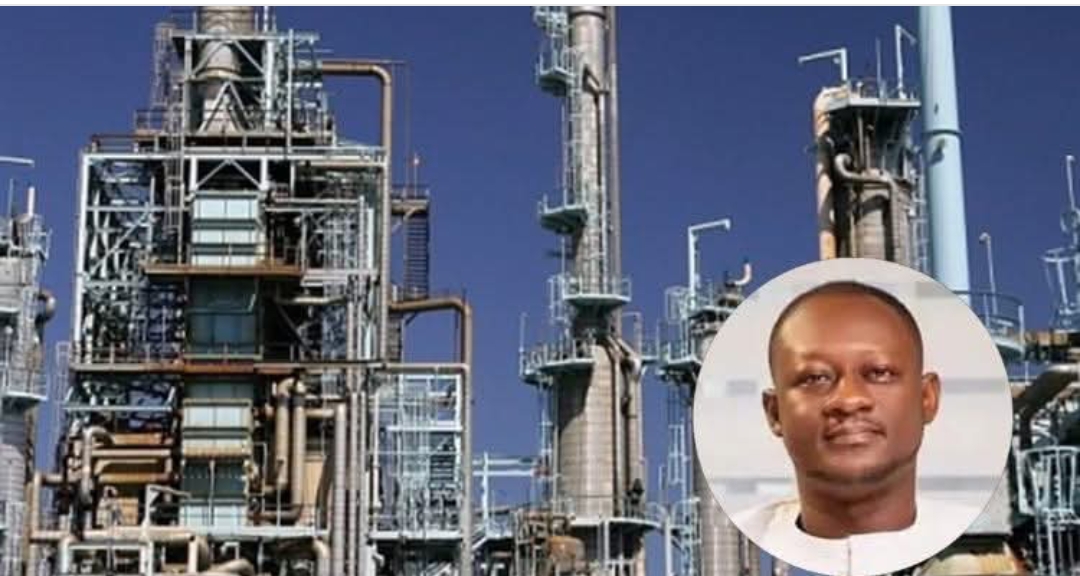
 After years of operational setbacks and industry uncertainties, Ghana’s premier state-owned oil refinery, the Tema Oil Refinery (TOR), is poised to return to full refining capacity by October 2025, according to its Acting Managing Director, Edmund Kombat.
This long-awaited revival signals a pivotal moment not just for Ghana’s energy security but for the broader West African downstream oil sector. The announcement, made by Kombat earlier this week, reflects a concerted effort by government and industry stakeholders to restore TOR’s relevance amid rising energy demand and regional competition.
Kombat, who was appointed Acting MD in a bold move to inject technocratic leadership into TOR, brings an impressive blend of legal, financial, and energy sector experience to the role.
From Boardrooms to Refineries: Who Is Edmund Kombat?
A seasoned entrepreneur and energy strategist, Kombat is not new to the corridors of power or the complexities of refinery management. His credentials span multiple sectors:
- Founder & Chairman of the Edkom Group, which includes firms like Citi Energy Ltd and Oyster Agribusiness Ltd, where he reportedly raised over $3 million, improving livelihoods for more than 4,500 farmers.
- He has also held key roles in the Bank of America Merrill Lynch in London and Premium Bank in Accra, giving him robust global financial insight.
- His policy experience includes working as Business Analyst for the Ministry of Energy and as Special Assistant to the CEOs of both TOR and BOST (Bulk Oil Storage and Transportation).
- Most recently, he served as Head of Risk & Compliance at Convenio Energy Pty in South Africa.
Academically, Kombat is a Harvard-trained public policy expert, having earned a Master in Public Administration (MPA) as an Edward S. Mason Fellow at the Kennedy School of Government. He also holds a First Class BA from the University of Ghana, an LL.B from GIMPA, and a BL from the Ghana School of Law.
A Strategic Turnaround
Kombat’s announcement is a strategic reflection of months of behind-the-scenes work to stabilize TOR, attract investment, and upgrade infrastructure. Analysts believe that a successful restart will help reduce Ghana’s reliance on imported refined products, boost foreign exchange savings, and restore public confidence in state-led industrial ventures.
TOR, once a key pillar of Ghana’s energy architecture, has over the years suffered from underfunding, mismanagement, and political interference. Kombat’s entry may signal a shift toward merit-based leadership and operational transparency.
Regional Significance
With refineries in the region, such as Nigeria’s Dangote Refinery, already attracting international attention, TOR’s re-entry into the refining space adds competitive pressure and opens up new possibilities for cross-border trade and collaboration within ECOWAS.
As the countdown to October 2025 begins, Kombat and his team face the challenge of not only restarting operations but sustaining them in a tough economic climate. Still, industry watchers remain cautiously optimistic.
“This is not just about resuming operations,” a senior analyst at the Institute for Energy Security noted, “It’s about repositioning TOR as a viable, competitive, and transparent asset for Ghana and West Africa.”
For Edmund Kombat, the road ahead is steep, but his diverse expertise may just be the refinery’s most valuable resource.
Stay informed, stay ahead with The Ameh News
Discover more from Ameh News
Subscribe to get the latest posts sent to your email.