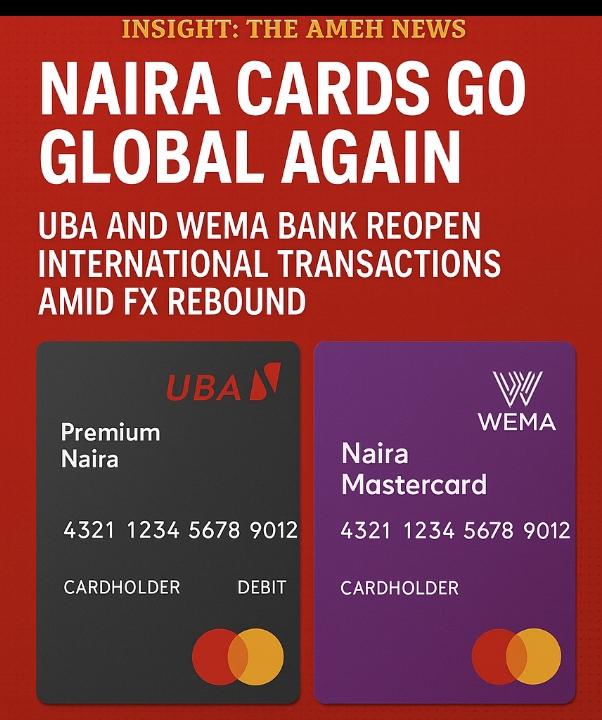
 Nearly three years after Nigeria’s naira debit cards were stripped of their international utility, two of the nation’s leading banks—United Bank for Africa (UBA) and Wema Bank—have made a powerful comeback, reintroducing global transaction access on their naira cards. Beyond a banking update, the move tells a larger story of economic recalibration, regained investor confidence, and a renewed push for sustainable financial inclusion.
Reconnecting Nigeria to the World
UBA led the charge, announcing that all Premium Naira Cards—Gold, Platinum, and World variants—are now active for global transactions. “You can now use your Premium Naira Card for everyday payments, online shopping, POS, and ATM transactions across the world,” the bank said in a direct message to customers.
Hot on its heels, Wema Bank declared, “Your Wema Naira Mastercard just went global! Now you can pay in dollars on all your favourite international platforms—Amazon, eBay, AliExpress, Netflix, Spotify, YouTube.”
This reactivation means more than just consumer convenience; it reflects a return of trust in the naira and the resilience of Nigeria’s banking infrastructure. For digital entrepreneurs, students, freelancers, and SMEs, it’s a green light to re-engage with the global digital economy.
When the Global Door Slammed Shut
The international functionality of naira cards was halted in mid-2022 amid worsening foreign exchange constraints. Dollar liquidity had dried up. Banks, facing pressure to meet even domestic FX demands, began suspending cross-border services to protect reserves. For Nigerians who depended on platforms like Zoom, Coursera, or Canva, and for SMEs importing software or tools, the disruption was severe.
Alternative payment systems—like dollar cards, domiciliary accounts, and digital wallets—filled the gap, but at a higher cost and with barriers to access. The situation exposed Nigeria’s financial system fragility, underlining the urgent need for more sustainable FX policies and inclusive digital payment frameworks.
Rebuilding Confidence: What Changed?
The current shift is no accident—it is the result of structural improvements in Nigeria’s FX ecosystem.
Ayokunle Olubunmi, Head of Financial Institutions Ratings at Agusto & Co, explained: “There’s a notable improvement in FX liquidity, a narrowing of the official-parallel market exchange rate gap, and a decline in arbitrage incentives.”
Charles Sanni, CEO of Cowry Treasurers, linked the trend to a stronger macroeconomic footing. “High interest rates have curbed currency speculation. The naira has appreciated against the dollar, and investor sentiment is improving,” he noted. “We’ve seen a rise in diaspora remittances, policy support for FX inflow, and improved oil revenue—all pointing to better sustainability.”
Sanni added that Nigeria’s improved credit rating, a more transparent FX trading system, and stronger bank capitalisation are aligning to support long-term stability.
A Sustainable Financial Inclusion Agenda
The return of international naira card usage also has implications for Nigeria’s broader sustainability agenda—particularly in financial inclusion and digital equity.
For millions of unbanked and underbanked Nigerians, naira cards remain the most accessible financial tools. Reintegrating them into global platforms not only enhances access to services but also encourages digital adoption across rural and urban populations alike. It reduces dependence on less-regulated or inaccessible alternatives, and improves traceability in transactions—key for governance and fiscal planning.
Moreover, as Nigeria edges closer to its ambition of a $1 trillion economy, the resumption signals a readiness to support small businesses and tech-savvy youth who operate across borders but lack access to foreign exchange channels. Sustainability here is not only about policy—it’s about ensuring continuous access, reliability, and trust in everyday financial tools.
A Cautious Optimism Moving Forward
The path ahead will still require strategic discipline. Resuming international access is only part of the equation. Maintaining it will demand that monetary authorities continue managing inflation, safeguarding FX reserves, closing policy gaps, and protecting the naira’s purchasing power.
Banks, in turn, must work closely with regulators to promote responsible card usage, curb misuse, and integrate sustainability metrics into their retail banking strategies.
A Nation Reconnected, with Purpose
UBA and Wema Bank’s decision to reopen international transactions on naira cards is more than just a service update—it’s a reaffirmation of Nigeria’s global connectivity, a step forward in economic recovery, and a boost to digital and financial sustainability.
As Nigerians swipe their naira cards on global platforms once again, the hope is that this is not a temporary rebound, but a steady march toward a stronger, more inclusive, and sustainable financial future.
@2025 The Ameh News: All Rights Reserved
Discover more from Ameh News
Subscribe to get the latest posts sent to your email.