 As global maritime operations transform under the weight of new environmental, digital, and labour standards, Abdulkadir Ahmed, Managing Director of NLNG Shipping and Marine Services Limited (NSML), has made a resounding call: Nigeria must invest in maritime capacity development or risk being left adrift.
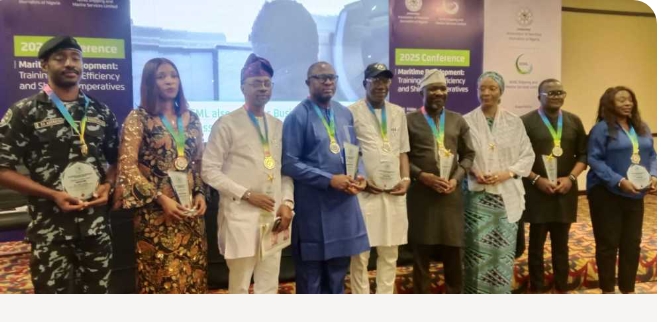
Speaking through the company’s Chief Finance Officer, Mr. Mutiu Olayiwola, at the 2025 Annual Conference of the Association of Maritime Journalists of Nigeria (AMJON) in Lagos, Ahmed delivered a keynote that resonated deeply with industry stakeholders. Themed “Maritime Development: Training, Ports Efficiency and Shipping Imperatives,” the gathering was not just another conference—it became a moment of reckoning for Nigeria’s maritime sector.
In his presentation titled “The Evolving Global Maritime Regulatory Environment – The Role of Maritime Training and Capacity Development,” Ahmed traced the seismic regulatory shifts altering the face of global shipping. From climate-centered regulations to cybersecurity threats and seafarer welfare, the stakes are higher than ever. “Global shipping is no longer just about vessels and cargo,” Ahmed noted. “It’s about people, preparedness, and progressive thinking.”
He pointed to groundbreaking International Maritime Organization (IMO) mandates like the Sulphur Cap, EEXI, and CII, which now compel shipping companies to overhaul their fleets, systems, and training programmes in pursuit of energy efficiency and carbon neutrality. The rise of autonomous shipping and the vulnerability of vessels to cyberattacks, he warned, require maritime professionals who are not only skilled in navigation and engineering but also in data security and smart technology management.
A Human Wake-Up Call: Lessons from COVID-19
Ahmed’s address was particularly stirring when he reflected on the human cost of systemic neglect in seafarer welfare. The COVID-19 pandemic, he said, exposed the industry’s fragility and the emotional toll on its frontline workers—many of whom were left stranded at sea, isolated from families and medical support.
“The pandemic revealed what happens when we ignore the human angle of maritime operations,” he said solemnly, welcoming recent updates to the Maritime Labour Convention (MLC) which now guarantee rest, medical care, and repatriation rights for seafarers. “These aren’t just technical upgrades. They are moral imperatives.”
Building the Next Generation at Home
Against this backdrop, Ahmed showcased NSML’s investment in human capital through the Maritime Centre of Excellence (MCOE) in Bonny, Rivers State—a facility that is redefining maritime training in Africa. With over 200 cadets trained in STCW 2010-compliant and UK-accredited courses, many of whom are now embedded within NSML’s fleet operations, the centre is not just a school—it’s a pipeline for national pride and economic empowerment.
Equipped with one of Africa’s most sophisticated simulators, the MCOE delivers real-time training in engine room protocols, bridge navigation, cargo handling, and emergency response. It’s an investment, Ahmed said, that ensures Nigeria can groom professionals who are globally competitive without relying on foreign institutions.
Sustainable Innovation at Sea
Beyond capacity building, NSML’s contributions stretch into technology and sustainability. From overseeing the construction of LPG vessels to adopting dual-fuel and alternative-energy ships, the company is aligning its operations with IMO’s ambitious 2030 and 2050 emission targets. Ahmed also cited partnerships with key stakeholders like NIMASA and involvement in the Deep Blue Project as part of the company’s broader mission to fortify Nigeria’s maritime sovereignty.
A Call to Action
Ahmed’s speech wasn’t merely a technical briefing—it was a rallying cry. He urged government agencies, private players, and the media to align efforts in building a maritime ecosystem where training is a priority, not an afterthought. “Without skilled people,” he warned, “there can be no safe ships, no efficient ports, no compliant fleets.”
He praised AMJON for being more than a watchdog—calling the media association a vital partner in shaping maritime narratives and pushing accountability. “The story of Africa’s maritime transformation,” he concluded, “must be told by those who believe in its potential.”
As the industry battles fragmentation, capacity development may well be the compass that keeps Nigeria on course.
@2025 The Ameh News: All Rights Reserved
Discover more from Ameh News
Subscribe to get the latest posts sent to your email.