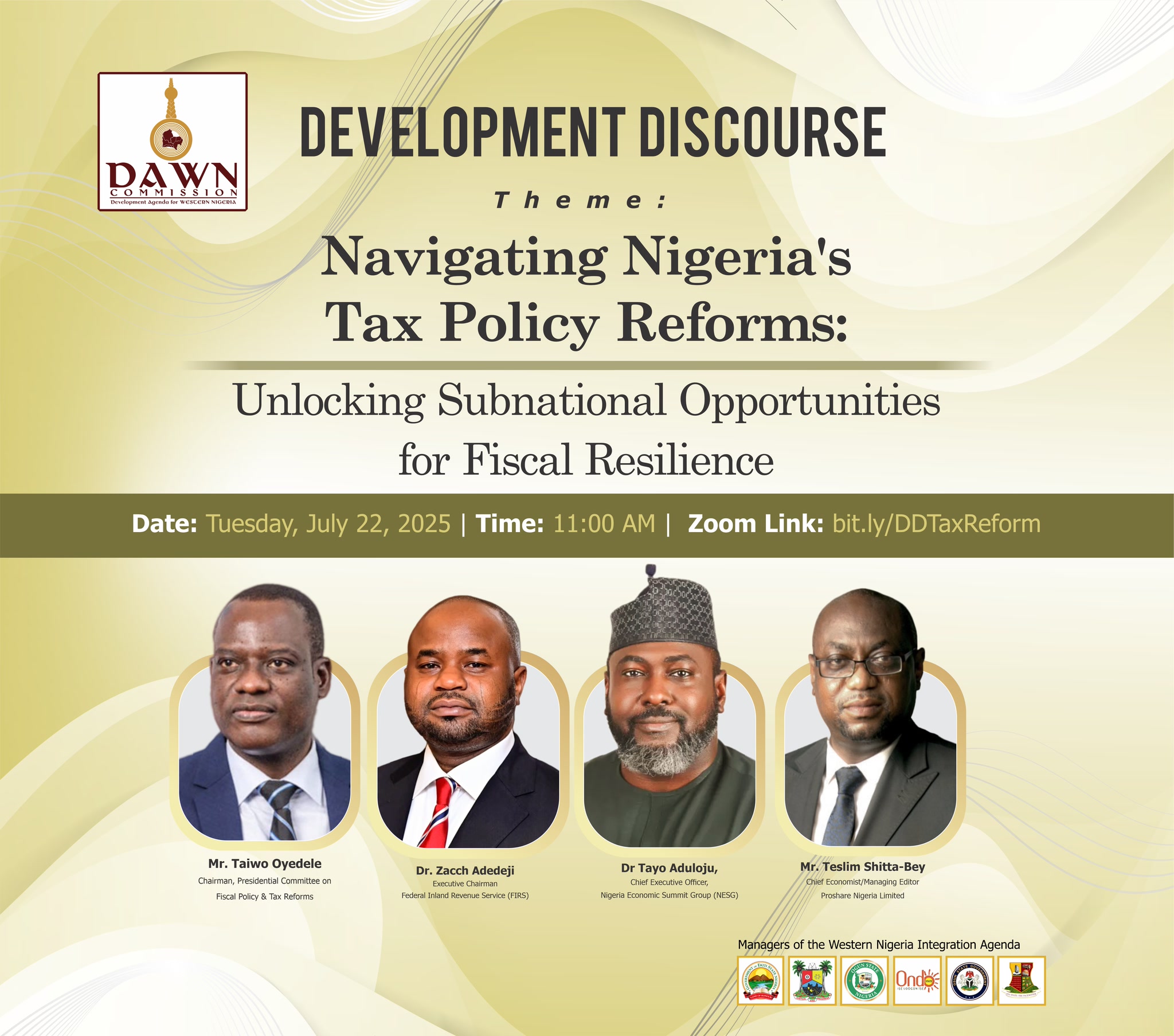
 Nigeria’s fiscal pressures continue to mount, a timely intervention came from the DAWN Commission on Tuesday, July 22, when it hosted a virtual Development Discourse that dug deep into the nation’s tax reform challenges, not from the lens of policy alone, but with a poignant focus on people.
Themed “Navigating Nigeria’s Tax Policy Reforms: Unlocking Subnational Opportunities for Fiscal Resilience,” the session served as both a wake-up call and a roadmap. But more importantly, it struck a human chord, reminding stakeholders that behind every budget deficit, every revenue projection, and every tax reform are millions of Nigerians struggling to make ends meet.
At the heart of the conversation was Mr. Taiwo Oyedele, Chairman of the Presidential Fiscal Policy and Tax Reforms Committee, who issued a powerful challenge: “States must move from revenue receivers to solution providers. This is no longer about theory. It’s survival. And the human cost of inaction is too high.”
His words resonated with many who tuned in from across the country, small business owners, civil servants, artisans, and market women, all of whom understand too well what it means to operate within a system that taxes them without improving their lives.
Joining Oyedele was Dr. Zacch Adedeji, Executive Chairman of the Federal Inland Revenue Service (FIRS), who called for a shift in the relationship between government and citizens. “People pay taxes when they see value. When they see roads, jobs, health care, not just bureaucracy. Reforms must restore that trust,” he said.
The event, hosted online, was not merely a forum for economic experts. It became a platform for advocating human-centered solutions. One speaker, Dr. Teslim Beyioku, captured this sentiment with urgency. “We cannot fix Nigeria’s tax base if we ignore the people it affects. A mother in Oyo State, who runs a small tailoring shop, is taxed by multiple agencies. She pays, but gets no electricity, no running water. Is that fairness?”
This emotional but accurate portrait of the Nigerian tax reality shifted the conversation from theory to lived experience, highlighting how fragmented and regressive policies continue to punish the productive segment of society.
Mr. Seye Oyeleye, Director-General of the DAWN Commission, opened the session with a sobering message to the six South-West states and other subnational governments: “Fiscal resilience is not a luxury; it is an existential need. If we must build strong states, we must empower our people, not burden them.”
Representatives from Scholar Praxis, Proshare Nigeria, and the Nigerian Economic Summit Group (NESG) added depth to the policy side of the conversation. But each expert circled back to one theme — the people.
It’s not just about plugging leaks in the tax system or increasing internally generated revenue (IGR). It’s about what those funds translate to, public health, quality education, infrastructure, job creation, and safety nets for the vulnerable.
For Mariam Adeyemi, a young entrepreneur from Osun who listened in, the conversation gave her hope but also stirred frustration. “I want to do right by the system. But the system needs to do right by me too. I’m tired of paying dues and bribes to survive,” she shared in the live chat.
As hashtags like #TaxReformNigeria and #DAWNDevelopmentDiscourse trended on social media, it was clear the dialogue had struck a chord nationwide.
In a country where over 133 million people live in multidimensional poverty, and where many view taxation as a punishment rather than a civic duty, DAWN Commission’s forum has opened up a crucial path: one where tax reforms are driven not just by fiscal logic, but by empathy.
The takeaway from the discourse? Subnational governments can no longer afford to view tax as a tool for survival alone, it must be a vehicle for service delivery and human dignity.
With the right reforms, designed around the real needs of Nigerians, tax policy can become a force for shared prosperity.
As one participant aptly put it during the closing Q&A: “Reform is not complete until the people feel it in their homes, in their pockets, and in their lives.”
@2025 The Ameh News: All Rights Reserved
Discover more from Ameh News
Subscribe to get the latest posts sent to your email.