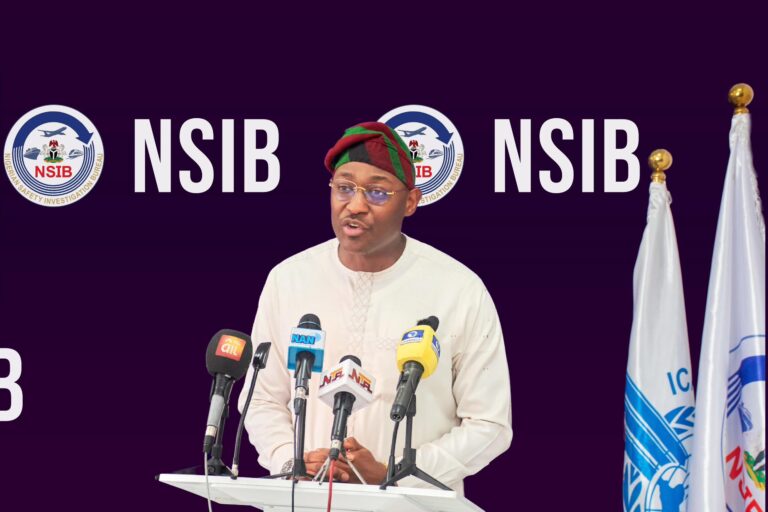
 Capt. Alex Badeh Jnr, Director General and CEO of NSIB
In the heart of Nigeria’s evolving transport sector, where road crashes, maritime mishaps, and rail derailments have too often made headlines, a quiet but determined revolution is taking shape. The Nigerian Safety Investigation Bureau (NSIB) is stepping forward—not just as a responder to accidents but as a proactive architect of safety. With a renewed mandate and sharper tools in its regulatory arsenal, the Bureau is rewriting the narrative on transport safety across the country.
Established under the NSIB Act of 2022, the agency has broadened its reach to oversee not only aviation but also rail, marine, and land-based transport. This multimodal mandate signals a shift in both philosophy and practice—one that treats safety not as an afterthought but as a living, evolving framework.
Last week, in a statement signed by Mrs. Bimbo Olawumi Oladeji, Director of Public Affairs and Family Assistance, the Bureau announced the near-completion of two critical regulatory frameworks:
- The NSIB Casualty Investigation Regulations for maritime transport
- The Rail and Track Accident Investigation Regulations for the rail sector
“These instruments are tailored to Nigeria’s operating realities while drawing strength from international best practices,” Oladeji stated, offering a glimpse into how the Bureau is balancing global benchmarks with local challenges.
Behind these documents is a deeper vision, championed by Capt. Alex Badeh Jnr, Director General and CEO of NSIB. His message is clear: it is not enough to investigate what went wrong. The goal is to ensure that each investigation yields actionable insights that will prevent future tragedies.
“Our aim is not merely to respond to accidents but to build a system where every finding becomes a building block for safety,” Capt. Badeh Jnr said. “We want to transform how transport safety is understood and implemented in Nigeria.”
For families who have lost loved ones in preventable crashes, this is more than policy—it’s a promise. For rail commuters worried about the next derailment or ferry passengers crossing stormy waters, it offers hope. And for industry players, it marks the beginning of a more rigorous, accountable, and data-driven era.
The NSIB is calling on all stakeholders—government agencies, transport operators, and industry professionals—to prepare. Adopting and implementing the Bureau’s safety recommendations will require internal reforms, technical upgrades, and above all, a cultural shift toward prioritizing safety.
Experts say this unified approach—cutting across air, rail, marine, and road—is long overdue. By removing the silos between different modes of transport and embedding a mode-agnostic investigative framework, Nigeria stands to drastically reduce transport-related risks.
As Nigeria continues to grapple with infrastructure gaps and increasing passenger volumes, the Bureau’s new regulatory push could not have come at a more critical time. It offers a rare opportunity to break the cycle of incident, investigation, and inaction.
This isn’t just about regulations. It’s about changing the mindset—from reactive to preventive. It’s about creating a transport system where safety isn’t the exception but the norm.
With these frameworks nearing implementation, the NSIB is charting a new course. And in doing so, it just might be laying the tracks—and the lifelines—for a safer Nigeria.
@2025 The Ameh News: All Rights Reserved
Discover more from Ameh News
Subscribe to get the latest posts sent to your email.