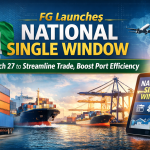
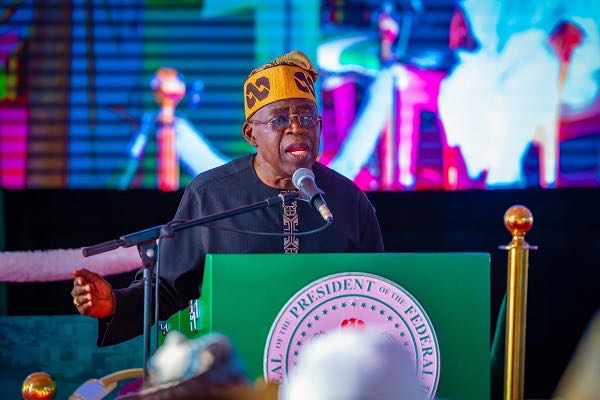
 In a move described by experts as a “game-changer” for Nigeria’s trade and economic transformation, President Bola Ahmed Tinubu has directed that the long-anticipated National Single Window (NSW) digital trade platform must go live by the first quarter of 2026.
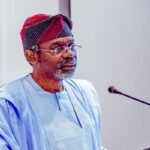
The directive, delivered by his Chief of Staff, Hon. Femi Gbajabiamila, at the fifth meeting of the NSW Steering Committee held at the State House in Abuja, signals a shift from policy planning to full-scale execution. For the President, this project is not just a bureaucratic milestone—it is central to Nigeria’s ambition of building a $1 trillion economy.
“This project is one of Mr. President’s transformative initiatives,” Gbajabiamila said. “We must stay focused, meet our timelines, and deliver the results expected of us.”
A Portal to Reform: Redesigning Nigeria’s Trade Landscape
The National Single Window is envisioned as a single, centralised digital platform that will harmonise the operations of all government agencies involved in import and export procedures. From the Nigeria Customs Service to port health and quarantine, the idea is to create a seamless, transparent, and efficient system that drastically cuts down port delays, trade costs, and corruption.
Tola Fakolade, Director of the NSW Project, confirmed that all Q2 2025 milestones have been successfully achieved and platform customisation is already underway.
“We are on track,” he said confidently. “We’ve moved past paperwork—we’re building the actual system that will revolutionise the way goods move in and out of Nigeria.”
Traders Speak: Relief, Skepticism, and Hope
For people like Amina Yusuf, a 43-year-old exporter of dried hibiscus flowers from Kano, the National Single Window couldn’t come soon enough.
“Sometimes it takes me weeks to clear my goods,” she lamented. “I pay extra for storage, lose customers abroad, and still deal with multiple offices just to get one document signed. If this new platform works, it will change my life.”
In Lagos, where cargo congestion has long defined the experience of clearing goods, freight forwarder Dipo Oladeji shared cautious optimism.
“We’ve heard many promises before. But if the government is really backing this with a law and a deadline, then maybe this one will actually work. That would mean faster clearance, fewer bribes, and more trust in the system.”
Policy to Platform: Experts Weigh In
Experts in trade facilitation and digital governance have praised the move, warning however that timely execution and inter-agency cooperation will be crucial.
Dr. Ngozi Madu, a digital governance consultant and former adviser at the Ministry of Trade, said:
“The National Single Window is not just about software. It’s about breaking down institutional silos, retraining staff, aligning goals across ministries, and securing strong data systems. Without coordination, it risks becoming just another expensive portal.”
She, however, noted that the political will shown by the Tinubu administration—including legislative backing—gives the project a much stronger chance of success.
Dr. Zacch Adedeji, Executive Chairman of the Federal Inland Revenue Service (FIRS), reinforced this at the meeting, noting the platform is no longer just an initiative—it is now legally enshrined.
“When we started last month, this was just a project. Now, it is backed by law. The reward for hard work is more work,” Adedeji told the committee members.
“From Strategy to Action”—Ministers Rally Behind Timeline
Finance Minister Wale Edun described the project as “complex but transformational,” urging that the government shift gears decisively.
“We’ve spent enough time on strategy. This is now the time for action. We must meet the Q1 2026 deadline.”
Minister of Industry, Trade and Investment, Jumoke Oduwole, echoed the urgency, describing the timeline as “non-negotiable.”
In line with regional integration goals, President Tinubu is also calling on African leaders to adopt the Pan-African Payment and Settlement System (PAPSS) to reduce dependence on foreign currencies and deepen intra-African trade.
A Bigger Vision: Digital Economy, Regional Integration
The NSW rollout aligns with Tinubu’s broader economic transformation agenda, including tax reforms, digital infrastructure expansion, and consumer credit development. But more symbolically, it represents a direct intervention to dismantle decades of inefficiency, corruption, and opacity that have plagued Nigeria’s trade corridors.
“This is not just a technical platform,” said Gbajabiamila. “It is a key part of the foundation we are laying for a stronger, digital, and competitive Nigerian economy.”
What the National Single Window Will Do:
- Unify trade documentation across agencies
- Reduce cargo clearance times and port congestion
- Minimise human interference and unofficial payments
- Increase transparency and data-driven decision-making
- Boost investor confidence and attract foreign direct investment
The NSW Steering Committee includes representatives from the Ministries of Finance, Trade, and Industry, the FIRS, and the Nigeria Customs Service.
As Q1 2026 looms, the real test begins—not in more strategy documents or legislative sessions, but in software code, port scanners, training sessions, and the day-to-day experiences of traders like Amina, who’ve waited for years for government processes to finally work with them, not against them.
@2025 The Ameh News: All Rights Reserved
Discover more from Ameh News
Subscribe to get the latest posts sent to your email.