Energy Transition Manager says Nigeria’s vast gas reserves can power inclusive development and low-carbon growth if bold, strategic steps are taken.
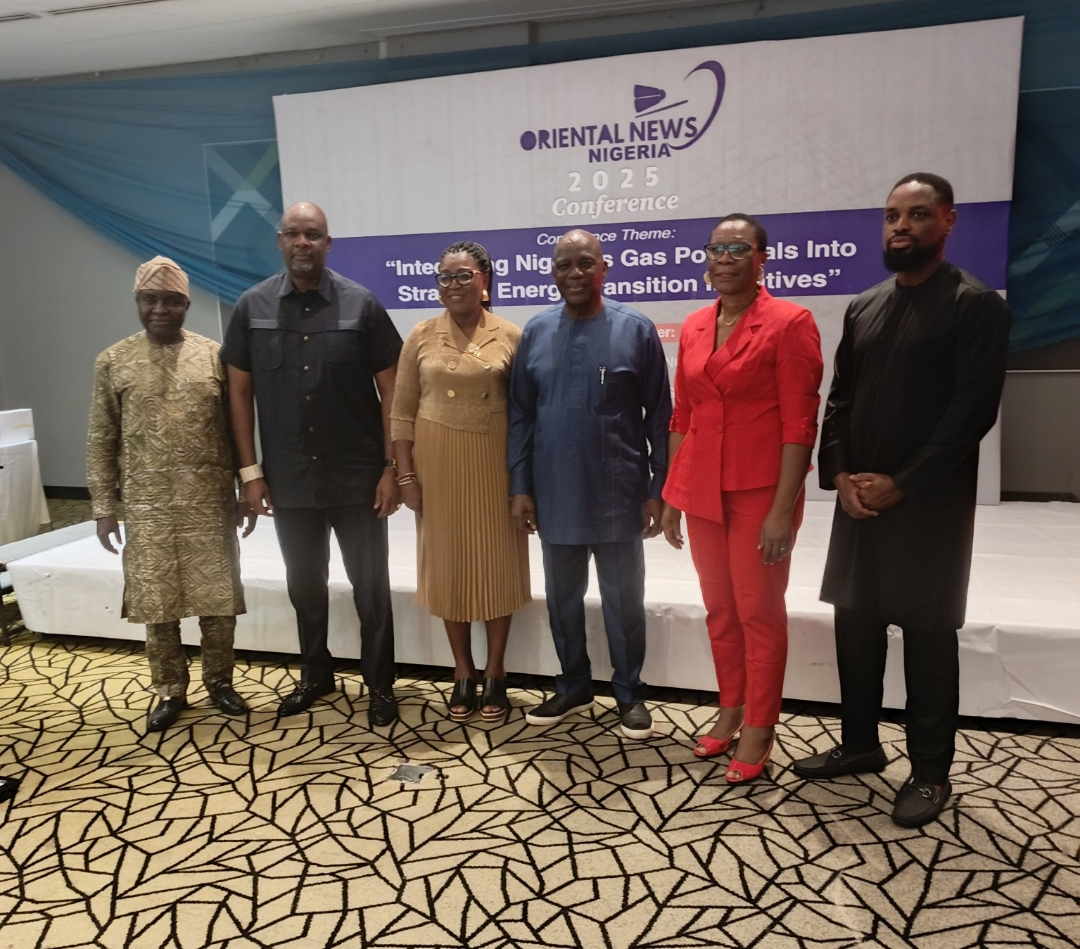 At the 2025 Oriental News Nigeria Energy Conference held in Ikeja, Lagos, Mr. Temitope Ogedengbe, Manager of Energy Transition at Nigeria LNG (NLNG), delivered a thought-provoking keynote address that laid out a bold vision for repositioning Nigeria’s natural gas as a driver of sustainable development and economic transformation.
The conference, themed “Integrating Nigeria’s Gas Potentials into Strategic Energy Initiative,” brought together energy sector leaders, investors, and policymakers. The event was chaired by Professor Bart Nnaji, Chairman of Geometric Power Group and a former Minister of Power.
In his address, Ogedengbe emphasized that gas should not be treated as a mere transitional fuel but as a transformational catalyst for national development—powering industries, homes, and clean energy ambitions.
“Energy transition is not just a global obligation,” Ogedengbe said. “For us in Nigeria, it’s a national opportunity. Gas must be central to our energy future.”
Bridging Global Trends and Local Realities
Ogedengbe noted that while the global energy landscape is rapidly shifting—with over $2 trillion invested in renewables globally in the past year—Nigeria’s energy reality demands a more nuanced approach.
Africa contributes just 4% of global carbon emissions but suffers from one of the world’s highest energy access deficits. According to Ogedengbe, expecting the continent to leapfrog fossil fuels entirely is unrealistic and unjust.
“We must balance environmental responsibility with energy security and economic development,” he stated.
The Case for Gas
Nigeria’s proven gas reserves, estimated at over 200 trillion cubic feet, offer vast untapped potential. However, Ogedengbe expressed concern over persistent underutilization. Much of the gas is either flared, reinjected into the ground, or stranded due to poor infrastructure and market inaccessibility.
He stressed the need to incentivize non-associated gas production and aggregate marginal gas fields to build volume for domestic pipelines and exports.
Ogedengbe pointed to Nigeria LNG’s success as a model. Since its inception in 1989, NLNG has generated over $100 billion in revenues, with a significant portion accruing to government coffers. In a notable shift, NLNG now channels 500,000 metric tons of LPG annually into the domestic market—replacing harmful fuels like firewood and coal for cooking.
“Replacing wood with LPG in Nigerian kitchens is not just about emissions—it’s about saving lives,” he added.
Addressing Infrastructure and Policy Gaps
Ogedengbe called for urgent completion of gas transport infrastructure projects like the Ajaokuta–Kaduna–Kano (AKK) pipeline and OB3, which are critical to unlocking gas access across the country.
He also backed full operationalization of the Gas Infrastructure Fund, stronger investment in CNG and LPG, and enhanced incentives for gas-based industries such as fertilizer and petrochemicals.
In his view, small, modular solutions—from mini-power plants to decentralized gas hubs—can help democratize gas access and create jobs.
“Gas can fuel our power plants, data centers, and transportation systems. We must think in both grand and granular terms,” he said.
Competing in a Low-Carbon Export Market
Ogedengbe warned that international buyers—particularly in Europe and Asia—are demanding lower-carbon LNG products. He urged Nigerian producers to adopt carbon capture and storage (CCS), reduce leaks, and improve operational efficiency to remain competitive.
“Gas exports must meet global climate standards. Cleaner production will help Nigeria attract premium buyers and financing,” he said.
A Call for Strategic Action
Ogedengbe concluded with a challenge to Nigeria’s policymakers, industry players, and investors:
“We must be bold and strategic. Nigeria’s gas is more than a bridge—it is a builder of a new energy economy.”
He described NLNG’s own transition framework as anchored on four pillars: measure, reduce, avoid, and mitigate—ensuring emissions are tracked, reduced, and offset through sustainable practices and nature-based solutions.
Professor Bart Nnaji, in his chairman’s remarks, echoed the urgency of the moment. He emphasized that reliable gas supply is essential to Nigeria’s industrial growth and energy security.
The Oriental News Nigeria Energy Conference continues to serve as a platform for connecting thought leadership with policy and industry action. The 2025 edition focused squarely on leveraging gas to deliver on Nigeria’s energy transition goals while fostering inclusive growth.
“It is a contradiction that Nigeria remains energy-poor despite its gas wealth. We must correct this,” Prof. Nnaji said.
@2025 The Ameh News: All Rights Reserved
Discover more from Ameh News
Subscribe to get the latest posts sent to your email.