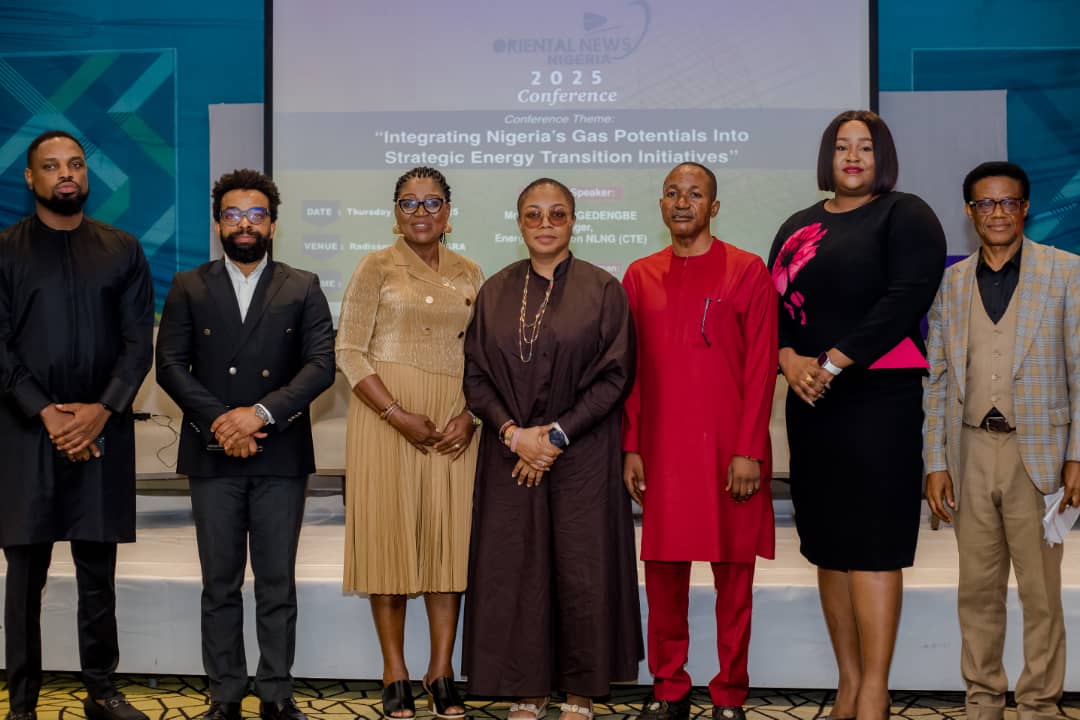
 Mr Temitope Ogedengbe of NLNG, Olu Phillips of Channels TV. Yemisi lzuora, Publisher Oriental News, Engr. Chichi Emenike of Neconde Energy Limited, Japhet Aien of REA, Adelanke Dayo-Adepoju MEMAN and Ehimen Joseph PETROAN
The Rural Electrification Agency (REA) has described the Electricity Act as a major policy breakthrough capable of accelerating Nigeria’s transition to cleaner and more localized energy systems, particularly through hybrid and gas-powered mini-grids.
REA’s Managing Director and Chief Executive Officer, Abba Aliyu, made this known through his representative, Japheth Ailenataman, at the Oriental News Nigeria 2025 Energy Conference held in Lagos. The event, themed “Integrating Nigeria’s Gas Potential into Strategic Energy Transition Initiatives,” brought together industry leaders, policymakers, and energy experts to chart a path forward for gas utilization in the country’s energy mix.
Aliyu said the Electricity Act, which grants states the autonomy to regulate electricity markets within their jurisdictions, has opened up new possibilities for embedded generation and off-grid solutions. He emphasized that the Act’s provision for technology neutrality provides a clear framework for embracing cleaner fuels like gas in rural electrification efforts.
“Gas qualifies under the Act as a cleaner transition fuel and should be fully integrated into our energy access strategies,” he said.
According to the REA boss, the agency’s hybrid mini-grid project designs already support off-grid gas-powered systems in areas where such solutions are viable. He added that the decentralization of the electricity sector means REA must now engage more actively with state electricity regulators on licensing, tariffs, safety standards, and technical regulations for gas-based and interconnected mini-grids.
Aliyu highlighted the agency’s growing focus on blending solar and gas technologies, especially in underserved communities and institutional projects. He cited ongoing solar hybrid mini-grid demonstrations in Nigeria’s southern economic hubs and large-scale embedded systems in universities such as the 12MW facility at the University of Maiduguri.
“These projects reflect the vast opportunities for gas-solar hybrid systems in bridging power supply gaps across the country,” he said.
He further noted that initiatives like the National Public Facility Electrification Scheme (NFPS)—recently introduced by the federal government—will benefit from reliable and cost-reflective gas supply to enhance power generation for public institutions through embedded mini-grid systems.
Aliyu reaffirmed REA’s commitment to delivering decentralized, clean, and sustainable electricity solutions in alignment with Nigeria’s broader net-zero goals.
“Our role in Nigeria’s energy transition is clear. We are committed to expanding access through decentralized sources, including solar and gas-powered hybrid mini-grids, to ensure no community is left behind,” he added.
The REA’s renewed focus under the Electricity Act highlights a strategic shift toward inclusive and technology-driven energy models, leveraging Nigeria’s abundant gas resources to power communities, institutions, and businesses.