 When Mrs. Olubunmi Kuku took office as the Managing Director and Chief Executive Officer (MD/CEO) of the Federal Airports Authority of Nigeria (FAAN) two years ago, Nigeria’s aviation industry stood at a crossroads. Aging infrastructure, operational inefficiencies, dwindling revenues, and customer dissatisfaction painted a worrying picture of an authority meant to be the nation’s aviation backbone.
Today, stakeholders agree that FAAN under Kuku has been on a path of transformation. Her tenure is defined by modernization projects, operational efficiency drives, and a commitment to putting passengers at the center of aviation service delivery.
A Leadership Rooted in Vision and Accountability
Mrs. Kuku, who came into office with years of experience in aviation administration and the private sector, quickly set the tone: FAAN was not only going to run airports but reposition them as gateways to national pride and economic growth. Her management style is often described as disciplined, pragmatic, and people-focused.
“Airports are the front doors to the nation. They must reflect efficiency, safety, and hospitality,” she remarked at her first anniversary in office, a statement that has since guided many of her reforms.
Infrastructure and Operational Renewal
From Lagos to Kano, Abuja to Enugu, airports under FAAN have seen visible changes. The Murtala Muhammed International Airport (MMIA), Lagos, Nigeria’s busiest gateway, recorded major improvements in terminal refurbishment, runway lighting, and baggage handling systems. Abuja airport expanded its passenger processing space to reduce congestion, while Port Harcourt and Kano airports received long-overdue facility upgrades.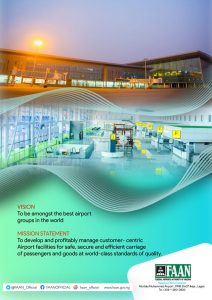
Enugu airport also benefitted from enhanced security and new airfield lighting, boosting regional connectivity.
Top 5 Reforms Under Kuku
- Safety & Security Enhancement – Deployment of advanced screening machines, strengthened perimeter fencing, and tighter collaboration with security agencies to reduce airport breaches.
- Digital Transformation – Introduction of automated tolling systems, e-ticketing for car parks, online payment platforms, and integrated operational dashboards for real-time monitoring.
- Revenue Diversification – Aggressive push for non-aeronautical revenues through revamped concession agreements, retail expansion, and in-airport advertising.
- Customer Service Orientation – Creation of dedicated passenger service desks, complaint-resolution channels, retrained frontline staff, and cleanliness campaigns.
- Infrastructure Modernization – Upgraded terminals, improved runway lighting systems, functional baggage belts, and revamped lounges at key airports.
Passenger Voices
For many Nigerians, the improvements under FAAN have not gone unnoticed.
- Fidelia Okafor, a Lagos-based business traveler, noted: “The check-in process at MMIA is smoother now compared to two years ago. At least things feel more coordinated.”
- Uche Musa, a student flying from Abuja, said: “I noticed better signage and customer service desks. It makes it easier for first-time flyers like me.”
- International passengers, too, have expressed cautious optimism. “It’s not yet Heathrow or Dubai, but I can see genuine improvements. Nigeria’s airports are heading in the right direction,” said Thomas Kelly, a British expatriate frequenting Abuja.
Challenges Along the Journey
Despite the progress, hurdles remain. Lagos airport still struggles with congestion during peak hours. Power supply disruptions occasionally frustrate both passengers and airlines. Funding constraints also limit FAAN’s ability to fast-track large-scale infrastructure projects.
Yet, stakeholders see a departure from the status quo. According to a former NCAA official: “Mrs. Kuku has brought professionalism to FAAN. For the first time in years, there is consistency in reforms and financial transparency.”
What’s Next for FAAN
Looking ahead, Mrs. Kuku has outlined bold plans for the next phase of FAAN’s transformation:
- Smart Airports Initiative – Deployment of biometric verification, self-service kiosks, and AI-powered surveillance.
- Green Aviation Drive – Introducing renewable energy solutions and eco-friendly airport facilities to align with global sustainability targets.
- Expanded Cargo Handling – Developing modern cargo terminals to boost Nigeria’s share of African trade and support agribusiness exports.
- Concessioning for Efficiency – Exploring public-private partnerships to bring in fresh capital and expertise for airport operations.
A Journey Still Unfolding
Two years is a short time in the lifespan of an aviation authority, but the reforms under Mrs. Kuku show what committed leadership can deliver. For passengers, airlines, and investors alike, the past two years have been a story of progress, gradual, sometimes uneven, but undeniably forward-looking.
As Nigeria works toward becoming Africa’s aviation hub, FAAN’s transformation journey under Kuku is a reminder that strong leadership, accountability, and innovation remain the keys to unlocking the sector’s potential.
The next chapter will test how far FAAN can sustain its reforms, attract private investments, and deliver world-class services. But one thing is clear: the seeds of transformation have already been planted, and their fruits are beginning to show.
@2025 The Ameh News: All Rights Reserved
Discover more from Ameh News
Subscribe to get the latest posts sent to your email.