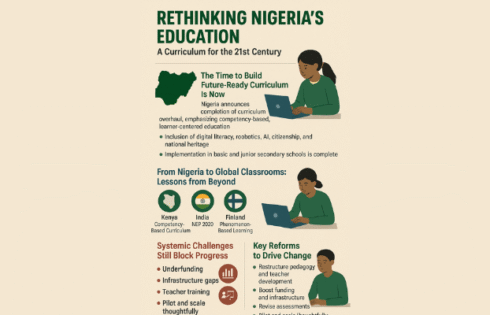
Nigeria stands at a defining crossroads. With over 60 percent of its 220 million citizens under the age of 25, the country’s future hinges on whether its education system can equip this massive youth population with 21st-century skills.
For decades, Nigeria’s curriculum has been criticised as rote, overloaded, and disconnected from global realities. Now, the Federal Government has unveiled what it calls a “future-ready” curriculum, a sweeping redesign aimed at aligning education with global competency standards.
Yet while the ambition is bold, execution will determine whether this reform becomes a turning point or another policy document gathering dust.
A bold curriculum redesign
In August 2025, the Federal Ministry of Education announced sweeping changes to basic, senior secondary, and technical education curricula, moving away from the outdated 6-3-3-4 system. The changes trim bloated subject offerings: pupils in Primary 1–3 will study 9–10 subjects; Primary 4–6, 10–12; Junior Secondary, 12–14; Senior Secondary, 8–9; and technical school students, 9–11.
Earlier in the year, the government also introduced 15 vocational and trade subjects, from solar installation and garment-making to agricultural entrepreneurship and digital literacy, seeking to embed employable skills from an early age. The changes, to be rolled out from the 2025/26 academic session, were designed collaboratively with agencies including NERDC, UBEC, NSSEC, and NBTE.
Education Minister Dr Tunji Alausa, represented by Minister of State for Education Prof. Suwaiba Sa’id Ahmad, called the overhaul “a comprehensive shift to make education relevant, inclusive, and transformative.”
Reform or rhetoric?
Nigeria faces some of the world’s most pressing education challenges: over 10 million out-of-school children, chronic teacher shortages, crumbling infrastructure, and a culture of memorisation over mastery. Critics say these systemic flaws could undermine even the most visionary curriculum.
While the government calls the reforms “future-ready”, some experts argue they are overdue. Countries like Kenya rolled out a competency-based curriculum in 2017, investing heavily in teacher training and digital content, while Finland’s phenomenon-based learning and Singapore’s high teacher investment model show how ambitious reforms can succeed. Nigeria, by contrast, spends just 7–8 percent of its budget on education, well below the UNESCO-recommended 15–20 percent.
Without a significant funding boost, there is a risk that the new curriculum may remain aspirational.
Innovation already at work
There are reasons for optimism. Nigerian schools are experimenting with models that could serve as blueprints.
KEY Academy in Lagos, shortlisted among the world’s most innovative schools, blends traditional subjects with project-based learning and cultural heritage, demonstrating that reform is possible even within tight constraints.
Similarly, the Institute for Industrial Technology (IIT) in Lagos offers a beacon of vocational excellence, training underprivileged youth with technical and industrial skills while embedding strong values and employability training. IIT’s partnerships with industries highlight how schools can bridge the skills gap and align training with workforce demands.
Scaling such models nationwide, however, will require deliberate investment and political will.
The reform’s greatest hurdles
Funding gaps: Nigeria’s education spending remains far below global standards. Modernising schools, training teachers, and scaling vocational programmes will require significant investment, possibly through public-private partnerships and donor support.
Teacher preparedness: Many teachers lack training in learner-centred and tech-enabled instruction. Retraining is essential if reforms are to succeed.
Infrastructure deficit: In rural schools, electricity, libraries, and internet access are scarce. Without addressing these gaps, digital literacy and hands-on skills training will remain inaccessible to millions.
Policy instability: Nigeria’s education policies have often been derailed by political turnover. Experts warn that curriculum reform will fail without sustained implementation for at least a decade.
Exam-centric culture: WAEC and NECO remain rooted in rote learning. Competency-based assessment will clash with this system unless examinations are also reformed.
Global lessons
Kenya’s CBC rollout offers a cautionary tale. While ultimately successful, it faced resistance from parents and teachers due to unclear communication and resource gaps. Finland and Singapore’s success underscores the importance of teacher quality over quantity, significant investment, and consistent evaluation.
“Nigeria’s challenge is not ambition; it’s execution,” says Mr Abiola Olabode, an education policy analyst. “Curriculum reform must come with a complete ecosystem overhaul: assessment changes, teacher retraining, and a budget that reflects education as a national priority, not an afterthought.”
A roadmap for success
To ensure this reform avoids the fate of previous failed initiatives, Nigeria should:
Prioritise teacher training: Launch national retraining programmes, including digital literacy and learner-centred instruction.
Reform assessments: Shift WAEC and NECO exams to measure problem-solving, creativity, and application rather than memorisation.
Invest in infrastructure: Target funding for ICT, libraries, laboratories, and rural connectivity, with private sector collaboration.
Pilot, then scale: Start with pilot states, evaluate outcomes, and adjust before a national rollout.
Engage communities: Parents, local leaders, and PTAs must be active participants to ensure cultural and economic realities are reflected.
Ensure accountability: Transparent monitoring and consistent political backing are vital to sustaining momentum.
Why this reform matters
With Africa projected to host one-third of the global youth population by 2050, Nigeria’s ability to train its young people will shape the continent’s economic transformation. Success could make Nigeria a continental leader in education reform, attracting foreign investment and creating a globally competitive workforce. Failure could deepen inequality, unemployment, and social unrest.
Globally, education is increasingly seen as an economic strategy. China’s curriculum reforms over the past decade, tied to tech and manufacturing, have helped it dominate key industries. Nigeria’s plan signals a similar recognition: that its future lies not just in oil, but in the minds of its young citizens.
Conclusion: A test of political will
This curriculum overhaul is ambitious, overdue, and potentially transformative. But ambition without sustained investment and structural reform risks failure. Nigeria must treat this as a generational project, not a political talking point.
If executed well, this moment could redefine education in the Global South, turning Nigeria’s youth bulge into an engine for innovation and growth. But the clock is ticking and the world is watching.
Discover more from Ameh News
Subscribe to get the latest posts sent to your email.