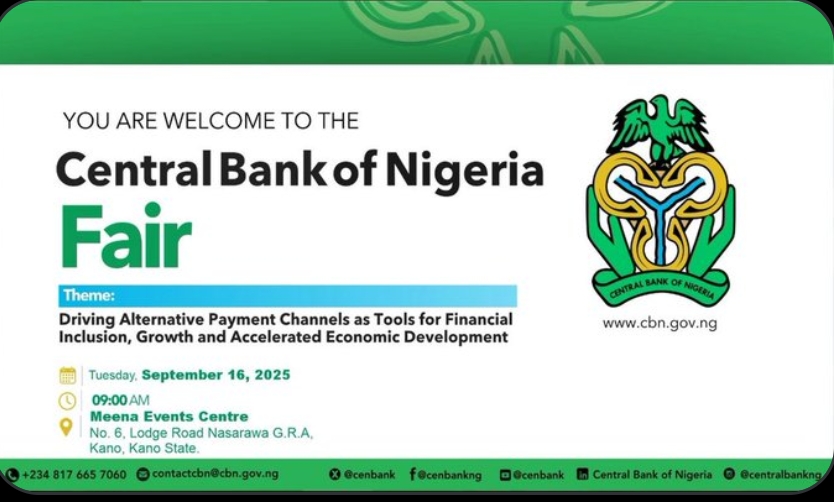
 The Central Bank of Nigeria (CBN) has announced that its flagship CBN Fair will hold in Kano on Tuesday, September 16, 2025, as part of its continuous drive to deepen financial inclusion and accelerate economic growth through innovative payment systems.
The event, which will commence at 9:00 a.m., is themed: “Driving Alternative Payment Channels as Tools for Financial Inclusion, Growth, and Accelerated Economic Development.”
According to the apex bank, the fair is designed to sensitize the public, businesses, and other stakeholders on the expanding opportunities available in Nigeria’s financial sector, particularly in leveraging alternative payment channels to promote cashless transactions, empower small businesses, and extend financial services to underserved communities.
The CBN Fair has, over the years, become a major platform for engagement between the Bank and the public, enabling Nigerians to better understand the policies and initiatives being implemented to strengthen the economy.
Stakeholders in the financial services sector, including banks, fintechs, and microfinance institutions, are expected to participate in the fair, which will feature panel sessions, product exhibitions, and interactive engagements with consumers.
The CBN noted that Kano, as a commercial hub in northern Nigeria, provides a strategic location for driving discussions on financial literacy, payment innovations, and inclusive growth.
By advancing awareness on alternative payment systems, the CBN hopes to fast-track Nigeria’s transition to a more digital economy, reduce reliance on cash, and expand access to credit, savings, and investment opportunities for millions of Nigerians.
Since its inception, the CBN Fair has been staged in key cities such as Lagos, Port Harcourt, Enugu, and Abuja, each edition leaving a visible mark on Nigeria’s financial literacy landscape. In Lagos, the fair’s focus on mobile money adoption reportedly boosted awareness among market traders, many of whom have since embraced point-of-sale (POS) systems as a safer and faster way of doing business.
In Port Harcourt, the campaign around financial inclusion emphasized microcredit schemes and savings culture, helping small business owners tap into CBN-backed intervention funds. Meanwhile, the Enugu edition broadened public understanding of consumer rights and responsibilities, reinforcing trust between banks and their customers.
Beyond awareness, the fairs have consistently provided a platform for Nigerians to directly question regulators and operators about issues affecting their daily transactions. This engagement has often translated into policy refinements and innovations tailored to consumer needs.
Reflecting on the journey, financial analysts note that the CBN Fair has evolved from a simple outreach program to a national dialogue on inclusive finance, bridging the gap between formal financial institutions and millions of Nigerians traditionally excluded from banking services.
As the Kano edition approaches, expectations are high that the fair will not only highlight new technologies in alternative payments but also chart practical ways for ordinary Nigerians to benefit from the evolving digital economy.
Discover more from Ameh News
Subscribe to get the latest posts sent to your email.