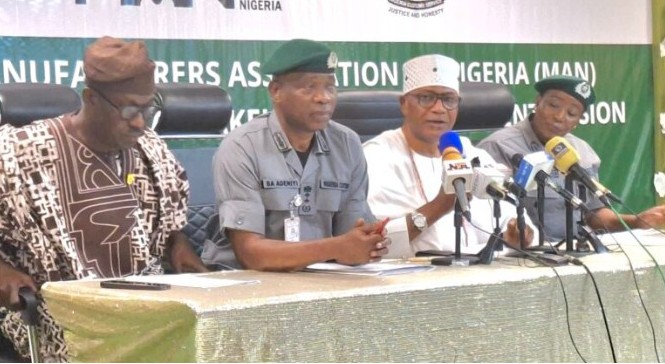
 In what analysts are calling a watershed moment for industrial policy in Nigeria, the Nigeria Customs Service (NCS) and the Manufacturers Association of Nigeria (MAN) held a landmark consultation on Friday, September 26, 2025, to address mounting pressures facing the country’s manufacturing sector.
The joint press briefing, co-chaired by MAN President, Francis Meshioye, OFR, and Comptroller-General of Customs, Bashir Adewale Adeniyi, MFR, underscored the value of structured dialogue in shaping policies that balance government revenue needs with industrial growth.
The meeting came on the heels of the temporary suspension of the 4% Free on Board (FOB) levy by the Ministry of Finance, an issue that had triggered widespread debate within the business community. Under the Nigeria Customs Service Act 2023, such stakeholder consultations are now required, ensuring transparency and inclusivity in policy formulation.
What Manufacturers Said: Bottlenecks in the Operating Environment
During the consultation, manufacturers raised concerns over systemic barriers that threaten their competitiveness. Key issues highlighted include:
- The 4% FOB charge, which manufacturers viewed as a financial burden on importers of raw materials and machinery.
- Multiple Customs checkpoints, which delay cargo movement and raise logistics costs.
- The persistence of alerts in the clearance system, creating bottlenecks and unpredictability.
- Technical failures on the B’Odogwu platform, meant to simplify processes but instead complicating them.
“These issues pile costs on local manufacturers and make Nigerian products less competitive on regional and global markets,” said Francis Meshioye, President of MAN. “We are not asking for favors, but for fairness that allows industries to operate efficiently and create jobs.”
Customs’ Response: Balancing Revenue with Facilitation
In response, Comptroller-General Bashir Adeniyi assured manufacturers that the Customs Service is committed to both its revenue mandate and trade facilitation.
He outlined reforms already underway, including:
- The Authorized Economic Operator (AEO) scheme for trusted traders.
- The Advance Ruling system for greater clarity in Customs classification and valuation.
- The Time Release Study, which measures efficiency in cargo clearance.
More significantly, Adeniyi announced that after consultations with the Ministry of Finance, strategic exemptions from the 4% FOB levy have been approved. These cover:
- Importation of raw materials, spares, and machinery under Chapters 98 and 99 of the Customs Tariff.
- Manufacturers not yet onboarded under those chapters, who will be fast-tracked for inclusion.
- Humanitarian and life-saving imports, along with goods under the Presidential Healthcare Initiative.
- Commercial airline spare parts, essential for safety and continuity in aviation.
Manufacturers who have already paid the levy but fall under the exemption list will have their payments treated as credits for future Customs transactions.
“This is a clear demonstration that Customs is open to reforms and willing to make concessions where necessary,” Adeniyi said.
Why This Matters
Economists, trade specialists, and industry leaders have hailed the dialogue as a positive shift in Nigeria’s policy culture.
Dr. Muda Yusuf, former DG of Lagos Chamber of Commerce & Industry (LCCI):
“This is a big win for manufacturers. The FOB levy exemption reduces operating costs, which is crucial at a time when forex shortages and inflation are biting. What stands out here is not just the exemption itself, but the process—government consulted stakeholders before finalizing a decision. That is the future of economic governance.”
Trade Policy Expert at University of Lagos:
“Trade facilitation is the backbone of competitiveness. Multiple checkpoints and clearance delays act as non-tariff barriers. By addressing these, Customs is indirectly promoting export diversification and regional trade integration under AfCFTA.”
An Industrialist and CEO of a mid-sized manufacturing firm in Ogun State:
“Manufacturers have long felt sidelined in policy design. This consultation signals a new era of partnership. If sustained, it will encourage manufacturers to invest in capacity expansion, which translates to more jobs and forex savings through import substitution.”
Institutionalizing Dialogue for the Future
Both parties agreed on the need to make consultations a permanent fixture. The measures include:
- Regular dialogue before the rollout of major Customs policies.
- A feedback mechanism for monitoring real-time policy impacts.
- Quarterly review meetings to assess progress and update frameworks.
The Manufacturers Association also praised the AEO scheme, calling for clear guidelines so that more members can benefit from fast-track clearance and lower compliance costs.
Economic Impact: The Bigger Picture
The significance of this consultation goes beyond import exemptions. It reflects a shift toward participatory governance, where government agencies work hand-in-hand with industry stakeholders to design policies that support economic transformation.
For manufacturers, it means lower costs, greater certainty, and a stronger case for investment. For Customs, it builds trust, encourages compliance, and ensures sustainable revenue collection.
As Dr. Yusuf noted, “Nigeria cannot diversify its economy or build strong industrial clusters without a Customs regime that supports rather than stifles manufacturers.”
Looking Forward
The Customs–MAN engagement demonstrates that constructive dialogue delivers superior outcomes. It also offers a blueprint for other government–private sector engagements.
With the promise of technology-driven reforms, elimination of unnecessary checkpoints, and streamlined regulatory processes, the future looks brighter for Nigerian manufacturers.
As Nigeria pushes toward becoming Africa’s industrial hub, partnerships like this one may prove decisive in achieving sustainable growth, job creation, and global competitiveness.
The Nigeria Customs Service (NCS) and the Manufacturers Association of Nigeria (MAN) have reached a landmark agreement to exempt raw materials, machinery, and humanitarian imports from the 4% FOB levy. Experts say the dialogue signals a new era of collaboration, boosting competitiveness, trade facilitation, and Nigeria’s drive for economic diversification.
Discover more from Ameh News
Subscribe to get the latest posts sent to your email.