 For more than half a century, the story of Nigerian aviation has mirrored the country’s economic and political journey—rising, falling, rebuilding, and now entering what experts call a “new era of endless possibilities.” At the heart of this evolution lies the shifting roles of federal government–owned airlines, private carriers, and now a new generation of state-owned airlines led by Ibom Air.
Flashback: The Era of the Federal Government Airline
Nigeria’s aviation history started under the firm control of the federal government through its flagship carrier, Nigeria Airways. At its peak, Nigeria Airways was not just a national asset—it was a continental force. With a fleet spanning multiple continents and thousands of employees, the airline embodied national pride and ambition.
But the same government ownership that gave it life eventually contributed to its downfall.
Years of:
- Excessive political interference
- Chronic mismanagement
- Poor financial discipline
- A lack of long-term operational strategy
sent the carrier into a steep decline. By the early 2000s, Nigeria Airways had become a shadow of its former self. In 2004, the airline collapsed completely, leaving Nigeria without a national flag carrier and creating a vacuum in the market.
The Entry of Private Airlines: A Market Reborn
With the fall of Nigeria Airways, private carriers stepped forward to fill the void. Over the next two decades, the Nigerian sky was reshaped by privately owned operators such as:
- Aero Contractors
- Arik Air
- Dana Air
- Max Air
- Azman Air
- Air Peace
- Overland Airways
These airlines brought a new sense of competition and commercial dynamism. They introduced:
- Better customer service
- Flexible pricing policies
- Vision-driven management
- Route expansion and operational agility
For the first time, the aviation sector became driven by business principles instead of political interests. Still, the private sector faced its own headwinds: high forex pressure, rising fuel costs, aging infrastructure, and economic uncertainties.
The Modern Shift: State-Owned Airlines Return—This Time in a New Form
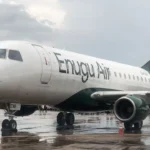
Just as private airlines were learning to dominate the market, a new chapter emerged: state-owned airlines operated not by the federal government but by individual states seeking economic and tourism growth. NIGERIAN STATES AND THEIR AIRSPACE 𝐈𝐁𝐎𝐌 𝐀𝐈𝐑 — Akwa Ibom State 𝐄𝐍𝐔𝐆𝐔 𝐀𝐈𝐑 — Enugu State 𝐂𝐀𝐋𝐋𝐘 𝐀𝐈𝐑 — Cross River State and Gateway Airline– Ogun State
Leading this new movement is Ibom Air, owned by the Akwa Ibom State Government.
Ibom Air has rapidly become one of Nigeria’s most admired carriers, earning praise for:
- Punctuality and reliability
- Modern fleet operations
- Strong corporate governance
- Cleaner aircraft branding and customer experience
Its success has inspired other states, such as Lagos and Cross River, to explore similar aviation investments.
Unlike Nigeria Airways, these state-owned carriers:
- Operate under corporate business structures, not politics
- Are revenue-driven, not subsidy-dependent
- Aim to boost state GDP, tourism, and job creation
- Partner with private investors and operators
Ibom Air’s model demonstrates that government ownership does not automatically lead to inefficiency—provided governance structures are strong and commercial discipline is maintained.
Reflection: Three Phases, One Future
Nigeria’s aviation journey now reflects three defining eras:
- The Federal Government Airline Era
- National pride but unsustainable operations.
- The Private Airline Expansion Era
- Innovation, market growth, and customer-driven services.
- The State-Owned Modern Airline Era
- An Economist and transport policy specialist, reflects:
- “With private airlines continuing to drive innovation and state-backed carriers like Ibom Air setting new operational standards, Nigeria has a unique opportunity to become a leading aviation hub in Africa. The possibilities are indeed endless.”
- A hybrid model where government ownership meets modern corporate governance.
Experts believe that blending the strengths of all three models could unlock a new aviation renaissance—one where Nigeria competes globally, strengthens regional connectivity, and expands its influence under the African Continental Free Trade Area (AfCFTA).
Today, the sector stands at a rare intersection of opportunity. With private airlines driving innovation and state-owned success stories like Ibom Air proving that government participation can work, Nigerian aviation may finally be entering the era it has long waited for—one defined not by collapse, but by endless possibilities.
A reflective flashback on Nigeria’s aviation journey, from the days of the federal government–owned Nigeria Airways to the rise of private carriers and the new success of state-owned airlines led by Ibom Air—exploring how these phases are shaping a new era of opportunities.
Discover more from Ameh News
Subscribe to get the latest posts sent to your email.