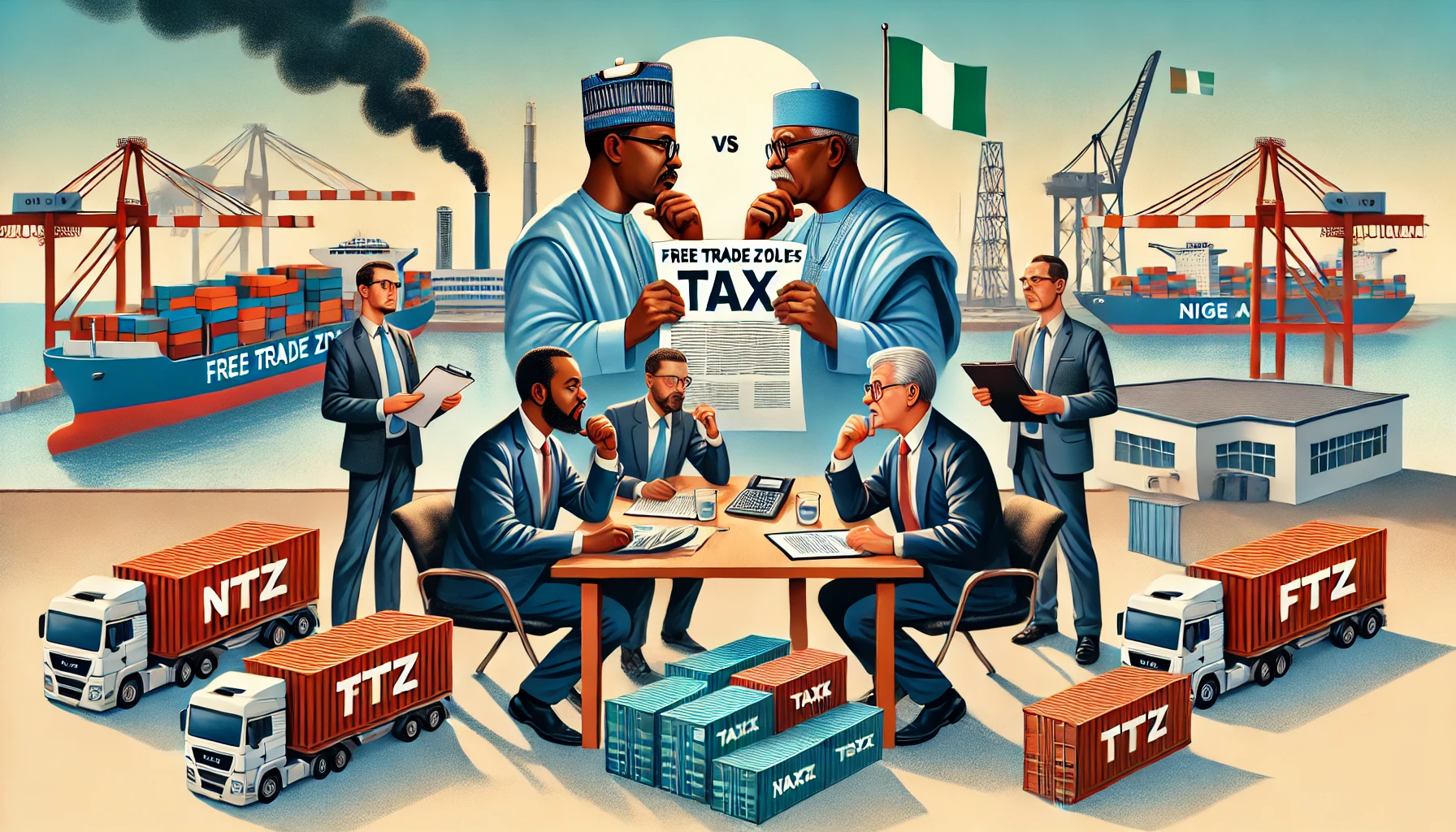
Nigerian manufacturers have renewed calls for stronger government policies to protect indigenous industries from alleged unfair practices by foreign firms operating within the country’s free trade zones (FTZs).
This call was led by Dr. Mallinson Afam Ukatu, Chairman of Mallinson Group and Fellow of the Manufacturers Association of Nigeria (MAN), during the 2025 Commerce and Industry Correspondents Association of Nigeria (CICAN) End-of-Year/Engagement Programme, held at MAN House, Ikeja, Lagos.
Represented by Mr. Dominic Ezugwu, Chief Financial Officer of Mallinson Group, Dr. Afam warned that Nigeria risks reducing its manufacturers to “spectators in their own economy” if policy loopholes continue to enable foreign firms to dominate key sectors through what he described as illicit and anti-competitive practices within FTZs.
According to him, nations that lead global trade do so through deliberate industrial strategies—anchored on access to affordable finance, stable energy supply, and fair trading systems.
He argued that local manufacturers cannot thrive as long as financing mechanisms remain uncompetitive and bogged down by bureaucratic bottlenecks.
Funding Bottlenecks Hindering Manufacturers
Dr. Afam criticised delays in the disbursement of Bank of Industry (BOI) loans routed through commercial banks, despite their relatively moderate interest rates of 8–9%.
“In many cases, the funds arrive at commercial banks, but instead of releasing them, the banks hold on to the money while manufacturers keep paying interest on facilities they never fully access,” he said.
He contrasted this with China’s zero-interest government-backed loans for machinery exports, describing their strategy as deliberate industrial expansion that gives foreign firms structural advantages in Nigeria.
Foreign Firms Exploiting Free Trade Zones — MAN
Dr. Afam expressed deep concern over what he termed “unfair activity” by some Chinese and Indian companies operating in Nigeria’s FTZs.
He noted that many of these firms enjoy duty waivers, tax exemptions, and accelerated approvals unavailable to indigenous manufacturers.
“What is happening in our free trade zones? Goods produced there are flooding the Nigerian market—some accounting for as much as 99% of their output—yet with little or no export records.
If FTZs become a backdoor to undermine the domestic market, then we have a serious national problem,” he warned.
He added that many foreign entrants are increasingly becoming traders rather than investors, now dominating markets such as Idumota and Alaba, where they own shops and warehouses and sell directly to consumers at prices local firms cannot match due to the incentives they enjoy.
“The question we must ask is: What economic value is retained in Nigeria when profits are repatriated to home countries through sales proceeds, raw material sourcing, and machinery imports?”
Local Content, Energy Reforms, and Enforcement Needed
Dr. Afam stressed that indigenous manufacturers are not asking for preferential treatment, but for a level playing field supported by:
- Single-digit interest rates for manufacturing loans
- Mandatory timelines for commercial-bank disbursement of BOI loans
- Elimination of multiple taxation
- Stronger enforcement of local content policies
- Transparent and equitable FTZ operations across all states
He also identified energy costs as a major threat to production, urging the government to accelerate the shift toward natural gas and compressed natural gas (CNG) utilisation.
MAN Reaffirms Partnership with CICAN
Delivering a goodwill message, Mr. Salami Musa of MAN’s Corporate Services Division, on behalf of the association’s leadership, praised CICAN for giving visibility to the manufacturing sector’s challenges and advocacy efforts.
“Without the quality of representation you provide, our efforts would be akin to winking in the dark,” he noted, while reminding journalists that entries for the MAN of the Year Personality Award close on December 15.
Manufacturing Is Still Fragile — CICAN
Earlier, CICAN Chairman Mr. Charles Okonji expressed concern over the sector’s fragile recovery, noting that despite recording a 9.62% contribution to GDP in Q1 2025, the trajectory remains unstable.
He highlighted persistent barriers such as unreliable power supply, poor logistics, high borrowing costs, declining access to credit, and volatile foreign exchange conditions.
Okonji stressed the need for:
- Massive investment in infrastructure
- Policies that promote “Made in Nigeria” products
- A more supportive fiscal and monetary environment
- Joint commitment by government and private sector to revitalise the industrial base
“This is not the Nigeria we envisioned when we spoke about export-led development and a diversified economy,” he said.
Nigerian manufacturers, led by Dr. Mallinson Afam Ukatu, have urged the Federal Government to overhaul policies and curb alleged illicit activities by foreign firms in free trade zones, warning that unfair advantages threaten local industries, jobs, and long-term economic sustainability.
Discover more from Ameh News
Subscribe to get the latest posts sent to your email.