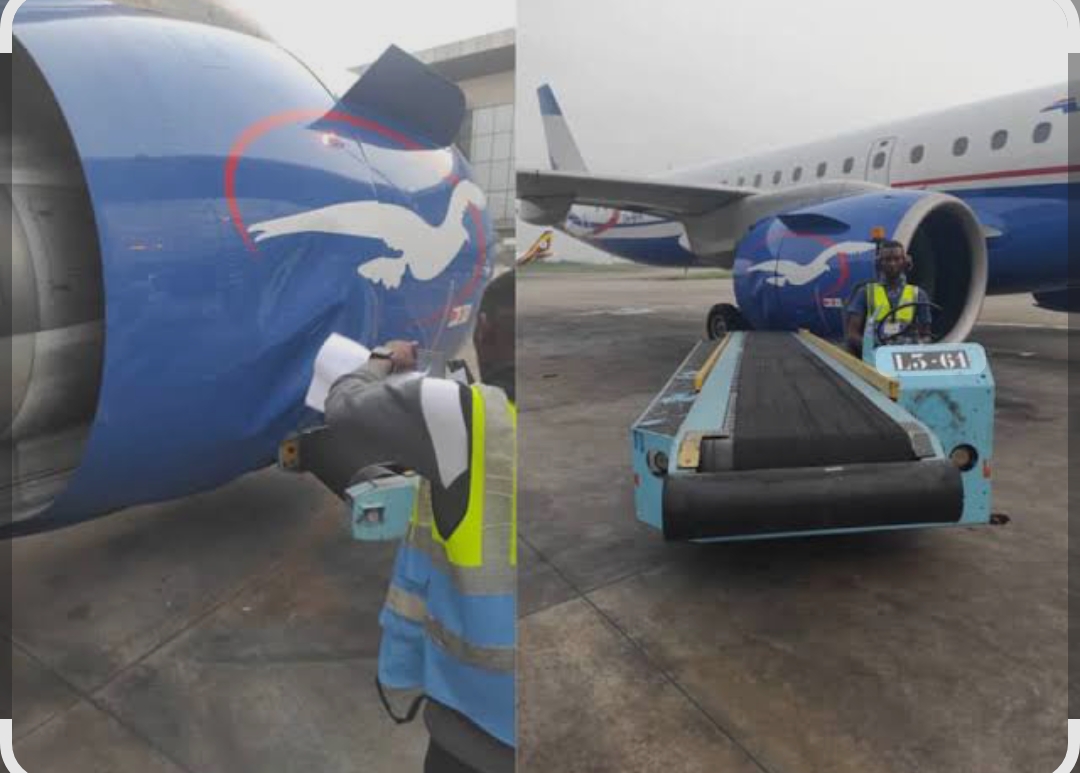
 Flight operations of Air Peace were disrupted on Friday following damage to one of its newly acquired Embraer 195-E2 aircraft at the Murtala Muhammed International Airport (MMIA), Lagos, after a ground handling incident involving equipment operated by the Nigerian Aviation Handling Company (NAHCO) Plc.
The disclosure was made by aviation industry expert Michael Achimugu via his official X (formerly Twitter) handle, where he explained that passengers had already boarded the aircraft when a ground handler’s conveyor belt struck the aircraft, damaging its engine cover. The incident necessitated the immediate deboarding of passengers and the grounding of the aircraft.
According to Achimugu, the affected aircraft was scheduled to operate nine flight sectors, meaning all passengers booked on those flights were automatically disrupted. He noted that despite the damage occurring through no fault of the airline, Air Peace would still face public backlash, refund demands, compensation obligations and significant repair costs, largely in foreign currency.
He recalled a similar past incident involving a bird strike that reportedly cost the airline over $3 million to fix. In that case, Air Peace waited nearly a month for the aircraft manufacturer to supply a replacement engine cowling, further compounding operational disruptions.
The grounded aircraft, one of Air Peace’s brand-new E195-E2 jets, was said to be fully booked until January 15, 2026. As a result, numerous passengers with confirmed bookings are expected to experience delays or cancellations.
Achimugu noted that airlines typically refrain from publicly blaming service providers, instead citing “technical or operational reasons” for disruptions. This, he said, leaves airlines to shoulder passenger anger and regulatory consequences under Part 19 of the NCAA Regulations 2023, even when incidents are caused by third-party failures.
He stressed that Air Peace has suffered several such technical disruptions through no fault of its own, calling for stronger accountability measures against poorly trained ground handling personnel whose errors inflict reputational, financial and technical damage on airlines. He revealed that efforts are underway to strengthen regulations to ensure service providers face heavier sanctions for incidents of this nature.
The aviation expert also urged greater transparency in passenger communication, insisting that travelers deserve honest explanations when disruptions are caused by ground handling or other third-party lapses rather than airline negligence.
While acknowledging improvements in access to foreign exchange under President Bola Ahmed Tinubu’s administration, Achimugu noted that easier forex access does not eliminate the high cost of aircraft repairs, lost operating time or revenue shortfalls.
He appealed for the understanding of affected passengers, disclosing that although Air Peace maintains two standby aircraft, both had already been deployed to manage other disruptions. Even if available, he added, their seating capacity would not have matched that of the damaged E195-E2.
“These are the behind-the-scenes realities that often make airlines appear culpable,” Achimugu said, calling for greater public education and transparency to prevent the aviation industry from being perceived as secretive.
He expressed empathy with Air Peace and other domestic operators facing similar challenges, saluting their resilience in keeping operations running despite mounting operational pressures.
Discover more from Ameh News
Subscribe to get the latest posts sent to your email.