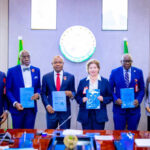
 L-R: Deputy Director, Huawei Business Environment/Affairs Nigeria, Dr. Nihinlola Mary Fafore; Head, Spectrum Administration Department, Nigerian Communications Commission (NCC), Engr. Atiku Lawal; Head, Fixed Networks and Converged Services (NCC), Engr. Gidado Maigana Ahmed; Head Spectrum Assignment (NCC), Mr. Abubakar Hammanyaji; Country Lead, Digital Access Program, Foreign, Commonwealth & Development Office (FCDO), Mr. Idongesit Udo; Head, Spectrum Planning, (NCC), Dr. Joseph Emeshili present at the Day1. of the Stakeholder Engagement on Spectrum Roadmap 2025 – 2030, Guidelines for the Use of the 60 GHz For Multi Gigabit Wireless Systems and the Guidelines for the Use of the Lower Part of the 6 GHz Band for Wifi-6 in Nigeria held at the Auditorium, Communications and Digital Economy Complex, NCC Annex Office, Mbora, FCT, Abuja.
The Nigerian Communications Commission (NCC) on Monday convened key industry players, regulators, and development partners in Abuja for a Stakeholder Engagement on the Spectrum Roadmap 2026–2030, reinforcing its commitment to forward-looking spectrum management to support Nigeria’s digital economy.
The engagement, held at the Communications and Digital Economy Complex, NCC Annex Office, Mbora, FCT, focused on policy directions that will guide spectrum planning, allocation, and utilisation over the next five years, amid rising demand for high-speed broadband and emerging digital services.
Central to the discussions were two major regulatory frameworks: the Guidelines for the Use of the 60 GHz Band for Multi-Gigabit Wireless Systems and the Guidelines for the Use of the Lower Part of the 6 GHz Band for Wi-Fi 6 in Nigeria. The NCC said the frameworks are designed to unlock additional spectrum capacity, improve network performance, and support innovative wireless technologies nationwide.
Day One of the engagement attracted senior officials of the NCC, industry leaders, and international partners. In attendance were Dr. Nihinlola Mary Fafore, Deputy Director, Business Environment and Affairs, Huawei Nigeria; Engr. Atiku Lawal, Head, Spectrum Administration Department, NCC; Engr. Gidado Maigana Ahmed, Head, Fixed Networks and Converged Services, NCC; Mr. Abubakar Hammanyaji, Head, Spectrum Assignment, NCC; Dr. Joseph Emeshili, Head, Spectrum Planning, NCC; and Mr. Idongesit Udo, Country Lead, Digital Access Programme, UK Foreign, Commonwealth and Development Office (FCDO).
Speaking at the forum, NCC officials stressed that the Spectrum Roadmap 2026–2030 is aimed at ensuring efficient and transparent use of spectrum resources while creating a predictable regulatory environment that encourages investment and innovation. According to the Commission, effective spectrum planning is critical to expanding broadband penetration, supporting 5G deployment, and enabling high-capacity fixed and wireless networks.
Industry stakeholders noted that opening up the 6 GHz and 60 GHz bands will play a significant role in meeting Nigeria’s growing data needs, particularly for enterprise connectivity, smart infrastructure, education, healthcare, and digital services. Development partners also highlighted the importance of inclusive policies that promote digital access and close connectivity gaps in underserved and rural areas.
Participants agreed that sustained collaboration between the regulator, operators, equipment manufacturers, and development partners will be essential to translating spectrum policy into improved quality of service, wider coverage, and affordable broadband for consumers.
The NCC reaffirmed that outcomes from the stakeholder engagement will inform final policy decisions under the Spectrum Roadmap 2026–2030, positioning Nigeria to harness next-generation wireless technologies and strengthen its competitiveness in the global digital economy.
NCC Spectrum Roadmap 2026–2030, Nigerian Communications Commission, Spectrum Policy Nigeria, 6 GHz Band Nigeria, 60 GHz Spectrum Guidelines, Wi-Fi 6 Nigeria, Broadband Expansion, Digital Economy Nigeria, 5G Spectrum Planning, Telecoms Regulation Nigeria
The NCC has engaged telecom stakeholders in Abuja to shape Nigeria’s Spectrum Roadmap 2026–2030, focusing on 6 GHz and 60 GHz spectrum guidelines to boost broadband, Wi-Fi 6 adoption, and digital economy growth.
Discover more from Ameh News
Subscribe to get the latest posts sent to your email.