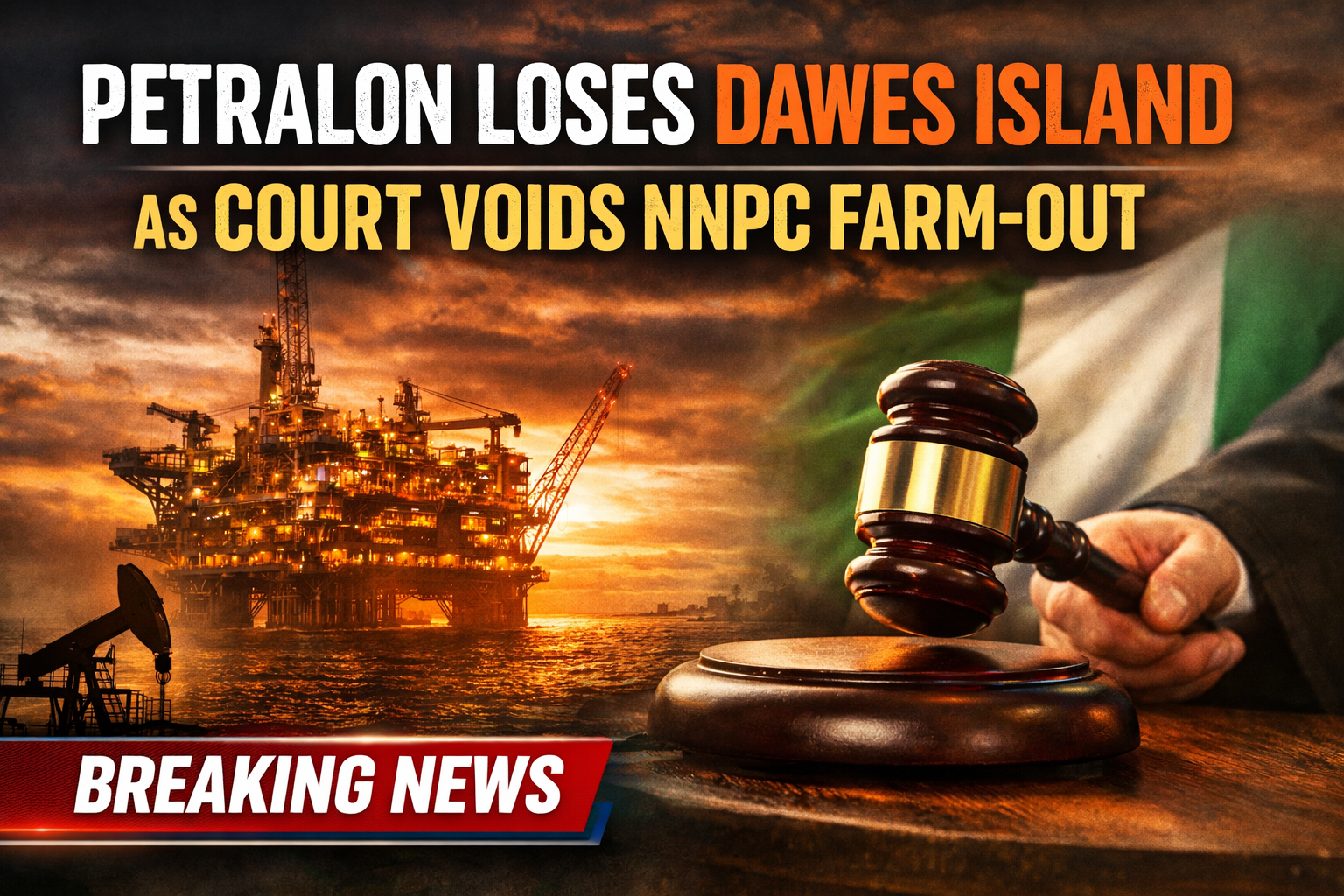
 Nigeria’s marginal field programme has been thrown into renewed uncertainty after the Federal High Court in Lagos nullified the controversial award of the Dawes Island Marginal Field to Petralon 54 Limited, restoring full licence and operational rights to Eurafric Energy Limited.
In a landmark judgment delivered on Wednesday in Suit No. FHC/L/CS/628/2021, the Court held that the revocation of Eurafric’s marginal field licence by the former Department of Petroleum Resources (DPR) in 2020, and the subsequent transfer of the asset to Petralon, were unlawful and procedurally defective.
The ruling effectively dismantles Petralon’s multi-year control of the producing field and invalidates its Farm-Out Agreement with the Nigerian National Petroleum Company Limited (NNPC), raising fresh concerns over regulatory certainty and investor confidence in Nigeria’s upstream oil sector.
Court Faults Regulatory Process
In its decision, the Court ruled that the DPR, now succeeded by the Nigerian Upstream Petroleum Regulatory Commission (NUPRC), acted outside its powers by revoking Eurafric’s licence without due process and secretly reassigning the asset to Petralon.
The judgment is seen as a significant setback for regulatory actions taken during the transition from the DPR to the NUPRC and has prompted renewed scrutiny of marginal field awards made in that period.
Industry analysts warn that the ruling could trigger a wave of litigation by operators who believe their assets were unjustly reassigned.
“This is not merely a dispute between two companies,” said energy analyst Chidi Nwosu. “It raises serious questions about the finality of regulatory decisions and the protection of contractual rights within Nigeria’s upstream framework.”
The NUPRC is now expected to reinstate Eurafric Energy as the recognised operator of the Dawes Island Field and address the operational and contractual consequences arising from Petralon’s activities on the asset.
Joint Venture Breakdown and Asset Allegations
Court proceedings exposed deep divisions within the Dawes Island Joint Venture, originally involving Eurafric Energy Limited, Tako E&P Solutions, and Petralon 54 Limited, which joined the project under a Farm-In arrangement.
According to the judgment, Eurafric accused Petralon of failing to meet its financial and operational commitments, secretly lobbying regulators to oust its partners, and engaging in what the Court described as “calculated conversion” of joint venture assets.
Evidence before the Court showed that more than 62,000 barrels of crude oil produced from the field were allegedly sold by Petralon without disclosure or remittance to its JV partners, prompting separate legal action to compel full financial transparency.
The Court was also critical of Petralon’s litigation strategy, noting that the company initiated arbitration proceedings only to undermine the process through repeated court actions against the arbitral tribunal—conduct the judge described as a deliberate attempt to delay proceedings while consolidating sole control of the field.
Warning to Marginal Field Operators
Legal practitioners say the judgment sends a strong warning to operators within Nigeria’s marginal field ecosystem.
“This ruling underscores the dangers of aggressive manoeuvring within joint ventures,” said senior energy lawyer Adebola Fisher. “It highlights the severe legal and reputational consequences of attempting to gain unilateral control of an asset at the expense of partners and due process.”
The Court’s findings also align with earlier concerns raised by the House of Representatives Committee on Public Petitions, which had described the exclusive award of the Dawes Island Field to Petralon as “suspicious and irregular.”
Uncertainty Over Next Steps
Despite restoring Eurafric’s licence, the ruling leaves several operational and regulatory issues unresolved, including:
The status of ongoing field operations and service contracts initiated by Petralon;
The legal and commercial implications for NNPC following the nullification of the Farm-Out Agreement;
Eurafric’s capacity to remobilise and stabilise production after years of litigation.
While Eurafric has welcomed the ruling as a victory for due process and contractual integrity, analysts caution that restoring production and rebuilding investor confidence at Dawes Island may prove challenging in the short term.
Attention now turns to whether Petralon will appeal the judgment and how swiftly the NUPRC will implement the Court’s orders—steps that could set a defining precedent for Nigeria’s marginal field regime.
A Federal High Court in Lagos has overturned the award of the Dawes Island Marginal Field to Petralon 54 Limited, nullifying its Farm-Out deal with NNPC and restoring the licence to Eurafric Energy, raising fresh concerns over Nigeria’s marginal field regulatory process.
Discover more from Ameh News
Subscribe to get the latest posts sent to your email.