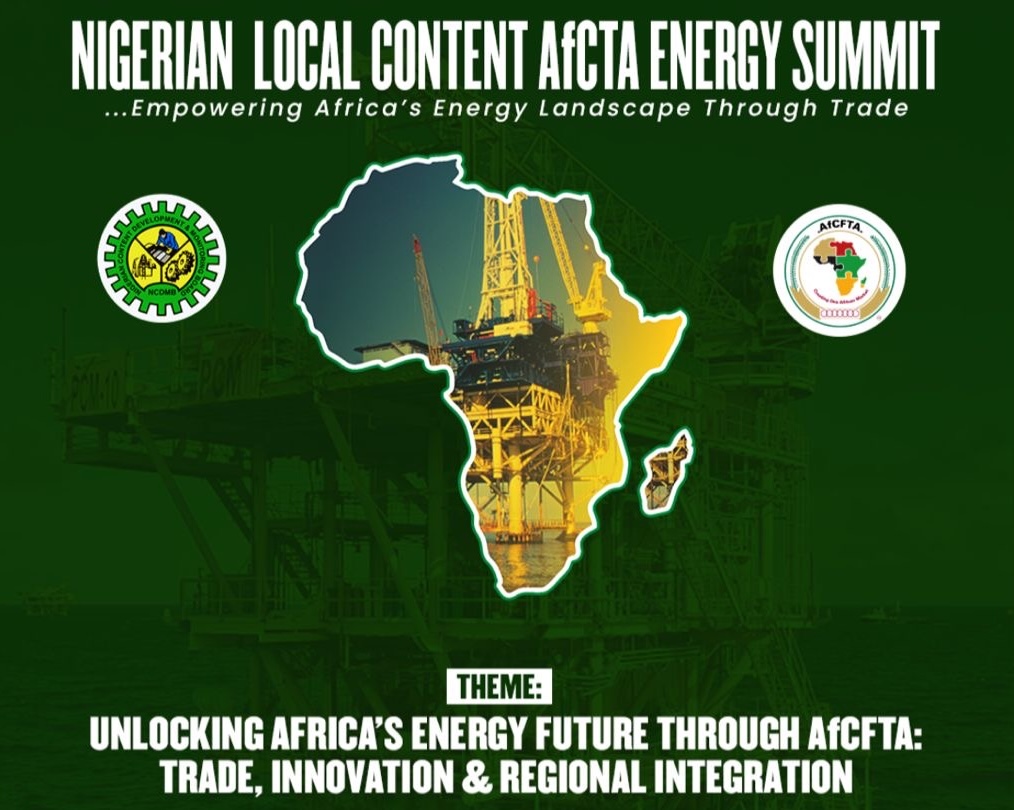
 Nigeria has reinforced its strategic ambition to anchor Africa’s industrial transformation on local capacity, regional collaboration and production-based trade, as deliberations at the AfCFTA Energy Summit 2026 placed Nigerian content at the centre of continental economic integration.
This renewed momentum framed deliberations around the Nigerian Content AfCFTA Energy Summit 2026, held on February 9, 2026, under the theme “Unlocking Africa’s Energy Future Through AfCFTA: Trade, Innovation and Regional Integration.” The summit followed a pre-conference engagement convened by the Nigerian Content Development and Monitoring Board (NCDMB) to prepare stakeholders for accessing AfCFTA’s vast continental market.
At the summit, the Nigerian Content Development and Monitoring Board (NCDMB) presented a forward-looking framework linking Africa’s vast natural resources with coordinated manufacturing, resilient regional value chains and harmonised trade systems capable of repositioning the continent within the global economic order.
Delivering a key presentation, Dr. Abdulmalik Halilu, Director of Corporate Services at NCDMB, outlined how deeper continental cooperation in industrial production and supply-chain integration would move Africa beyond its long-standing dependence on raw-material exports toward value-added manufacturing and competitive intra-African commerce.
According to him, the AfCFTA framework provides a historic platform for synchronising manufacturing capacity, logistics infrastructure, financing systems and regulatory standards across African economies—an alignment he said is essential for sustainable growth, energy security and long-term economic resilience.
The presentation formed part of broader reflections on AfCFTA implementation and its implications for Nigeria’s expanding local content drive, particularly within the oil, gas and energy value chain where indigenous capacity development is increasingly viewed as a catalyst for continental prosperity.
Stakeholders at the summit noted that Africa already possesses dispersed industrial strengths—from steel fabrication and component manufacturing to pipelines, instrumentation and energy infrastructure—spread across countries such as Nigeria, Egypt, South Africa, Angola, Algeria and the Democratic Republic of Congo. Harnessing these capabilities through structured regional value chains, they argued, would significantly lower production costs, boost competitiveness and expand intra-African trade.
With AfCFTA projected to unlock a multi-trillion-dollar single African market, discussions emphasised the urgency of translating policy into coordinated industrial action. Key enablers identified include tariff concessions, rules of origin tied to local content, sustainable funding frameworks and the Pan-African Payment and Settlement System, all designed to retain economic value within the continent while accelerating cross-border commerce.
Beyond trade facilitation, the summit highlighted the importance of infrastructure connectivity, regulatory harmonisation, industrial cluster development and digital inclusion of small and medium-scale enterprises, positioning these pillars as critical to building globally competitive African supply chains.
For Nigeria, participants stressed that the evolution of local content from a compliance mechanism into a continental industrial strategy marks a significant shift in policy direction—one that aligns national development with Africa-wide production integration.
As reflections from the summit suggest, the future of Africa’s economy will depend less on the export of unprocessed resources and more on the continent’s collective ability to produce, innovate and trade within a unified industrial ecosystem.
Through its AfCFTA-aligned local content agenda, NCDMB signalled that Nigeria intends not only to participate in this transformation but to help shape the architecture of Africa’s next economic era—defined by industrial strength, energy security and shared prosperity.
Dr. Abdulmalik Halilu outlines how coordinated manufacturing, regional value chains and harmonised trade under AfCFTA can drive Nigeria’s local content agenda and Africa’s long-term economic resilience.
Discover more from Ameh News
Subscribe to get the latest posts sent to your email.