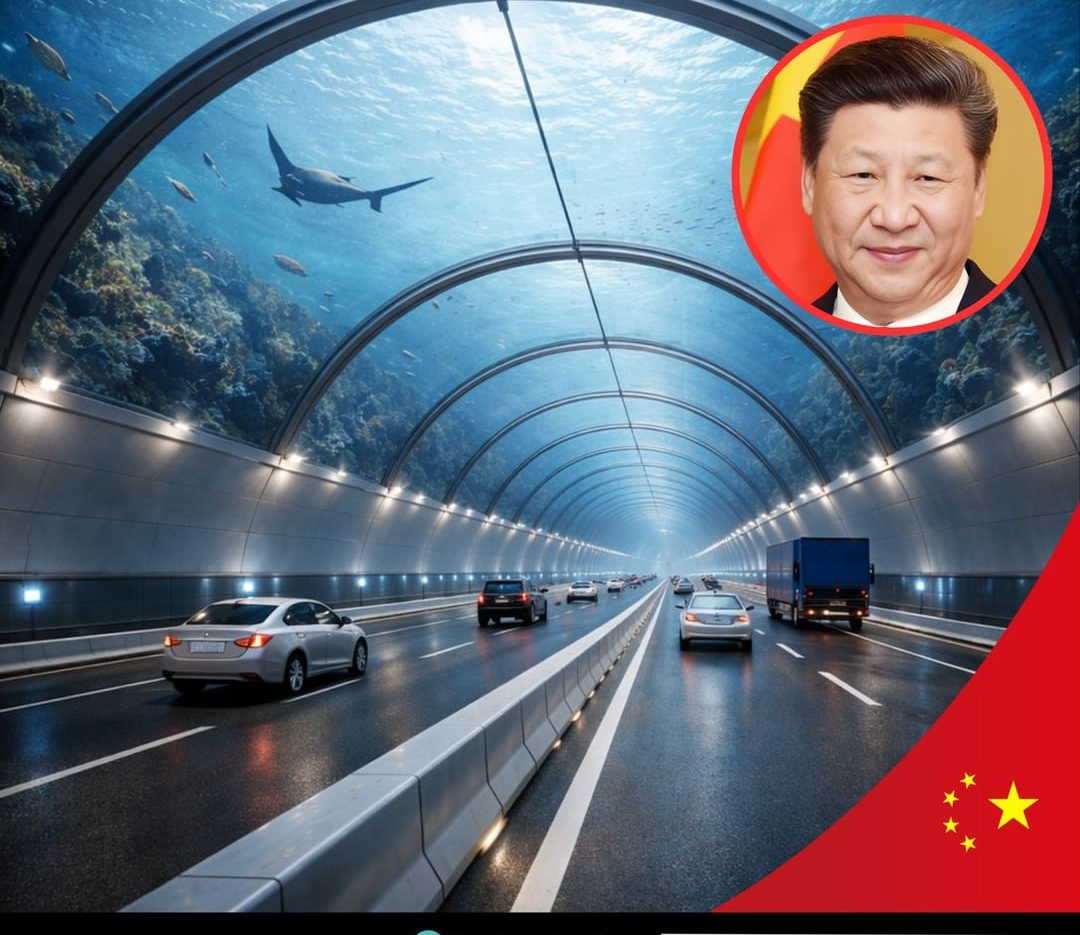
 China Breaks Speed Record with Massive Underwater Roadway Project.
In a striking demonstration of engineering efficiency, China has completed a large-scale underwater roadway in just over three months, achieving a construction timeline rarely seen for infrastructure of this magnitude. The tunnel, designed to carry heavy traffic beneath an active waterway, highlights China’s growing reputation for rapid, high-precision infrastructure delivery.
The project utilized immersed-tube tunnel technology, an innovative construction method in which large prefabricated tunnel sections are built off-site, transported to the location, submerged into pre-dredged trenches, and securely joined with watertight seals. This approach allows engineers to maintain exacting standards while minimizing disruptions to the waterway and surrounding areas—advantages that conventional drilling or cut-and-cover methods cannot easily match.
Experts say the project underscores China’s ability to mobilize vast labor forces, material supply chains, and sophisticated logistics to deliver complex infrastructure quickly. By prefabricating tunnel segments in controlled environments and installing them underwater with precision, engineers can drastically shorten construction timelines without compromising quality or safety.
Beyond speed, the roadway serves critical urban planning and transportation purposes. Dense coastal and port regions often face severe congestion, and expanding surface roads is typically limited by space and environmental considerations. Subsurface and underwater corridors help alleviate traffic pressure, maintain uninterrupted heavy-vehicle movement, and preserve urban land for other development purposes.
Urban planners note that underwater roadways can dramatically improve regional connectivity, redistributing traffic flow and reducing strain on bridges and surface routes. This is particularly valuable in port cities, where efficient freight and commercial transportation is essential to sustaining economic activity.
The project is also being hailed as a global case study in modular and speed-driven infrastructure construction. As cities worldwide confront the challenges of rapid urbanization, prefabricated, segmented approaches to large-scale projects are becoming increasingly popular. Immersed-tube tunnels, in particular, are emerging as a reliable method for river and coastal crossings due to their efficiency, environmental advantages, and safety profile.
Engineering analysts emphasize that such achievements depend heavily on thorough pre-construction planning, including detailed geotechnical surveys, hydrodynamic modeling, and robust risk management. The success of this tunnel reflects a carefully orchestrated sequence of design, fabrication, transport, and installation, demonstrating how overlapping processes can compress timelines while maintaining structural integrity.
China’s investment in high-speed, large-scale infrastructure aligns with its broader goal of enhancing regional and intercity connectivity. Bridges, tunnels, and expressways are increasingly used to unlock economic corridors, improve logistics efficiency, and support urban-rural integration.
For civil engineers and urban planners, the project is a vivid illustration of how advanced construction methods, modular techniques, and efficient project management are redefining expectations for infrastructure delivery. It also provides a blueprint for how cities worldwide might address urban congestion while optimizing land use and maintaining environmental safeguards.
The completion of this underwater roadway in record time is more than a national achievement; it signals a shift in global infrastructure standards, showing how innovation, resource mobilization, and careful planning can transform ambitious engineering projects into tangible, fast-moving solutions for urban and economic growth.
Discover more from Ameh News
Subscribe to get the latest posts sent to your email.