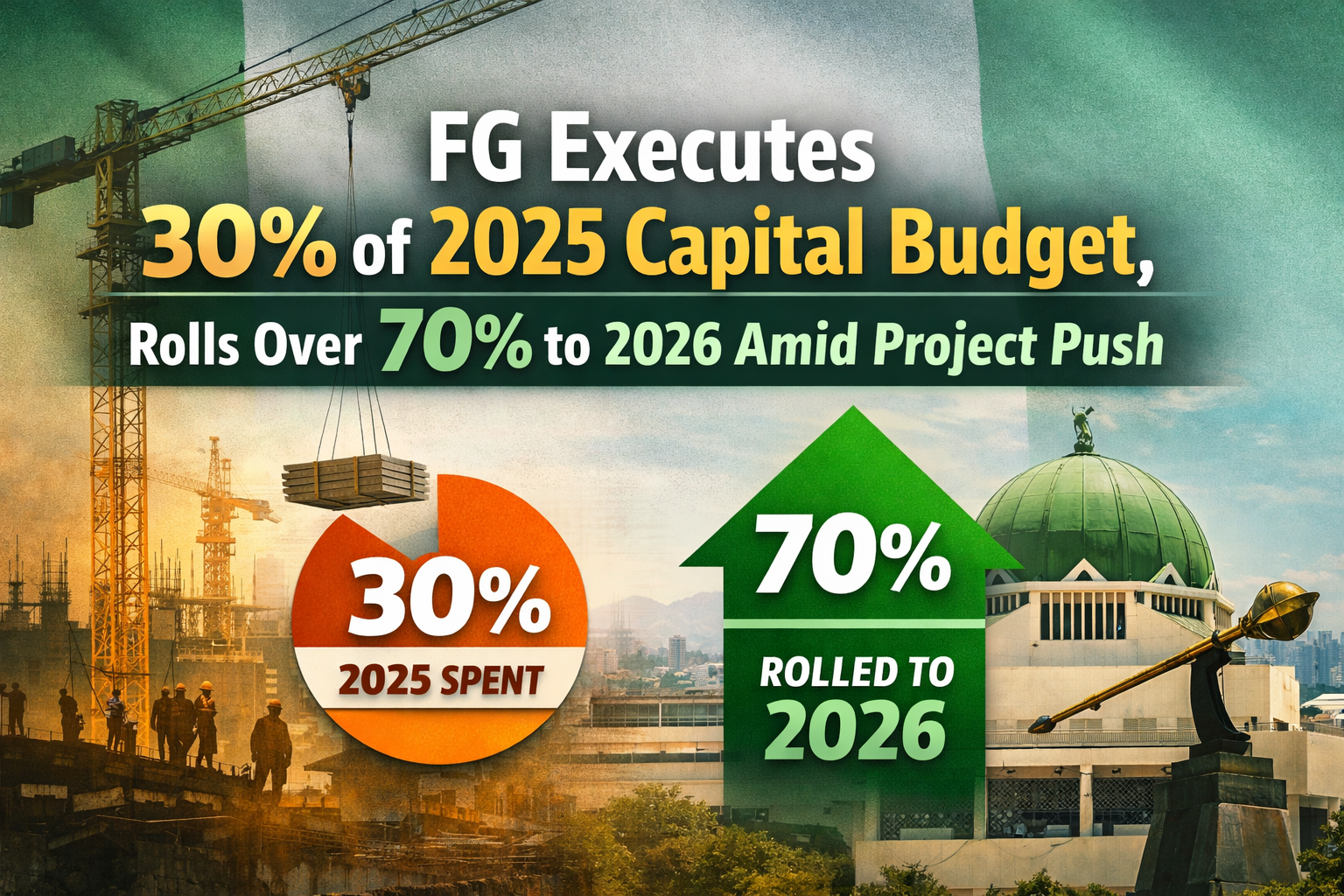
 The Federal Government of Nigeria has announced that 70 per cent of the 2025 capital budget will be rolled over into the 2026 fiscal year, while 30 per cent will be executed before the end of November. This move is aimed at fast-tracking project implementation and clearing outstanding financial obligations, while ensuring compliance with procurement rules.
In a statement issued on Thursday, Bawa Mokwa, Director of Press and Public Relations at the Office of the Accountant-General of the Federation, said Ministries, Departments, and Agencies (MDAs) have been directed to align fully with the Public Procurement Act in implementing both the extended 2025 capital budget and the 2026 budget.
The directive was reinforced by the Minister of State for Finance, Mrs. Doris Uzoka-Anite, during a stakeholders’ meeting on the extended 2025 capital budget held at the Federal Ministry of Finance in Abuja. She emphasised that all capital disbursements must strictly follow due process and be supported by available cash before execution.
The statement read, “Mrs. Uzoka-Anite emphasised that all capital payments must comply with the principles of the Procurement Act and that capital projects must be backed by cash before execution.”
Expert Perspectives
Economist Celestine Ukpong noted that while the deferral may appear significant, it offers an opportunity for the government to better plan and monitor capital project execution. “Rolling over 70 per cent of the budget is not necessarily a setback. It allows the government to consolidate ongoing projects, prevent wasteful spending, and ensure that funds are deployed efficiently under a controlled, cash-backed framework,” Ukpong said.
Peter Adebayo, FCA, highlighted the fiscal and administrative implications of the move. “From an accounting perspective, this rollover can enhance transparency and accountability, provided MDAs strictly follow procurement rules. The key challenge will be to maintain discipline in project execution and avoid delays that could affect economic growth,” he stated.
Both experts agreed that strict adherence to the Public Procurement Act and cash-backed project execution could prevent the chronic delays and cost overruns that have historically affected Nigeria’s capital projects. They further emphasized that this strategy could enhance investor confidence, particularly if the government demonstrates measurable progress in infrastructure development under the extended budget.
The government’s approach aims to ensure seamless continuity in capital project implementation while promoting transparency, accountability, and effective utilization of public funds. MDAs are expected to comply fully with these directives to guarantee that ongoing projects are completed efficiently and that new initiatives under the 2026 capital budget begin on a solid, compliant foundation.
FG rolls over 70% of 2025 capital budget to 2026 while executing 30% by November-end. Experts highlight potential for improved project delivery, fiscal discipline, and economic growth under strict procurement compliance.
The Federal Government defers 70% of the 2025 capital budget to 2026. Economist Celestine Ukpong and Peter Adebayo FCA weigh in, emphasizing transparency, fiscal discipline, and efficient project execution.
Discover more from Ameh News
Subscribe to get the latest posts sent to your email.