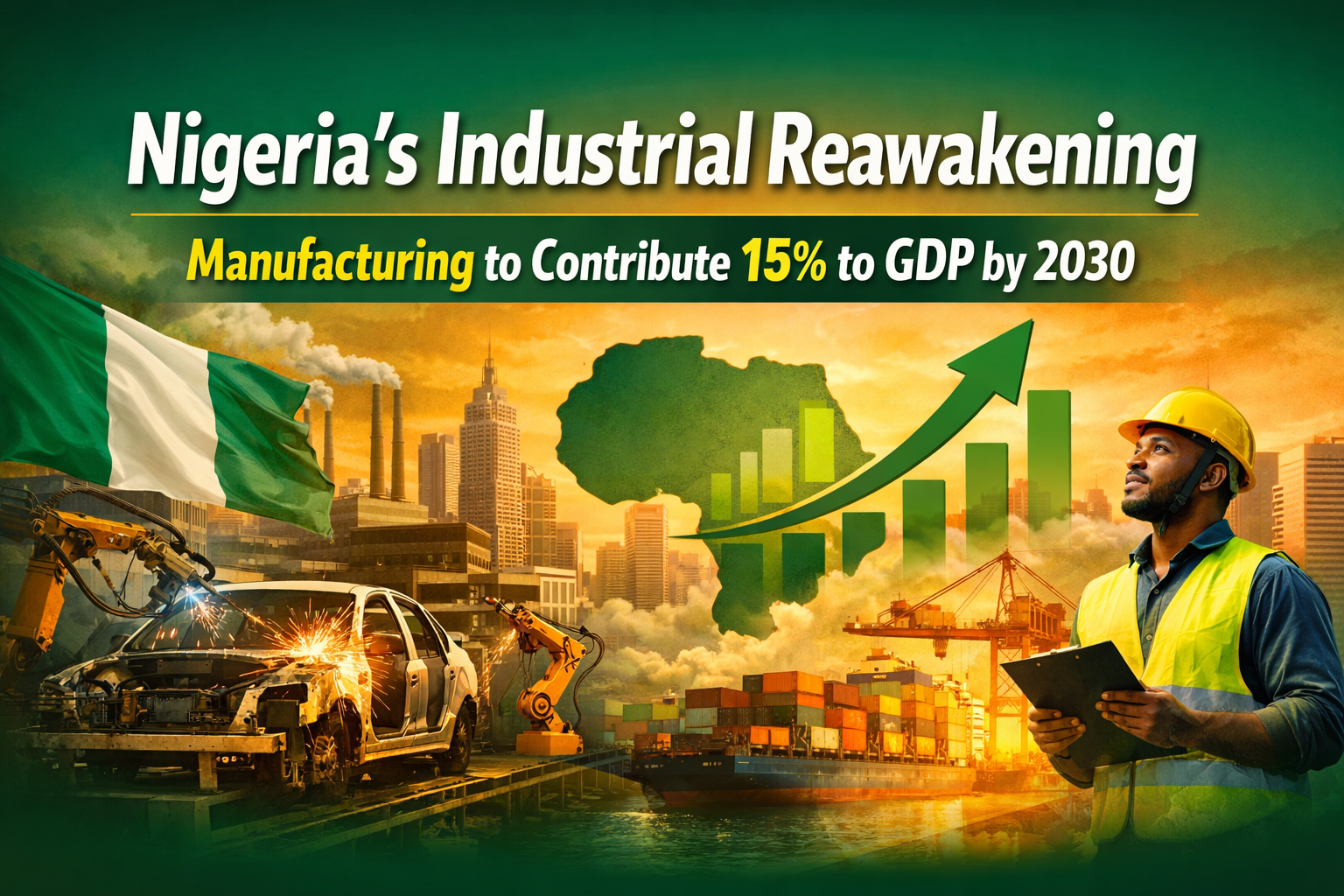
 Nigeria is once again placing its bets on industry.
In a bold and strategic recalibration of economic priorities, the Federal Government has unveiled an ambitious industrial policy aimed at raising manufacturing’s contribution to Gross Domestic Product (GDP) to 15 percent by 2030. It is a target that signals more than incremental reform. It represents a structural shift—an attempt to rebalance Africa’s largest economy away from oil dependency toward production, value addition, and sustainable industrial growth.
For decades, Nigeria’s economic story has oscillated between promise and paradox. Blessed with natural resources, a youthful population, and a large consumer market, the country has nonetheless struggled to build a strong manufacturing base. Industrial capacity has often been constrained by erratic power supply, foreign exchange volatility, logistics bottlenecks, high borrowing costs, and inconsistent policy implementation.
Now, policymakers say the tide is turning.
This new industrial roadmap aims not merely to improve manufacturing numbers but to reposition the sector as the anchor of long-term economic resilience. And for established players like Nestlé Nigeria, the shift could mark the beginning of a new era of opportunity—if execution matches ambition.
A Historic Push for Industrial Transformation
The 15 percent GDP target by 2030 is both symbolic and strategic.
Historically, Nigeria’s manufacturing contribution has fluctuated below its potential, often hovering in single digits to low double digits as a percentage of GDP. By comparison, emerging economies that achieved rapid industrialization—such as several Asian nations—built strong manufacturing bases before diversifying into services and high-value exports.
The new policy framework rests on five core pillars:
Local Value Addition and Backward Integration
Industrial Clusters and Special Economic Zones
Affordable Long-Term Financing
Export Expansion through AfCFTA
Technology, Innovation, and Skills Development
Taken together, these pillars are designed to address the structural weaknesses that have historically limited industrial growth.
At its heart, the policy seeks to answer a fundamental question: How can Nigeria convert its large domestic market into a production powerhouse rather than a consumption hub for imported goods?
Why Manufacturing Matters
Manufacturing is not merely another economic sector. It is the multiplier sector.
A vibrant manufacturing base drives employment across value chains—from raw material suppliers and transporters to distributors and retailers. It stimulates agricultural production, supports small and medium enterprises, deepens financial markets, and generates foreign exchange through exports.
Moreover, manufacturing offers stability. Unlike oil revenues, which fluctuate with global price cycles, diversified industrial output provides steady income streams and enhances economic sovereignty.
For Nigeria, whose population exceeds 200 million and continues to grow rapidly, the need for productive jobs is urgent. The industrial policy recognizes this demographic reality and frames manufacturing as the engine capable of absorbing skilled and semi-skilled labor at scale.
The Nestlé Nigeria Factor like Few companies that can illustrate the intersection between policy and industrial practice more clearly.
A subsidiary of the global food giant Nestlé, the company has operated in Nigeria for decades, building one of the country’s most recognizable manufacturing footprints in the fast-moving consumer goods (FMCG) sector. With factories in Ogun State and other strategic locations, Nestlé Nigeria produces popular food and beverage brands consumed across the country and beyond.
Importantly, the company has long invested in backward integration—sourcing raw materials such as maize, sorghum, and soybeans from local farmers. This strategy aligns directly with the government’s renewed emphasis on domestic value addition.
Under the new industrial policy, companies like Nestlé Nigeria could benefit in several key ways:
1. Strengthened Local Supply Chains
Incentives for agro-processing and domestic sourcing may deepen Nestlé’s partnerships with Nigerian farmers, improving yield quality and consistency while reducing reliance on imports.
2. Reduced Foreign Exchange Exposure
Foreign exchange volatility has historically impacted manufacturers dependent on imported inputs. By strengthening local production ecosystems, the policy could help stabilize cost structures.
3. Improved Infrastructure
Industrial cluster development and better power supply could reduce production costs significantly—energy remains one of the largest cost drivers for manufacturers in Nigeria.
4. Export Expansion
With the African Continental Free Trade Area (AfCFTA) framework gaining traction, Nigeria is positioning itself as a regional manufacturing hub. Nestlé Nigeria could scale exports into West and Central African markets more competitively.
Yet, the company’s future trajectory will depend not only on policy declarations but on sustained implementation.
Expert Reactions: Cautious Optimism.
Celestine Ukpong, an economist and development policy analyst, describes the 15 percent target as “ambitious but necessary.”
“Nigeria cannot continue to rely on crude oil exports as its primary economic stabilizer. Manufacturing offers scale, employment, and resilience. However, targets must be accompanied by measurable milestones and accountability mechanisms,” Ukpong said.
According to him, three variables will determine success:
Energy reform and reliable electricity
Stable macroeconomic policies
Access to affordable credit for manufacturers
Ukpong argues that unless interest rates decline and industrial financing becomes more accessible, small and medium manufacturers may struggle to expand capacity.
“Large corporations like Nestlé Nigeria have balance sheet strength. But if we want broad-based industrial growth, we must empower mid-sized and smaller players as well.”
He further noted that Nigeria’s demographic dividend can only translate into economic advantage if manufacturing scales rapidly.
Peter Adebayo, a Fellow of the Institute of Chartered Accountants of Nigeria (FCA), views the industrial policy through a fiscal lens.
“Manufacturing expansion strengthens tax revenue, deepens formalization, and improves corporate governance standards. It’s a win-win if properly implemented,” Adebayo explained.
He emphasized the importance of transparency in incentive structures.
“Tax incentives, import waivers, and financing support must be structured carefully to avoid revenue leakage. We need performance-based incentives tied to job creation and local content metrics.”
Adebayo also highlighted the strategic advantage for companies already invested in backward integration.
“Nestlé Nigeria’s existing local sourcing model positions it strongly within this policy framework. Companies that have already localized operations stand to gain more quickly.”
The Infrastructure Imperative
Policy without infrastructure is aspiration without execution.
Manufacturers in Nigeria frequently cite power shortages, high diesel costs, poor road networks, and port congestion as major obstacles. The new industrial framework includes commitments to improve industrial parks, logistics corridors, and energy reliability.
If these infrastructure commitments materialize, production costs could fall significantly, improving competitiveness against imports.
However, history offers cautionary lessons. Previous industrial policies often faltered at the implementation stage due to funding gaps, policy reversals, or bureaucratic delays.
The AfCFTA Opportunity
The African Continental Free Trade Area represents a transformative opportunity for Nigerian manufacturers.
By reducing trade barriers across Africa, AfCFTA opens access to a market of over one billion consumers. For Nestlé Nigeria and other producers, this could translate into export-driven growth beyond domestic demand.
Yet competitiveness remains key. To capture regional markets, Nigerian manufacturers must achieve cost efficiency, quality consistency, and regulatory compliance standards.
Risks and Realities
Despite widespread optimism, risks remain.
Exchange rate volatility could persist.
High inflation may impact consumer purchasing power.
Policy inconsistency could deter long-term investment.
Global supply chain disruptions may influence input costs.
Celestine Ukpong warns against over-reliance on projections.
“Industrialization is a marathon, not a sprint. The 15 percent target is achievable—but only with disciplined policy continuity across administrations.”
A Broader Economic Reset
The 15 percent manufacturing GDP target is not merely about numbers. It signals a philosophical reset—an acknowledgment that sustainable growth requires production capacity, not just consumption or resource extraction.
For companies like Nestlé Nigeria, the policy could reinforce long-term investment strategies aligned with national development goals.
For Nigeria, it could mean:
Millions of new jobs
Reduced import dependency
Improved trade balance
Stronger fiscal stability
Diversified revenue streams
But ambition alone will not transform factories into engines of prosperity. Implementation, transparency, and institutional discipline will determine whether 2030 marks a milestone—or a missed opportunity.
Conclusion: The Decade of Decision
Nigeria stands at an industrial crossroads.
The coming years will test whether policy momentum translates into measurable progress. If infrastructure improves, financing expands, and macroeconomic stability holds, manufacturing could indeed rise to 15 percent of GDP—or even surpass it.
For Nestlé Nigeria and other manufacturers, the opportunity is clear: scale operations, deepen local sourcing, expand exports, and align corporate growth with national ambition.
For policymakers, the responsibility is even greater: ensure that this industrial reawakening becomes a lasting transformation rather than another chapter in unrealized potential.
The decade to 2030 may well define Nigeria’s economic destiny.
Nigeria unveils an ambitious industrial policy to raise manufacturing’s GDP contribution to 15% by 2030. Experts Celestine Ukpong and Peter Adebayo analyze the economic impact and what it means for Nestlé Nigeria and the broader manufacturing sector.
Discover more from Ameh News
Subscribe to get the latest posts sent to your email.