 In a move that has sparked both anticipation and concern across Nigeria’s energy industry, President Bola Ahmed Tinubu’s administration has implemented a refined revenue-sharing framework for the nation’s oil and gas sector. The policy directs that 60% of revenues from oil sales be remitted directly to the Federation Account, effectively altering how the Nigerian National Petroleum Company (NNPC) operates financially. While touted as a step toward transparency, efficiency, and stronger governance, the immediate and long-term implications of this reform for Nigeria’s struggling refinery sector are complex and multifaceted.
Nigeria’s refinery sector, long plagued by technical inefficiencies, poor infrastructure maintenance, and underutilization, sits at a crossroads. With this new revenue framework, the question is no longer whether the sector will be impacted—but how significantly it will be reshaped.
Understanding the NNPC Revenue Shift
The core of the reform is deceptively simple: a larger portion of oil revenues now flows directly into the Federation Account, reducing the financial autonomy NNPC has traditionally exercised in managing crude allocations, refinery operations, and domestic fuel pricing. Historically, NNPC has relied on a model that allowed it to retain a portion of crude sales to fund upstream activities, refinery operations, and strategic reserves. This model, critics argue, led to opaque accounting, inconsistent refinery output, and chronic underinvestment in critical maintenance.
Under the new framework, NNPC’s capacity to reinvest its own earnings is curtailed. Instead, funding for refinery rehabilitation, capacity expansion, and operational upkeep may now depend more heavily on federal budget allocations, private investment, and public-private partnerships.
Economists suggest this shift could trigger both positive and negative outcomes. On one hand, it promotes transparency by centralizing revenue management; on the other, it may constrain NNPC’s ability to react swiftly to operational needs, which is particularly critical for refineries, whose uptime is sensitive to both financial and technical interventions.
Technical Challenges in Nigeria’s Refinery Sector
To grasp the potential impact, it is essential to examine the current technical state of Nigeria’s refineries. The country operates four major government-owned refineries—Port Harcourt (two units), Warri, and Kaduna—with a combined nameplate capacity of 445,000 barrels per day (bpd). Yet, the sector’s actual performance rarely exceeds 20–30% of capacity, translating to chronic fuel shortages, high import dependence, and inflated domestic prices.
Several technical factors underpin this underperformance:
Aging Infrastructure
Many of Nigeria’s refineries were commissioned in the 1960s through the 1980s. Decades of deferred maintenance have left critical systems—distillation units, cracking units, and hydrodesulfurization plants—operating below efficiency. Frequent shutdowns, sometimes lasting months, are not uncommon.
Inadequate Maintenance Funding
Historically, NNPC’s internal cash flow was partially allocated to routine maintenance and emergency repairs. The new revenue framework could reduce these internally controlled funds, potentially delaying critical upgrades unless the federal government ensures dedicated capital for refinery upkeep.
Operational Inefficiencies
Poor process control, outdated automation, and skilled workforce shortages contribute to frequent refinery downtime. Technical audits suggest that even minor equipment failures can cascade into weeks-long operational interruptions.
Feedstock Management
Refineries require a steady, high-quality crude supply for optimal output. In the past, NNPC’s flexibility in crude allocations allowed it to navigate supply constraints. With tighter revenue management, crude procurement strategies may face delays or budgetary bottlenecks, risking operational disruptions.
Economic Implications of the Revenue Shift
The revenue redirection has profound implications for both the macroeconomic and refinery-specific landscape.
1. Refinery Financing and Capital Projects
One of the most immediate concerns for refinery operators is funding. With NNPC retaining less revenue, the capacity to self-finance repair, expansion, or modernization projects is reduced. For example, the Port Harcourt refinery rehabilitation project, which aims to increase capacity utilization to 80% within two years, may face delays unless federal or private financing fills the gap.
International investors and joint venture partners often rely on NNPC’s historical cash flows to assess project feasibility. A perceived reduction in financial autonomy could influence investor confidence, affecting timelines and project costs. Conversely, centralizing revenue could enhance accountability and reduce misappropriation risks, potentially making long-term investment more attractive if managed transparently.
2. Fuel Supply and Domestic Price Stability
Nigeria’s refinery inefficiency has historically necessitated the importation of refined products. Any disruption in operational financing could exacerbate this dependence. Fuel importation places additional pressure on foreign reserves, contributes to price volatility, and undermines the government’s goal of energy self-sufficiency.
Conversely, if revenue centralization allows the federal government to strategically allocate funds to ensure uninterrupted refinery operation, the sector could benefit from a more coordinated approach. The ultimate impact on fuel availability and pricing will hinge on how effectively the federal allocation mechanisms are implemented.
3. Implications for Refinery Privatization and Public-Private Partnerships
Tinubu’s reform may influence ongoing privatization discussions and public-private partnerships. Investors often prefer predictability in financial flows. The new framework could either reassure investors of government oversight and stability or raise concerns over bureaucratic delays in accessing funds for operational needs.
Experts argue that aligning revenue flows with federal oversight could create a clearer path for private-sector participation in refinery operations, provided that operational autonomy and funding access are preserved.
Expert Insights
To gauge the real-world implications, we consulted leading analysts and engineers in the Nigerian energy sector.
Dr. Celestine Ukpong, an energy economist, notes:
“Centralizing revenue can increase transparency and reduce diversion of funds, but refineries are capital-intensive and require flexible, timely funding. If the government fails to create dedicated financial channels for maintenance and capacity upgrades, we risk prolonging inefficiencies and increasing fuel import dependency.”
Peter Adebayo, FCA, a petroleum sector consultant, adds:
“The reform is a double-edged sword. On paper, it strengthens governance and ensures proper allocation of Nigeria’s oil wealth. Technically, however, a refinery’s operational efficiency depends on immediate access to capital for maintenance and emergency repairs. The challenge will be to reconcile centralized revenue management with decentralized operational needs.”
Potential Scenarios for the Refinery Sector
Based on current data and technical realities, several scenarios could emerge:
Scenario 1: Positive Transformation
If the federal government establishes dedicated funding channels for refinery maintenance and upgrades, the revenue shift could strengthen the sector. Centralized oversight could reduce corruption, ensure consistent project financing, and encourage private investment. Over time, this could lead to higher capacity utilization, reduced import dependence, and stable fuel pricing.
Indicators of success:
Timely budget allocations to NNPC refineries
Public-private partnerships with guaranteed operational funding
Upgrades of critical infrastructure and process automation
Scenario 2: Operational Disruption
Conversely, if centralized revenue allocation leads to bureaucratic delays, refineries may face prolonged downtime. Critical repairs and expansions could stall, worsening fuel shortages, increasing imports, and inflating domestic prices. Investor confidence in the sector could decline, delaying modernization projects.
Indicators of risk:
Delayed maintenance schedules due to funding bottlenecks
Increased fuel import bills and pressure on foreign reserves
Downtime spikes at Port Harcourt, Warri, and Kaduna refineries
Scenario 3: Hybrid Outcome
A middle-ground scenario is likely, where federal oversight improves transparency but operational delays persist in the short term. The sector may see incremental improvements in governance, while technical inefficiencies continue to hamper output. Over time, strategic policy adjustments could tilt the balance toward positive transformation.
Lessons from International Experience
Global experience suggests that centralized revenue management can improve transparency, but only if accompanied by operational safeguards. Countries like Malaysia and Norway maintain strong oversight of national oil revenues while ensuring operational autonomy for refineries. In Norway, for example, revenues from oil are channeled into a sovereign wealth fund, yet operational units retain delegated authority to allocate funds for maintenance and capital projects—a model that balances accountability with operational flexibility.
Nigeria could adopt similar mechanisms, such as:
Ring-fenced refinery funding: Ensuring NNPC refineries have guaranteed, dedicated funds accessible immediately for operations and maintenance.
Performance-based allocations: Linking revenue release to measurable operational performance metrics.
Private sector engagement: Encouraging investors to inject capital under clear regulatory frameworks, mitigating reliance on federal disbursements.
Technical Recommendations for NNPC Refineries
To mitigate potential disruption and maximize the benefits of Tinubu’s revenue reform, experts recommend several technical interventions:
Emergency Maintenance Funds: Establish pre-approved, ring-fenced emergency funds for unplanned outages to prevent long shutdowns.
Digital Process Monitoring: Invest in automation and predictive maintenance systems to reduce downtime and increase operational efficiency.
Workforce Training: Strengthen technical expertise in refinery operations, maintenance, and process optimization.
Feedstock Optimization: Implement sophisticated crude blending strategies to ensure feedstock quality and consistency.
Collaboration with Private Partners: Foster joint ventures that bring not only capital but also operational expertise.
These steps, coupled with effective financial management under the new revenue regime, could help transform Nigeria’s refineries into efficient, self-sustaining facilities that reduce import dependence and stabilize domestic fuel supply.
In the nutshell: A Crossroads for Nigeria’s Refinery Sector
President Bola Ahmed Tinubu’s revenue reform represents a landmark shift in Nigeria’s oil and gas governance. Its impact on the refinery sector will depend on how well centralized financial oversight is balanced with operational flexibility. Without careful implementation, there is a real risk of exacerbating existing inefficiencies, prolonging downtime, and increasing reliance on imported refined products.
However, if executed strategically, this reform could strengthen governance, improve investor confidence, and provide a more sustainable pathway for Nigeria’s refineries to achieve higher capacity utilization. The reform challenges NNPC, federal regulators, and investors alike to rethink how financial and technical management intersect in a capital-intensive, technically complex sector.
Ultimately, Nigeria’s refinery future under the new revenue model will be determined by a delicate equilibrium between fiscal oversight and operational autonomy—a test of governance, strategy, and technical excellence that will shape the nation’s energy landscape for decades.
Nigeria’s NNPC revenue shift under President Tinubu redirects 60% of oil sales to the Federation Account. Experts analyze potential impacts on refinery operations, fuel supply, and sector investment.
Explore how President Tinubu’s NNPC revenue reform could reshape Nigeria’s refinery sector. Technical and economic analysis of potential disruptions, investment implications, and operational outcomes.
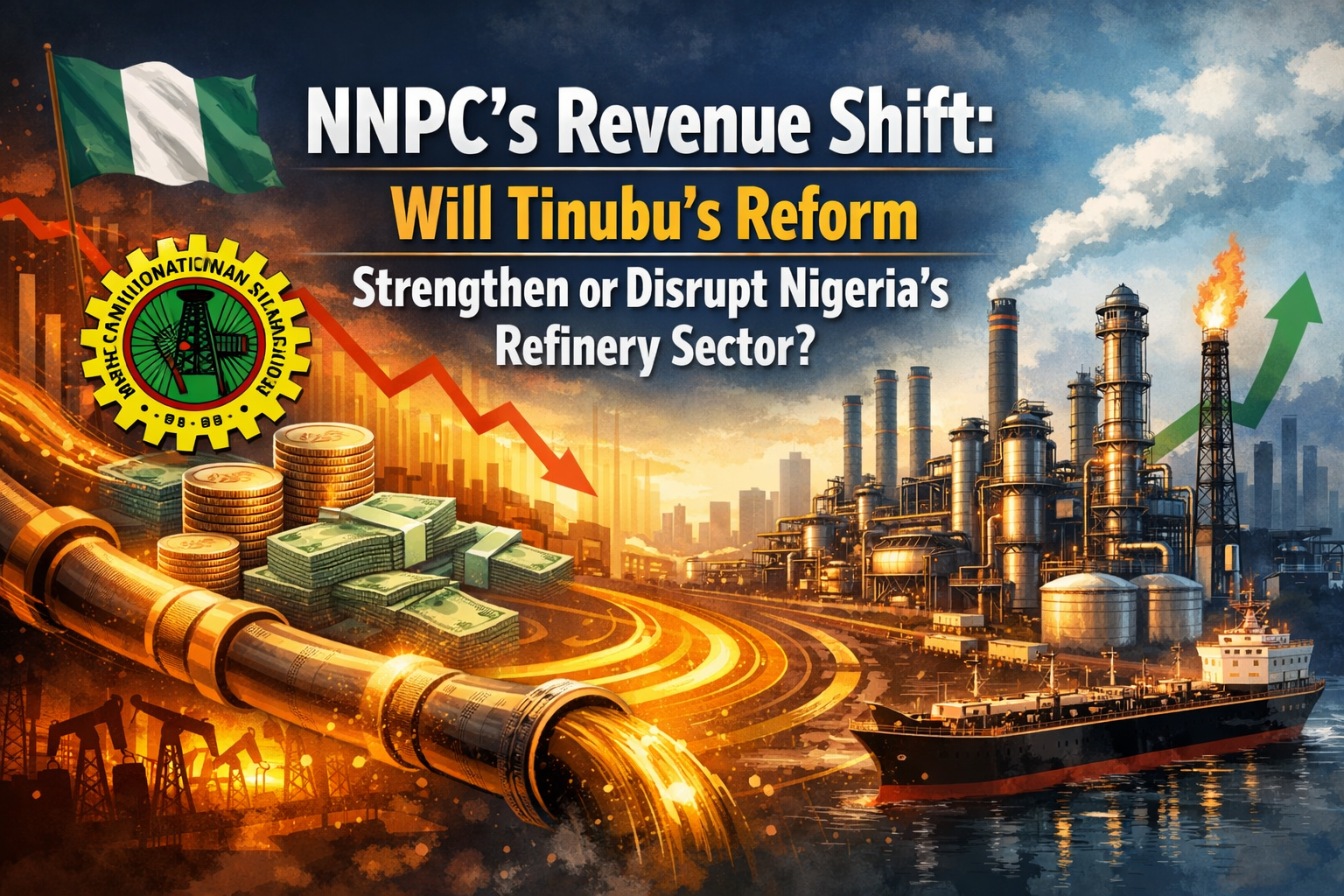
“Nigeria’s Refinery Crossroads: Balancing Revenue Reform with Operational Efficiency” — depicting refineries, oil pipelines, and abstract fiscal flows symbolizing the revenue shift.
Discover more from Ameh News
Subscribe to get the latest posts sent to your email.