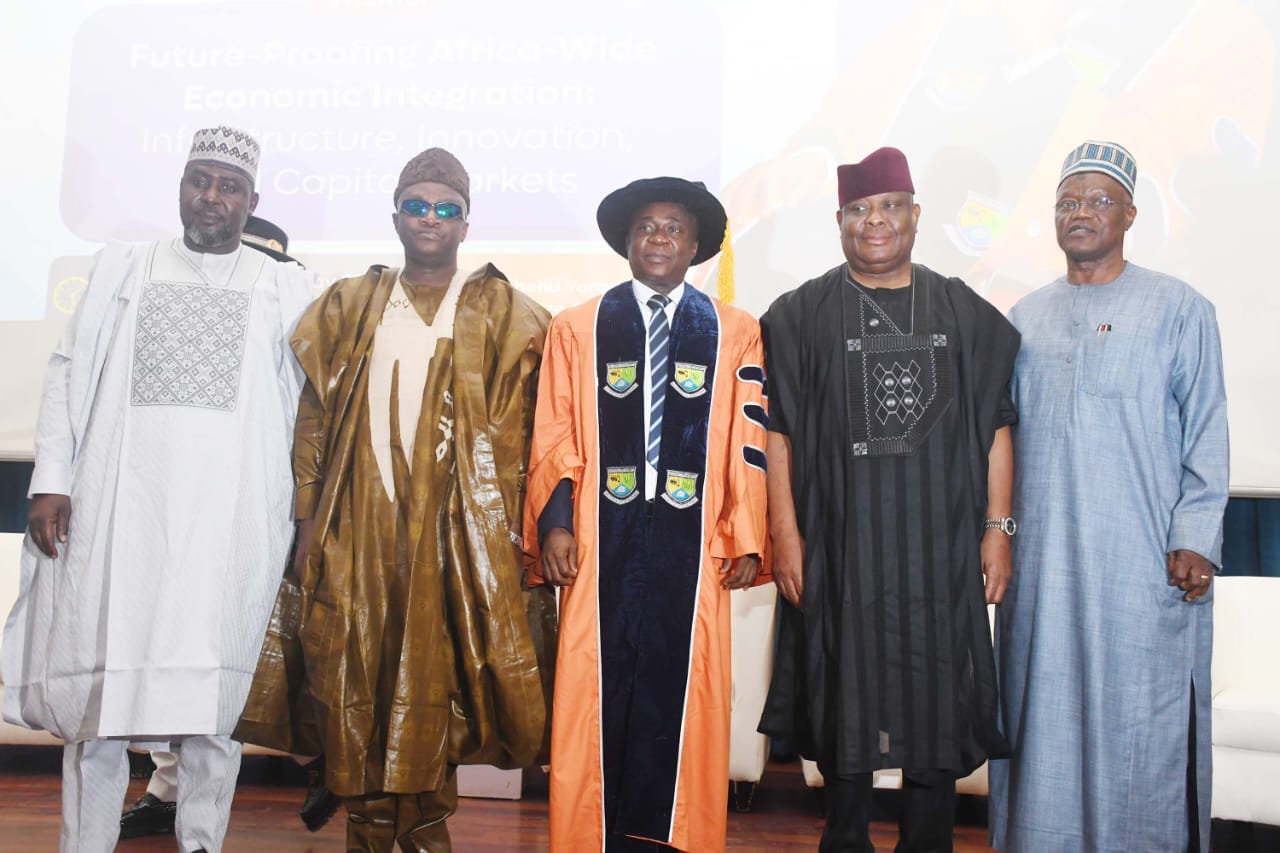
 L-R: Senator Aminu Abbas (Chairman Senate Committee on Science & Technology); Prof Kitso Ngarubi (Deputy Vice Chancellor Nasarawa State University Keffi; Prof Uche Uwaleke (Prof of Capital Market and Honoree); Senator Osita Izunaso (Chairman Senate Committee on Capital Market), and Senator Peter Jiya (Vice Chairman, Senate Committee on Capital Market) at the Prof Uche Uwaleke (PUU) Colloquium on Capital Market held on Monday February 23rd at the Yaradua Centre Abuja
Policymakers, regulators, academics, legislators, and capital market operators have called for urgent macroeconomic coordination, infrastructure financing reforms, and harmonized capital market regulations to future-proof Africa’s economic integration.
This formed the core outcome of the 3rd Prof Uche Uwaleke (PUU) Biennial Capital Market Colloquium held on Monday, February 23, 2026, at the Yar’Adua Centre, Abuja, under the theme: “Future-Proofing Africa-wide Economic Integration: Infrastructure, Innovation, and Capital Markets.”. The colloquium, held in honour of Professor Uche Uwaleke, Director of the Institute of Capital Market Studies at Nasarawa State University Keffi, convened thought leaders from academia and industry to interrogate how infrastructure, innovation, and resilient capital markets can collectively drive sustainable continental growth.
AfCFTA: Beyond Agreements to Implementation
Participants acknowledged the transformative potential of the African Continental Free Trade Area (AfCFTA) in expanding intra-African trade, boosting industrialization, and catalyzing cross-border investment flows. However, they stressed that signing trade agreements alone is insufficient without effective implementation, regulatory alignment, and macroeconomic stability.

Macroeconomic Stability as the Foundation
A key highlight of the colloquium was the emphasis on macroeconomic convergence across African economies. Participants argued that price stability, fiscal discipline, exchange rate predictability, and credible monetary policy frameworks are critical to long-term infrastructure financing and cross-border capital mobility.
Without stability, they warned, integration efforts could remain vulnerable to global shocks and domestic policy inconsistencies.
Infrastructure Financing and Energy Security
Infrastructure was described as the backbone of continental integration. Delegates stressed the need for coordinated investments in transport corridors, energy systems, and digital infrastructure.
Energy security, in particular, was identified as central to industrialization and regional competitiveness. The colloquium recommended blended finance models, infrastructure bonds, green bonds, diaspora bonds, and strengthened public-private partnerships as viable financing instruments to bridge Africa’s infrastructure gap.
Harmonized and Resilient Capital Markets
The forum underscored the importance of interoperable settlement systems, harmonized listing requirements, and coordinated regulatory oversight across African exchanges.
Participants noted that operational infrastructure—including registrars, clearing houses, custodians, and digital shareholder services—must be technologically integrated to enable seamless cross-border trading and investment.
The integrity of financial reporting was also highlighted as essential for investor confidence. Professional bodies such as the Institute of Chartered Accountants of Nigeria were encouraged to deepen collaboration with peer institutions across the continent to ensure uniform accounting, auditing, and ethical standards.
Fintech, Digital Identity, and CBDCs
As digital innovation accelerates, the colloquium called for enabling legislation to support fintech growth, digital identity systems, data governance frameworks, and cybersecurity standards. Regulatory sandboxes were recommended to balance innovation with investor and consumer protection.
Participants also examined the role of Central Bank Digital Currencies (CBDCs) in strengthening cross-border payments. Nigeria’s eNaira was cited as an example of how digital currencies could facilitate faster and more transparent transactions. However, experts cautioned that interoperability, cybersecurity resilience, and public trust are crucial to ensuring CBDCs unify rather than fragment African markets.
Intellectual Infrastructure and Legislative Oversight
Beyond physical infrastructure, the colloquium emphasized the importance of intellectual infrastructure and human capital development. African universities were urged to redesign curricula to reflect regional economic realities and encourage cross-border research collaboration.
Strong parliamentary oversight, transparency mechanisms, and institutional safeguards were also recommended to ensure policy continuity across political cycles.
Resolutions Adopted
At the end of deliberations, participants resolved to:
Advocate greater macroeconomic coordination across African economies.
Promote harmonization of capital market regulations and trading systems.
Accelerate AfCFTA implementation by eliminating non-tariff trade barriers.
Develop innovative infrastructure financing instruments, including green and diaspora bonds.
Strengthen collaboration among accounting, auditing, and financial regulatory bodies.
Foster partnerships between academia, industry, and government to align research with continental priorities.
Support legislative frameworks that encourage responsible fintech innovation while safeguarding investors.
A Future-Oriented Integration Agenda
The 3rd PUU Biennial Colloquium reaffirmed that Africa’s economic integration must be deliberate, coordinated, and future-oriented. Infrastructure must connect markets physically and digitally. Innovation must unlock productivity and competitiveness. Capital markets must mobilize long-term savings into transformative investments.
Participants agreed that a fully integrated African economic space is achievable if institutions are strengthened, policies harmonized, and political commitment remains steadfast.
The PUU Colloquium, stakeholders noted, continues to serve as a vital intellectual platform where rigorous dialogue shapes practical solutions for Africa’s capital market and economic future.
Stakeholders at the 3rd Prof Uche Uwaleke Biennial Colloquium in Abuja urge macroeconomic stability, capital market harmonization, and infrastructure financing reforms to fast-track Africa’s economic integration under AfCFTA.
Discover more from Ameh News
Subscribe to get the latest posts sent to your email.