The Central Bank of Nigeria (CBN) has reduced its Monetary Policy Rate (MPR) by 50 basis points to 26.5%, signaling a cautious shift towards easing borrowing costs amid a continued decline in inflation. The decision was reached during the Bank’s 304th Monetary Policy Committee (MPC) meeting on February 23–24, which saw eleven members in attendance.
Governor Olayemi Cardoso stated that the Committee’s move balances the need to sustain the ongoing disinflationary trend with the imperative of preserving financial system stability. The MPC also retained the Standing Facilities Corridor at +50/-450 basis points around the MPR and maintained Cash Reserve Requirements (CRR) at 45% for deposit money banks, 16% for merchant banks, and 75% for non-TSA public sector deposits.
The decision follows eleven consecutive months of easing headline inflation, which fell to 15.10% in January 2026 from 15.15% in December 2025. Food inflation declined sharply to 8.89% from 10.84%, while core inflation eased to 17.72% from 18.63%. The MPC attributed this trend to previous monetary tightening, stable foreign exchange rates, robust capital inflows, and improved domestic food supply, particularly staples.
Experts welcome the move.
Celestine Ukpong, an economist, described the cut as “a calculated but positive step by the CBN to stimulate economic activity. Lower borrowing costs will encourage businesses to invest and expand production while maintaining price stability.” He added that the Bank’s decision “reflects confidence in Nigeria’s disinflation trajectory and the strength of its external reserves.”
Peter Adebayo, FCA, a chartered accountant, emphasized the significance for the financial sector: “The rate cut reinforces investor and banking confidence. With ongoing recapitalization and strong reserve levels, financial institutions are well-positioned to support both corporate and retail lending. The challenge is to monitor potential inflationary pressures from election-related spending.”
The MPC highlighted the remarkable resilience of Nigeria’s banking sector, noting that 20 of 33 banks undergoing recapitalization have met the new minimum capital requirement. This progress underscores the sector’s growing capacity to support sustainable economic growth and financial stability.
The country’s external reserves rose to US$50.45 billion as of February 16, 2026, the highest in 13 years, providing nearly 10 months of import cover for goods and services. Robust export earnings, growing remittances, and the newly issued Presidential Executive Order 09, which channels oil and gas revenues into the Federation Account, have further strengthened fiscal and foreign exchange stability, according to the MPC.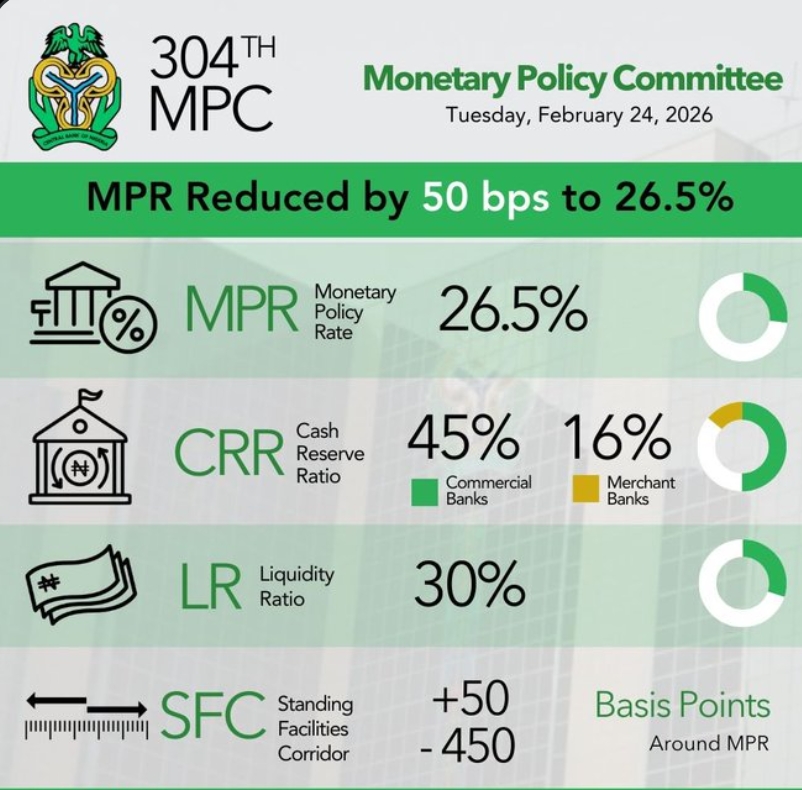
Economic activity indicators also point to steady growth. The Purchasing Managers’ Index (PMI) recorded 55.7 points in January 2026, signaling continued expansion in the manufacturing and services sectors. Analysts say that combining moderate interest rates with stable inflation and robust reserves could provide the momentum for sustained economic growth in the coming months.
Globally, the MPC noted that 2026 is expected to see strengthening economic activity, underpinned by trade progress, increased investment in artificial intelligence-related technologies, and gradual monetary easing. However, global risks—including protectionism, geo-economic tensions, and potential trade disputes—could present headwinds to domestic growth.
In conclusion, the MPC reaffirmed its commitment to an evidence-based policy framework, focusing on price stability while safeguarding the resilience of the financial system. The next MPC meeting is scheduled for May 19–20, 2026.
The Central Bank of Nigeria lowers the MPR to 26.5%, citing disinflation, forex stability, and improved food supply. Economists Celestine Ukpong and Peter Adebayo weigh in on growth, banking resilience, and investment prospects.
Discover more from Ameh News
Subscribe to get the latest posts sent to your email.