A Defining Moment in Africa’s Industrial Renaissance
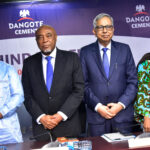
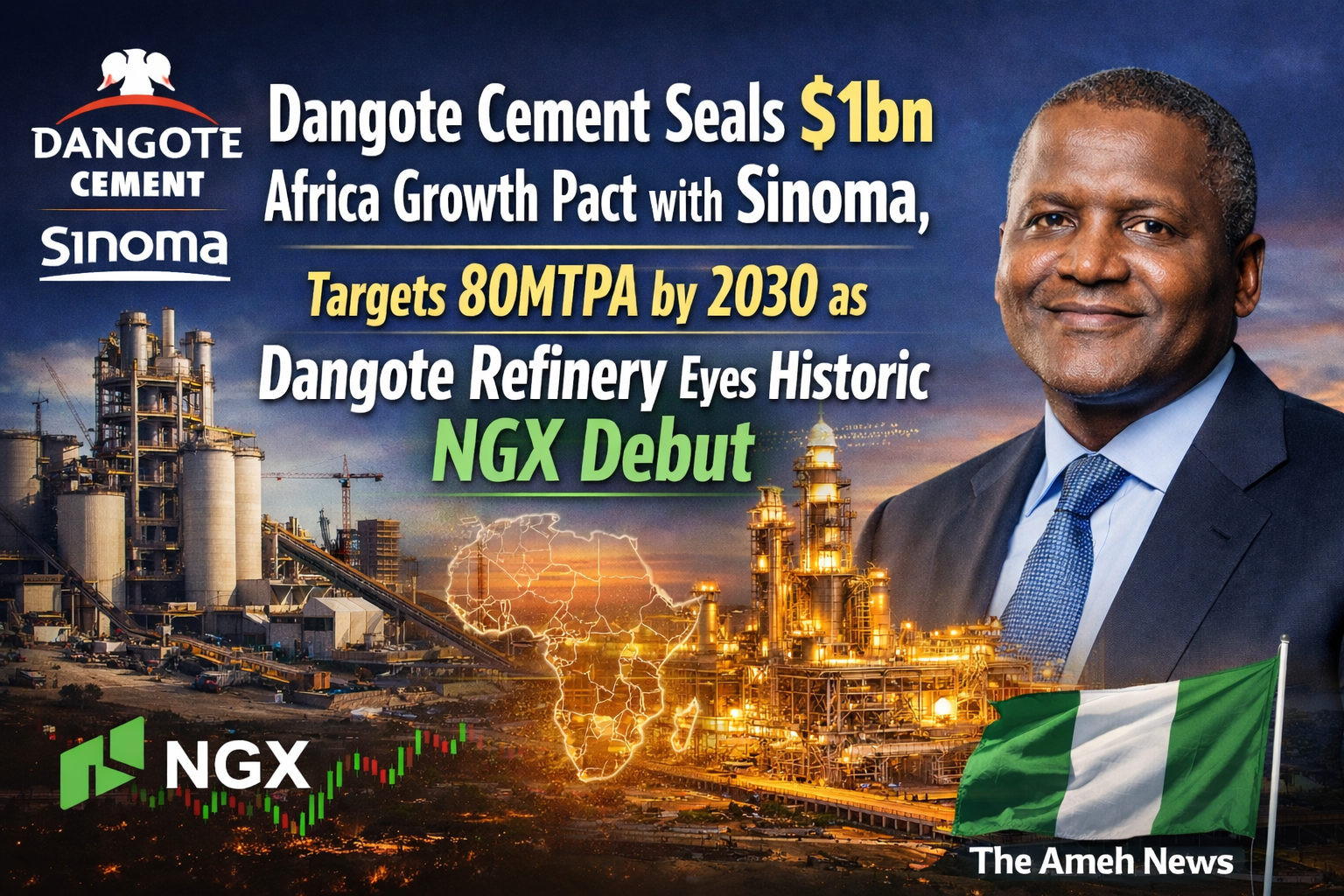 In what industry watchers describe as one of the most consequential industrial moves in recent African corporate history, Dangote Cement Plc has signed a $1 billion strategic framework agreement with Sinoma International Engineering for the construction of 12 new projects and expansion of existing operations across Africa.
The landmark agreement, sealed in Lagos, is more than a construction contract. It is a statement of intent — a reaffirmation of Africa’s largest cement producer’s determination to scale capacity, deepen continental integration, and anchor Nigeria’s industrial transformation.
For the Dangote Group, this is not merely expansion. It is execution at scale.
Vision 2030: Strategy Backed by Capital
The deal aligns squarely with the long-term roadmap of its parent company, Dangote Industries Limited, whose Vision 2030 targets include achieving 80 million tonnes per annum (MTPA) cement production capacity and generating $100 billion in annual revenue within the same period.
President of the Group, Aliko Dangote, described the projects as “carefully designed critical enablers” that will drive capacity expansion, operational optimisation, and export competitiveness.
According to Dangote, the expansion is structured to strengthen domestic dominance while simultaneously accelerating export activities across West, East, and Central Africa.
“Our objective is clear,” Dangote said at the signing ceremony. “We are building not just plants, but platforms for Africa’s infrastructure growth.”
Inside the $1 Billion Expansion Plan
Under the agreement, Sinoma International Engineering — globally recognised for delivering complex cement and industrial projects — will oversee the delivery of:
A new integrated production line in Northern Nigeria with satellite grinding units
A new cement line in Ethiopia
Expansion projects across Zambia/Zimbabwe, Tanzania, Sierra Leone, and Cameroon
Brownfield upgrades and modernisation of existing facilities
In Nigeria, new and expanded installations are planned for Itori, Apapa, Lekki, Port Harcourt, and Onne — strategically located to optimise logistics, export routes, and regional supply chains.
These investments are expected to:
Increase installed production capacity
Reduce operational bottlenecks
Improve energy efficiency
Enhance cost competitiveness
Expand export corridors
Chairman of Dangote Cement Plc, Emmanuel Ikazoboh, emphasised that the projects will significantly consolidate the company’s leadership position in Africa.
“The new capacities will strengthen our market share, deepen regional integration, and reinforce our dominant standing in the African cement landscape,” he stated.
Closing Africa’s Infrastructure Gap
Africa’s infrastructure deficit remains one of the continent’s most pressing economic challenges. Roads, housing, rail, ports, and industrial complexes require sustained investment — and cement is foundational to all of it.
Group Managing Director of Dangote Cement, Arvind Pathak, explained that the company’s strategy is built around closing supply gaps and reducing dependence on imports across African markets.
“Our commitment is to make Africa self-sufficient in cement production,” Pathak said. “When Africa produces what it consumes, value chains strengthen, jobs multiply, and economic resilience improves.”
Industry analysts note that increased cement capacity not only reduces construction costs but also supports urbanisation and housing initiatives across rapidly growing cities.
Energy Security: Gas as a Strategic Enabler
Parallel to the expansion drive, Dangote Cement has scaled up its Gas Sales and Purchase Agreements (GSPA) with subsidiaries of the Nigerian National Petroleum Company Limited — Nigerian Gas Marketing Limited and NNPC Gas Infrastructure Company Limited.
The enhanced agreements guarantee stable gas supply for expanded production while accelerating compressed natural gas (CNG) adoption as Autogas.
This dual objective — increased output and cleaner energy — reflects a strategic shift toward sustainability and cost discipline.
Energy constitutes a major cost component in cement manufacturing. By securing long-term gas supply and embracing cleaner fuel technologies, Dangote Cement aims to reduce volatility exposure while lowering its carbon footprint.
Economic Impact: Experts Speak
Economist Celestine Ukpong describes the $1 billion expansion as “a structural economic intervention disguised as a corporate project.”
According to Ukpong, the multiplier effect of such industrial investments could significantly boost Nigeria’s manufacturing GDP contribution and stimulate broader economic activity.
“This expansion will generate direct employment in plant construction and operations, but more importantly, it creates indirect opportunities across mining, logistics, engineering, finance, and services,” he explained.
Ukpong added that the projects position Nigeria strategically within the African Continental Free Trade Area (AfCFTA) framework.
“With increased capacity, Nigeria strengthens its export capability to neighbouring African markets. That supports trade balance improvement and foreign exchange earnings.”
Financial Architecture and Capital Market Depth
Peter Adebayo, FCA, views the expansion from a capital structuring perspective.
“This is a bold balance sheet signal,” Adebayo said. “It reflects confidence in long-term demand fundamentals and operational resilience.”
He noted that the expansion, combined with the refinery’s planned listing, demonstrates strategic sequencing — scaling production assets while unlocking capital market value.
“Large-scale industrial projects of this magnitude send positive signals to institutional investors. It suggests stability, scale, and sustainability.”
Dangote Refinery: The Capital Market Catalyst
While the cement expansion grabs headlines, a parallel development could reshape Nigeria’s financial markets.
Dangote Group’s $20 billion Dangote Refinery is preparing for a landmark listing on the Nigerian Exchange Limited (NGX).
Advisory firms expected to oversee the listing include:
Stanbic IBTC Capital
First Capital
Vetiva Capital Management
Dangote has disclosed plans to float a 10 percent stake within the next four to five months, subject to regulatory approvals.
The Group is also working closely with the Securities and Exchange Commission to finalise IPO structures and explore dollar-based dividend options.
Market watchers believe the listing could:
Increase NGX market capitalisation significantly
Attract foreign portfolio inflows
Improve liquidity
Enhance valuation benchmarks
Strengthen investor confidence
Peter Adebayo describes the potential listing as “a generational capital market event.”
“When assets of this scale list locally, it deepens financial markets and broadens investor participation,” he said.
Industrialisation as Economic Policy
Taken together, the cement expansion and refinery listing reflect a coordinated industrial strategy.
Rather than operating in silos, the Group appears to be aligning production expansion, energy security, and capital market participation into a unified growth architecture.
Economist Celestine Ukpong notes that such alignment is critical for emerging economies.
“Industrial policy is most effective when production, finance, and energy frameworks reinforce one another. That’s what we’re seeing here.”
Sustainability and Technology Integration
Beyond capacity, Dangote Cement is embedding advanced energy-efficient technologies in its new and upgraded facilities.
Modern kiln systems, digital monitoring tools, and fuel optimisation technologies are being integrated to reduce operational costs and environmental impact.
This emphasis on sustainability aligns with global investor expectations and environmental, social, and governance (ESG) standards.
Africa’s Industrial Flagship
Dangote Cement currently operates integrated plants and grinding facilities across multiple African countries, serving diverse markets with strategically positioned logistics hubs.
With the latest expansion, the company moves closer to its 80 MTPA target — reinforcing its status as Africa’s largest cement producer.
Meanwhile, the refinery listing promises to unlock new dimensions of capital formation and investor engagement.
Together, these moves signal not only corporate ambition but continental industrial confidence.
Conclusion: Scale, Structure, and Strategy
At a time when many emerging markets grapple with capital constraints and infrastructure deficits, Dangote Group’s coordinated expansion strategy stands out.
The $1 billion cement expansion underscores operational scale.
The refinery IPO signals capital market sophistication.
The gas agreements ensure energy stability.
And the overarching Vision 2030 framework provides strategic clarity.
For industry observers, this is not just growth — it is institutionalised industrial leadership.
As Africa positions itself for accelerated infrastructure development and deeper intra-continental trade integration, Dangote Group appears determined to remain at the centre of that transformation.
Dangote Cement signs a $1bn Africa expansion deal with Sinoma to boost capacity to 80MTPA by 2030, while Dangote Refinery prepares for a landmark NGX listing. Experts say the moves could reshape Nigeria’s industrial and capital market landscape.
Dangote Cement seals a $1bn Africa expansion pact with Sinoma as Dangote Refinery advances toward NGX listing. Analysts highlight major GDP, export, and capital market impact under Vision 2030.
Discover more from Ameh News
Subscribe to get the latest posts sent to your email.