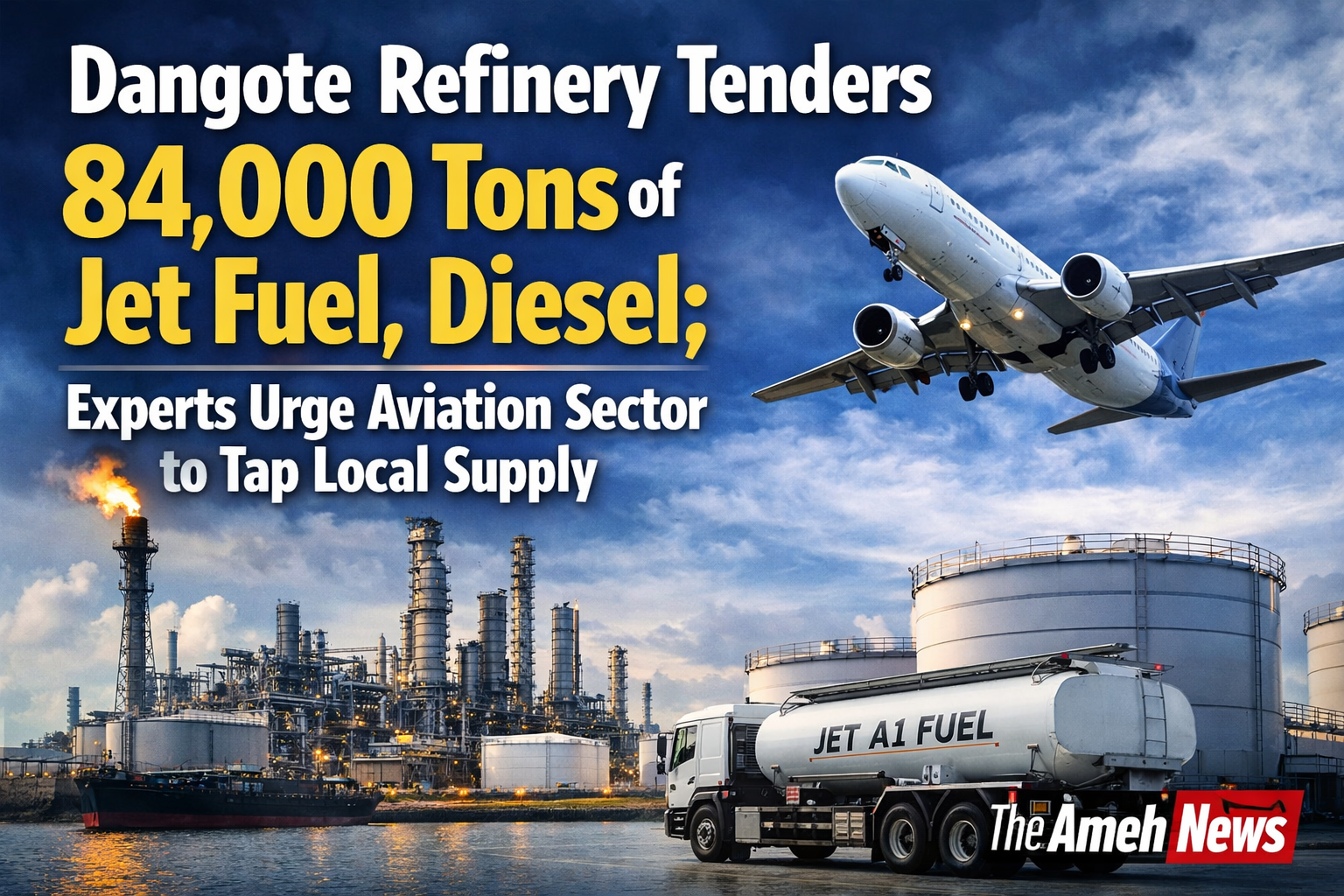
 Nigeria’s refining landscape is undergoing a significant shift as the Dangote Refinery has issued fresh tenders to sell about 84,000 metric tonnes of jet fuel and gasoil for March loading, a development that signals the refinery’s growing operational capacity and increasing presence in both domestic and international fuel markets.
Industry trading sources disclosed that the cargoes include aviation turbine fuel (Jet A1) and diesel, with loading scheduled for March. The move reflects the refinery’s transition from initial production to large-scale commercial output, reinforcing its ambition to become a major supplier of refined petroleum products across Africa.
Located in the Lekki Free Zone in Lagos, the refinery—developed by billionaire industrialist Aliko Dangote—has a 650,000 barrels-per-day processing capacity, making it the largest single-train refinery globally. The facility is expected to play a central role in reducing Nigeria’s long-standing reliance on imported refined fuels.
However, industry stakeholders argue that Nigeria’s aviation ecosystem must be the first beneficiary of the refinery’s jet fuel production before large export volumes are prioritised.
For years, airlines operating in Nigeria have struggled with the volatile pricing and supply constraints of Jet A1, a major cost component that often accounts for over 40 percent of airline operating expenses. Fluctuating aviation fuel prices have contributed to high ticket fares and operational disruptions across the sector.
Economist Celestine Ukpong said the emergence of large-scale local jet fuel production presents an opportunity to stabilise the aviation industry.
“Domestic refining of aviation fuel should fundamentally change the economics of airline operations in Nigeria,” Ukpong explained. “If local airlines gain reliable access to competitively priced Jet A1, it will reduce operational pressure, improve route sustainability, and ultimately make air travel more affordable.”
He noted that prioritising the aviation sector could also strengthen Nigeria’s position as West Africa’s aviation hub, particularly through airports in Lagos and Abuja.
Ukpong added that improved jet fuel availability could stimulate cargo aviation growth, which remains underdeveloped despite Nigeria’s significant agricultural export potential.
Financial analyst and chartered accountant Peter Adebayo, FCA, also stressed that the refinery’s fuel output should support critical sectors of the domestic economy before expanding aggressively into exports.
According to Adebayo, “The aviation sector is strategic to Nigeria’s economic integration. Ensuring steady supply of aviation fuel locally will reduce dependence on imported Jet A1 and protect airlines from global price volatility.”
He explained that beyond airlines, the benefits would extend across the aviation value chain, including ground handlers, cargo operators, airport authorities, and tourism-related businesses.
Nigeria’s aviation industry has repeatedly raised concerns over the high cost and inconsistent availability of aviation fuel, which has forced several airlines to reduce frequencies, suspend routes, or increase fares to remain viable.
Market observers believe the Dangote refinery’s growing production capacity could transform Nigeria’s downstream petroleum sector, potentially positioning the country as a regional exporter of refined products while also stabilising domestic supply chains.
As the refinery ramps up operations, analysts expect more regular tenders for petroleum products, including diesel, jet fuel, and petrol, which could reshape energy trade flows across West Africa.
For Nigeria’s aviation industry, the hope is that the refinery’s output will not only boost exports but also unlock long-awaited stability in the supply of aviation fuel, a key ingredient needed to drive the sector’s growth and competitiveness.
Dangote Refinery offers 84,000 tons of jet fuel and diesel for March loading as experts Celestine Ukpong and Peter Adebayo urge priority supply to Nigeria’s aviation sector to stabilise airline operations and reduce fuel costs.
Discover more from Ameh News
Subscribe to get the latest posts sent to your email.