 The Nigerian Safety Investigation Bureau (NSIB) has urged rail passengers across Nigeria to take the yellow safety line on train platforms seriously, stressing that the simple marking plays a crucial role in preventing accidents and protecting lives.
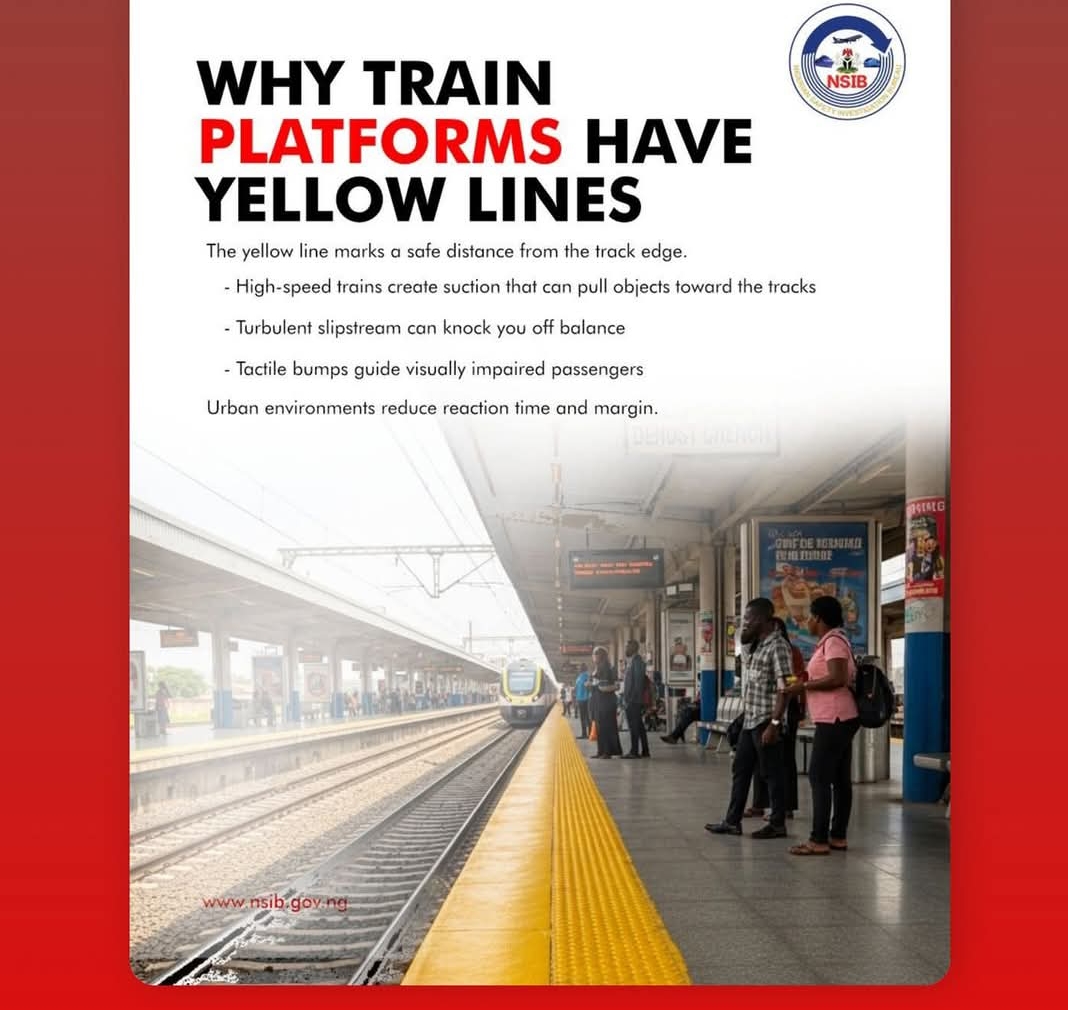
In a public safety advisory, the Bureau explained that the yellow line commonly seen along train platforms is not merely a visual design element but a carefully engineered safety boundary intended to keep passengers at a safe distance from moving trains.
According to the NSIB, modern trains—especially those operating at high speeds—generate powerful aerodynamic forces as they approach and pass through stations. These forces can create a suction effect capable of drawing loose items, clothing, or even people toward the tracks if they stand too close to the platform edge.
Safety experts also warn that the turbulent airflow, known as a slipstream, can destabilize passengers waiting near the track. In crowded urban environments where stations often experience heavy commuter traffic, such sudden air pressure changes can cause individuals to lose balance, potentially leading to dangerous falls onto the tracks. Beyond protecting passengers from aerodynamic hazards, the yellow line also integrates tactile paving—raised bumps embedded along the platform surface. These bumps serve as an essential navigational aid for visually impaired passengers, allowing them to detect the boundary of the safe waiting area through touch.
The NSIB noted that tactile ground surface indicators are widely used in rail systems around the world to ensure accessibility and safety for all passengers, including those with visual disabilities.
“In busy urban transport settings, reaction time is often limited and the margin for error becomes smaller. The yellow line provides a visual and tactile reminder of where passengers should stand while waiting for trains,” the Bureau explained.
As Nigeria continues to expand its rail transport infrastructure—linking cities and strengthening urban mobility—the NSIB emphasized the importance of public awareness and compliance with basic safety measures at stations.
Rail safety analysts say many platform-related accidents globally occur when passengers ignore safety boundaries, attempt to board moving trains, or stand too close to the platform edge.
The Bureau therefore encouraged commuters to adopt a simple rule: always remain behind the yellow line until the train comes to a complete stop and it is safe to board.
According to the NSIB, small safety habits practiced consistently by passengers can significantly reduce avoidable incidents and contribute to a safer rail transport system for everyone.
The Bureau concluded that safety on public transport is a shared responsibility between operators, regulators, and passengers, urging Nigerians to pay attention to station safety markings and follow basic rail safety etiquette.
The Nigerian Safety Investigation Bureau explains why the yellow line on train platforms is a critical safety boundary designed to protect passengers from suction, turbulence, and platform-edge accidents.
Discover more from Ameh News
Subscribe to get the latest posts sent to your email.