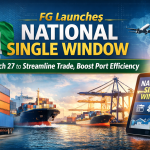
 Nigeria’s maritime sector is entering a transformative phase as the Nigeria Customs Service (NCS) Tin Can Island Command not only surpasses ₦120.4 billion in revenue for February 2026, but also positions itself at the forefront of the anticipated National Single Window (NSW) initiative set to revolutionize trade processes across the country.
The Command recorded a total revenue of ₦120,462,054,345.72 for the month, reflecting a significant increase from the ₦103.6 billion posted in the corresponding period of 2025. The surge highlights a steady trajectory of growth driven by operational efficiency, stricter compliance measures, and renewed stakeholder confidence.
At the centre of this performance is the Customs Area Controller, Frank Onyeka, whose leadership has ushered in a new era of discipline, transparency, and inclusiveness. Since assuming office, Onyeka has implemented targeted reforms aimed at strengthening revenue generation, enhancing compliance levels, and deepening collaboration with importers, freight forwarders, and other port users.
Industry observers note that these reforms are strategically aligned with Nigeria’s planned National Single Window system—a digital trade facilitation platform designed to harmonize and streamline cargo clearance processes among government agencies. The Tin Can Command, under Onyeka, is already laying the groundwork for this transition by digitizing processes, improving inter-agency cooperation, and eliminating bureaucratic bottlenecks.
Onyeka’s administration has prioritized intelligence-led operations and reinforced anti-smuggling mechanisms, effectively blocking revenue leakages while ensuring that legitimate trade is not disrupted. His balanced approach—combining firm enforcement with stakeholder engagement—has fostered a culture of compliance and accountability within the port ecosystem.
One of the most impactful outcomes of these reforms is the significant improvement in cargo clearance timelines at Tin Can Island Port. The Command’s push for 24-hour cargo exit has drastically reduced port congestion, minimized demurrage costs, and improved overall supply chain efficiency.
Stakeholders, including importers and logistics operators, are increasingly routing cargo through Tin Can Island Port, citing faster turnaround times and a more predictable operating environment. This growing preference has led to higher cargo throughput and increased vessel traffic, thereby further boosting revenue performance.
Maritime analysts believe the Command’s success offers a preview of what the National Single Window could achieve on a broader scale. By integrating digital platforms, simplifying documentation, and enhancing transparency, the NSW is expected to reduce trade costs, curb corruption, and improve Nigeria’s ease of doing business ranking.
Onyeka’s emphasis on dialogue and inclusiveness has also played a critical role in this transition. Regular engagement with stakeholders has built trust and ensured that reforms are not only enforced but also understood and embraced by port users.
As Nigeria prepares for the full rollout of the National Single Window, the Tin Can Island Command stands as a model of readiness—demonstrating how strategic leadership, operational discipline and technology-driven reforms can drive both revenue growth and trade facilitation.
With revenue figures on a steady rise and systemic improvements taking root, the Command’s trajectory signals a broader shift in Nigeria’s maritime industry—one that aligns efficiency with innovation and positions the sector as a key pillar of economic sustainability.
Tin Can Island Customs Command surpasses ₦120.4bn revenue, with Frank Onyeka driving reforms ahead of Nigeria’s National Single Window rollout to enhance trade and port efficiency.
Discover more from Ameh News
Subscribe to get the latest posts sent to your email.