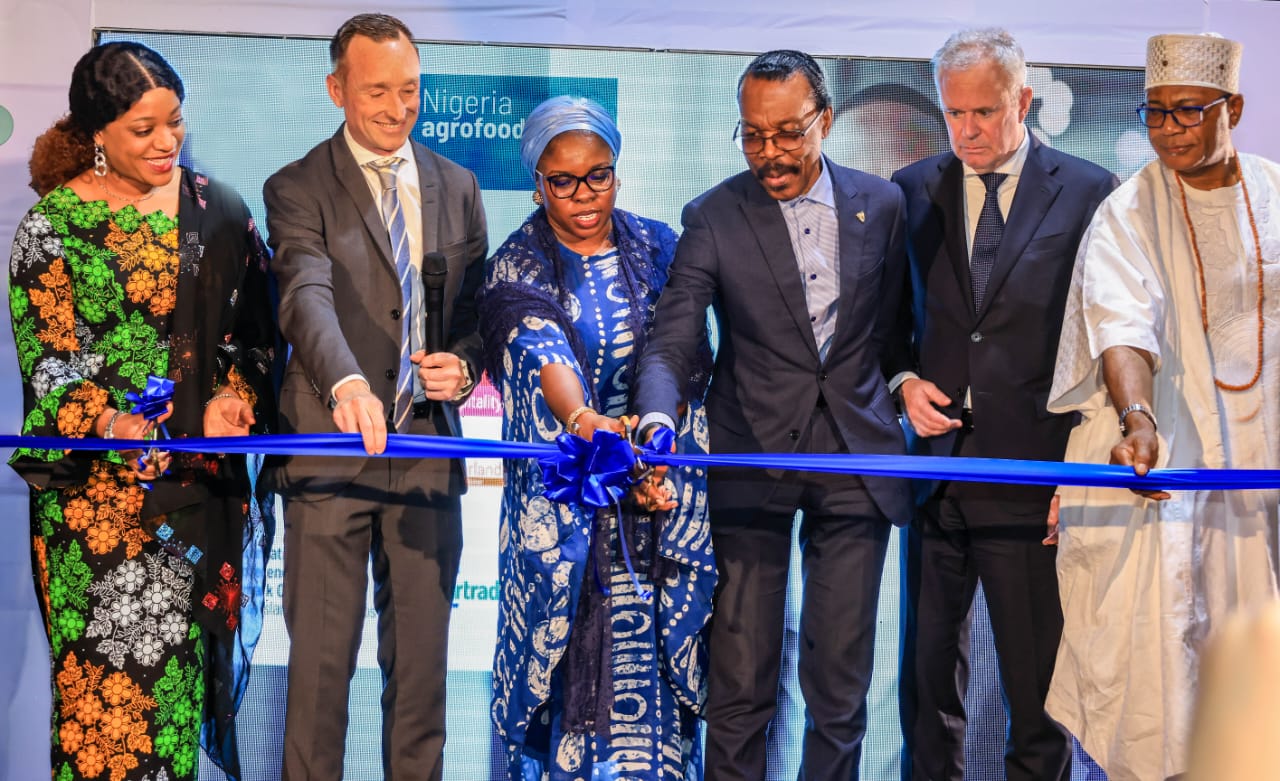
 L-R: First Lady, Akwa Ibom State, H.E Helen Eno-Obareki; Managing Director, fairtrade Messe, Paul Marz; Commissioner for Agriculture and Food Systems, Lagos State, Ms Ruth Abiola Olusanya; Managing Director, Financial Derivatives Company Ltd, Bismarck Rewane; Ambassador, Kingdom of the Netherlands to Nigeria, H.E. Bengt van Loosdrecht and President, Manufacturers’ Association of Nigeria (MAN), Otunba Francis Meshioye, OFR, at the Opening Ceremony of the 11th edition of agrofood Nigeria 2026 Exhibition and Conference, on Tuesday, March 24, 2026, in Lagos.
Nigeria’s agrofood sector has taken centre stage as industry leaders, policymakers, and global investors converge to unlock a projected €222 billion market opportunity, with strong calls for structural reforms to transform the country’s food value chain.
At the 11th edition of Agrofood Nigeria, held in Lagos, stakeholders emphasized that while Nigeria possesses vast agricultural potential, systemic inefficiencies—particularly in post-harvest management, logistics, and processing—continue to limit the sector’s global competitiveness.
The international exhibition and conference, organised by fairtrade Messe GmbH in collaboration with Modion Communications which was Rebranded As Creato Urban, Signals Strong Global Ambitions, featured 137 exhibitors across agriculture, food processing, packaging, ingredients, and hospitality. Participants from 15 countries and four continents showcased innovations aimed at strengthening Nigeria’s agro-industrial ecosystem.
With the theme “Achieving World-Class Food Security in Nigeria,” discussions at the event focused on repositioning agriculture as a driver of economic diversification, industrial growth, and export expansion.
Representing Lagos State Governor Babajide Olusola Sanwo-Olu, the Commissioner for Agriculture and Food Systems, Ruth Abiola Olusanya, highlighted Lagos’ strategic role as Africa’s largest food consumption hub.
She disclosed that the state’s food economy has surged from ₦6.5 trillion in 2019 to over ₦16 trillion, underscoring its dominance in regional food trade. “Lagos alone accounts for more than half of all food traded in the South-West and contributes about 22 per cent to Nigeria’s GDP,” she said, adding that the state’s economy is projected to reach ₦66 trillion.
According to her, Lagos presents a critical gateway for investors in agro-processing, cold chain logistics, packaging, and food technology seeking access to structured and high-demand markets across Africa.
Delivering a keynote address, renowned economist Bismarck Rewane of Financial Derivatives Company warned that global geopolitical tensions—particularly conflicts in the Middle East—could exacerbate food inflation and supply chain disruptions in Nigeria.
He cautioned that Nigerians must brace for potential shocks in food prices driven by external economic pressures, highlighting the vulnerability of the country’s food system to global events.
A critical issue raised at the conference was the staggering level of post-harvest losses. President of the Organization for Technology Advancement of Cold Chain in West Africa, Alexander Isong, described Nigeria’s cold chain infrastructure as grossly underdeveloped.
He revealed that Nigeria loses between ₦3.5 trillion and ₦5 trillion annually—equivalent to 30 to 40 million metric tonnes of food—due to inadequate storage, transportation, and preservation systems. “The real challenge is no longer production but what happens after harvest,” he noted, adding that over 97 per cent of Nigeria’s agricultural exports are shipped in raw, unprocessed form.
This, stakeholders argue, represents a missed opportunity for value addition, job creation, and foreign exchange earnings.
On the global front, President of the Manufacturers Association of Nigeria, Francis Meshioye, drew attention to worsening food insecurity, citing figures from the World Food Programme showing that approximately 733 million people faced hunger in 2023, with Africa bearing the brunt.
He stressed the need for Nigeria to strengthen its agro-industrial base to mitigate external shocks and improve food availability.
Also speaking, the National President of the Nigerian Association of Chambers of Commerce Industry Mines and Agriculture, Jani Ibrahim, expressed optimism that Nigeria can achieve world-class food security. However, he emphasized that success will depend on sustained investments, policy consistency, and strong collaboration between government and private sector players.
The event also witnessed strong international participation, with exhibitors and delegations from Germany, the Netherlands, China, the United States of America, the United Arab Emirates, and others, reflecting growing global interest in Nigeria’s agrofood market.
As Agrofood Nigeria 2026 wraps up, the consensus among stakeholders is clear: Nigeria stands on the brink of a massive agrofood expansion, but unlocking its €222 billion potential will require urgent and coordinated action to modernize the entire value chain—from farm to market.
Without such reforms, experts warn, the country risks continuing massive food losses, limited export value, and missed economic opportunities in one of its most critical sectors.
Agrofood Nigeria 2026 highlights a €222bn market opportunity, with experts urging urgent reforms in Nigeria’s food value chain to tackle losses, boost processing, and achieve food security.
Industry leaders at Agrofood Nigeria 2026 call for value chain transformation as Nigeria’s agrofood market is projected to hit €222bn, highlighting investment opportunities and food security challenges.
Discover more from Ameh News
Subscribe to get the latest posts sent to your email.