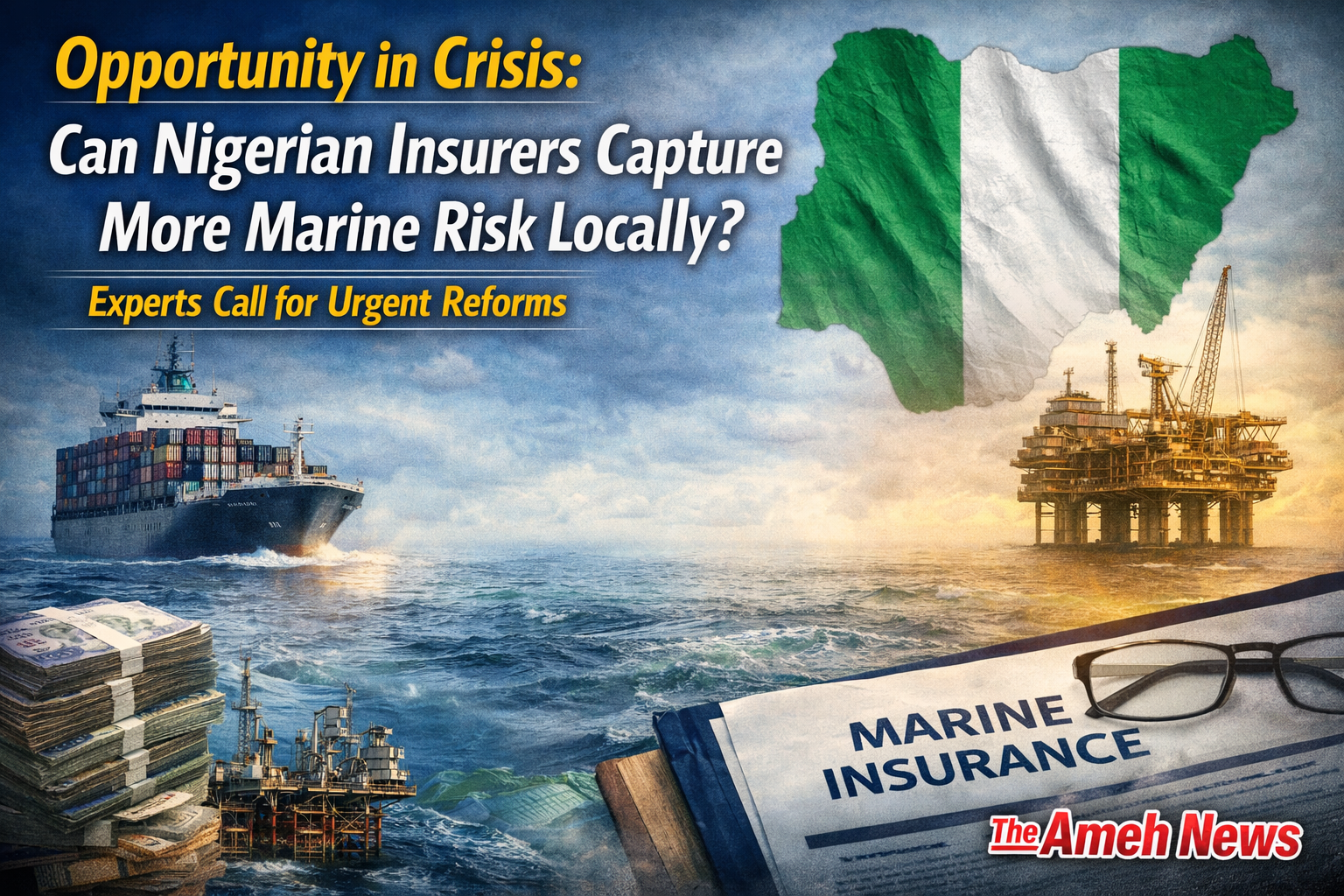
 Amid rising global shipping uncertainties and escalating marine insurance costs, industry stakeholders are urging Nigeria to seize a strategic opportunity—retain more marine insurance business locally and stem the tide of capital flight draining the economy.
Recurring geopolitical tensions around critical trade routes such as the Strait of Hormuz have heightened risk exposure for cargo movement worldwide. For Nigeria, a major importer and exporter within global maritime trade, the implications go beyond higher freight costs—they strike at the heart of insurance economics.
For decades, high-value marine risks tied to crude oil exports, LNG shipments, and large-scale imports have been largely underwritten offshore. This has resulted in billions of naira in premiums flowing out of the country annually, despite the presence of a growing domestic insurance sector, which is regulated by the National Insurance Commission (NAICOM).
Now, experts say it is time for a decisive shift.
Capital Flight and Lost Value
Economist Celestine Ukpong describes the current structure as “an economic paradox,” where Nigeria generates significant maritime activity but captures minimal insurance value.
According to him, “Marine insurance is a high-value segment that should ordinarily deepen Nigeria’s financial markets. Instead, we are exporting premiums and importing expertise. This weakens the local industry and limits its contribution to GDP.”
Ukpong argues that retaining even a fraction of these premiums domestically would strengthen insurers’ balance sheets, improve liquidity, and enable long-term investments in underwriting capacity.
Local Content: Lessons from Oil and Gas
Stakeholders are drawing parallels with Nigeria’s oil and gas sector, where local participation surged following reforms championed by the Nigerian Content Development and Monitoring Board (NCDMB).
The success of local content policies in that sector, analysts say, provides a blueprint for marine insurance.
Ukpong adds, “We have seen what deliberate policy enforcement can achieve in oil and gas. There is no reason marine insurance cannot replicate that success if the government is intentional.”
Strategic Communication and Industry Perception
For Dr. Ejike Nduilo, a public relations and strategic communications specialist, the challenge is not just structural—but perceptual.
“Global partners often perceive Nigerian insurers as lacking capacity, even when that is no longer entirely accurate,” Nduilo explains. “What is missing is a coordinated communication strategy that projects competence, builds trust, and showcases successful underwriting cases.”
He emphasizes that repositioning the Nigerian Insurance Industry requires deliberate storytelling, transparency in claims management, and stronger engagement with international stakeholders.
“Confidence drives capital. If you don’t tell your story, the market will assume the worst,” he adds.
Financial Prudence and Risk Retention
From a financial standpoint, Peter Adebayo, FCA, believes Nigerian insurers must strike a balance between ambition and prudence.
“Retaining more marine risk locally is desirable, but it must be backed by adequate capitalization and sound reinsurance arrangements,” Adebayo notes. “The danger is overexposure without the financial buffers to absorb large claims.”
He advocates for industry-wide collaboration, including risk pooling mechanisms and stronger partnerships with global reinsurers, to gradually increase local retention capacity.
According to him, “This is not about shutting out foreign players—it’s about negotiating from a position of strength.”
Policy Reforms Take Center Stage
Analysts agree that without firm regulatory enforcement, the push for local content in marine insurance may remain aspirational.
Key reforms being proposed include:
Mandatory local underwriting of Nigeria-bound cargoes,
Strengthening capital requirements for insurers,
Incentivizing reinsurance partnerships,
Enforcing compliance with existing insurance laws.
NAICOM, as the industry regulator, is expected to play a central role in driving these reforms and ensuring compliance across the value chain.
Turning Crisis into Opportunity
Rising global risks have made international insurers more cautious, with stricter underwriting conditions and higher premiums for high-risk routes. This shift, experts say, presents a window for Nigerian insurers to step in with localized expertise and competitive offerings.
With proximity to ports, better understanding of regional risks, and improving technical capabilities, domestic insurers are well-positioned to take on a greater share of marine underwriting—if supported by policy and capital.
A Defining Moment
As global uncertainty reshapes trade and insurance dynamics, Nigeria faces a pivotal moment. The choice is clear: continue ceding value to foreign markets or build a resilient domestic marine insurance ecosystem that supports economic growth.
For Ukpong, Nduilo, and Adebayo, the answer lies in urgency, coordination, and bold policy action.
“This is not just an insurance issue,” Ukpong concludes. “It is about economic sovereignty. The opportunity is here—Nigeria must decide whether to take it.”
Nigeria’s marine insurance sector faces a turning point as experts urge reforms to boost local underwriting, reduce capital flight, and leverage global shipping disruptions as a growth opportunity.
Furthermore, experts call for urgent reforms to help Nigerian insurers retain more marine risk locally, reduce capital flight, and capitalize on rising global shipping uncertainties.
Discover more from Ameh News
Subscribe to get the latest posts sent to your email.