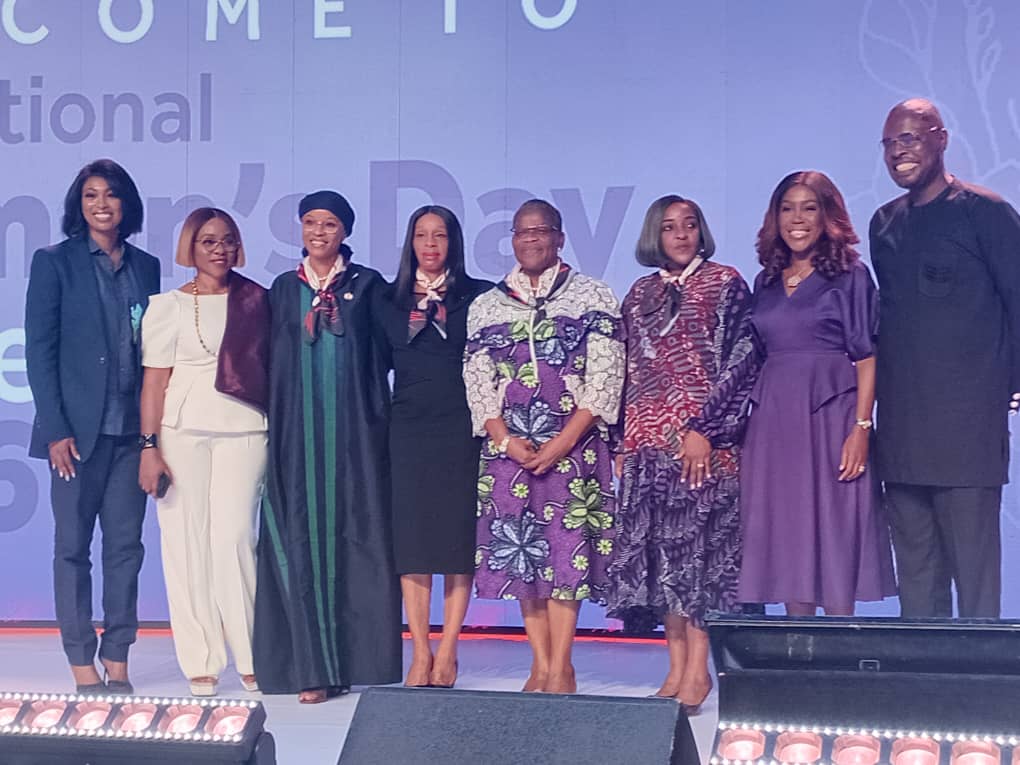
 Momentum for women’s economic inclusion took centre stage at the International Women’s Day 2026 conference in Lagos, as the Federal Government and Access Bank Plc unveiled renewed strategies to empower women as catalysts of Nigeria’s creative economy.
The high-level gathering, which drew more than 5,000 participants across physical and virtual platforms, brought together policymakers, financial institutions, development partners, and entrepreneurs to address the structural barriers that limit women’s economic advancement.
Delivering the keynote address, the Minister of Art, Culture, Tourism, and the Creative Economy, Hannatu Musa Musawa, reaffirmed the Federal Government’s commitment to unlocking the full potential of women in the creative sector.
Represented by the Director-General of the Centre for Black and African Arts and Civilisation (CBAAC), Mrs. Aisha Adamu, the minister described women as “central drivers of innovation, enterprise, and cultural preservation.”
She identified culture, capital, and courage as the defining pillars required to reposition women within Nigeria’s economic landscape.
According to her, the government is actively transforming the cultural and creative industries into structured economic drivers through investments in creative hubs, enterprise support schemes, and specialized skills development programs targeting women in film, fashion, digital media, and tourism.
“Across Nigeria, women have always been the invisible architects of our culture, yet their contributions have been underrepresented and undervalued,” she said.
Bridging the Financing Gap
A major highlight of the discussions was the persistent financing gap facing women-led businesses.
Musawa disclosed that although women own about 40 per cent of Nigeria’s small and medium enterprises (SMEs), access to finance remains a significant barrier to scaling their ventures.
“Too many ideas remain small not because they lack potential, but because they lack access to capital,” she stated.
To address this, the Federal Government is working on targeted interventions to unlock funding opportunities, strengthen market access, and improve gender-disaggregated data systems, while also promoting women’s participation in leadership and policy formulation.
Access Bank’s Strategic Investment in Women
On the private sector front, Chairman of Access Bank Plc, Mrs. Ifeyinwa Osime, emphasised that empowering women must be viewed as a strategic economic priority rather than a philanthropic gesture.
She highlighted the significant role women already play in Nigeria’s economy—owning nearly 39 per cent of businesses and driving close to 40 per cent of new enterprises.
With SMEs contributing about 48 per cent to Nigeria’s Gross Domestic Product (GDP) and accounting for over 80 per cent of employment, Osime warned that underinvestment in women directly undermines national growth.
“No economy can optimise its potential while underinvesting in half of its population,” she said.
She pointed to the bank’s flagship initiatives, including the W Initiative and Womenpreneur Pitch-a-ton programme, which have delivered access to finance, capacity-building opportunities, mentorship, and healthcare support to thousands of women entrepreneurs across the country.
Ezekwesili: Prioritise Women for Real Transformation
Providing a strong policy and advocacy perspective, former Minister of Education, Oby Ezekwesili, called for deliberate prioritisation of women’s inclusion in national development strategies.
She argued that societies only achieve meaningful transformation when critical issues are treated with urgency and consistency.
“There is no other way societies have transformed than when people who care make an issue a priority,” she said.
Ezekwesili stressed that eliminating structural barriers—particularly in access to finance, inputs, and opportunities—could unlock enormous economic value.
She cited agriculture as a key example, noting that productivity could rise by as much as 30 per cent if women had equal access to resources as men.
She also commended Access Bank’s holistic approach to women’s empowerment, describing it as critical to scaling businesses and improving livelihoods.
In her advisory to women, she emphasised continuous learning, strategic partnerships, and proactive engagement with financial opportunities, while underscoring the importance of shared values.
“Values are our internal currencies,” she added.

Further reinforcing the bank’s commitment, Mrs. Nene Kunle-Ogunlusi, Group Head, Women Banking at Access Bank Plc, highlighted recent grassroots initiatives aimed at expanding inclusion.
She referenced a Women’s Day outreach programme in Oyingbo, Lagos, where market women benefitted from free medical checks, financial literacy training, and empowerment services.
According to her, such interventions are designed to ensure that empowerment efforts extend beyond corporate spaces to reach underserved communities.
Call for Sustained Collaboration
Stakeholders at the conference unanimously called for stronger collaboration between government institutions and the private sector to scale impact.
They emphasised that bridging the gender gap in access to finance, markets, and leadership opportunities is essential for driving inclusive economic growth and long-term national prosperity.
The Big Picture
As Nigeria seeks to diversify its economy and strengthen non-oil sectors, the creative industry presents a significant opportunity for growth, job creation, and global competitiveness.
With women at the centre of this transformation, the combined efforts of the Federal Government and financial institutions signal a shift towards a more inclusive and sustainable economic future.
Women empowerment Nigeria, creative economy Nigeria, Access Bank women initiative, Hannatu Musawa, Oby Ezekwesili, women SMEs Nigeria, gender inclusion Nigeria economy
The Federal Government and Access Bank reaffirm their commitment to women’s empowerment in Nigeria’s creative economy, focusing on finance, skills development, and inclusive growth opportunities.
Discover more from Ameh News
Subscribe to get the latest posts sent to your email.