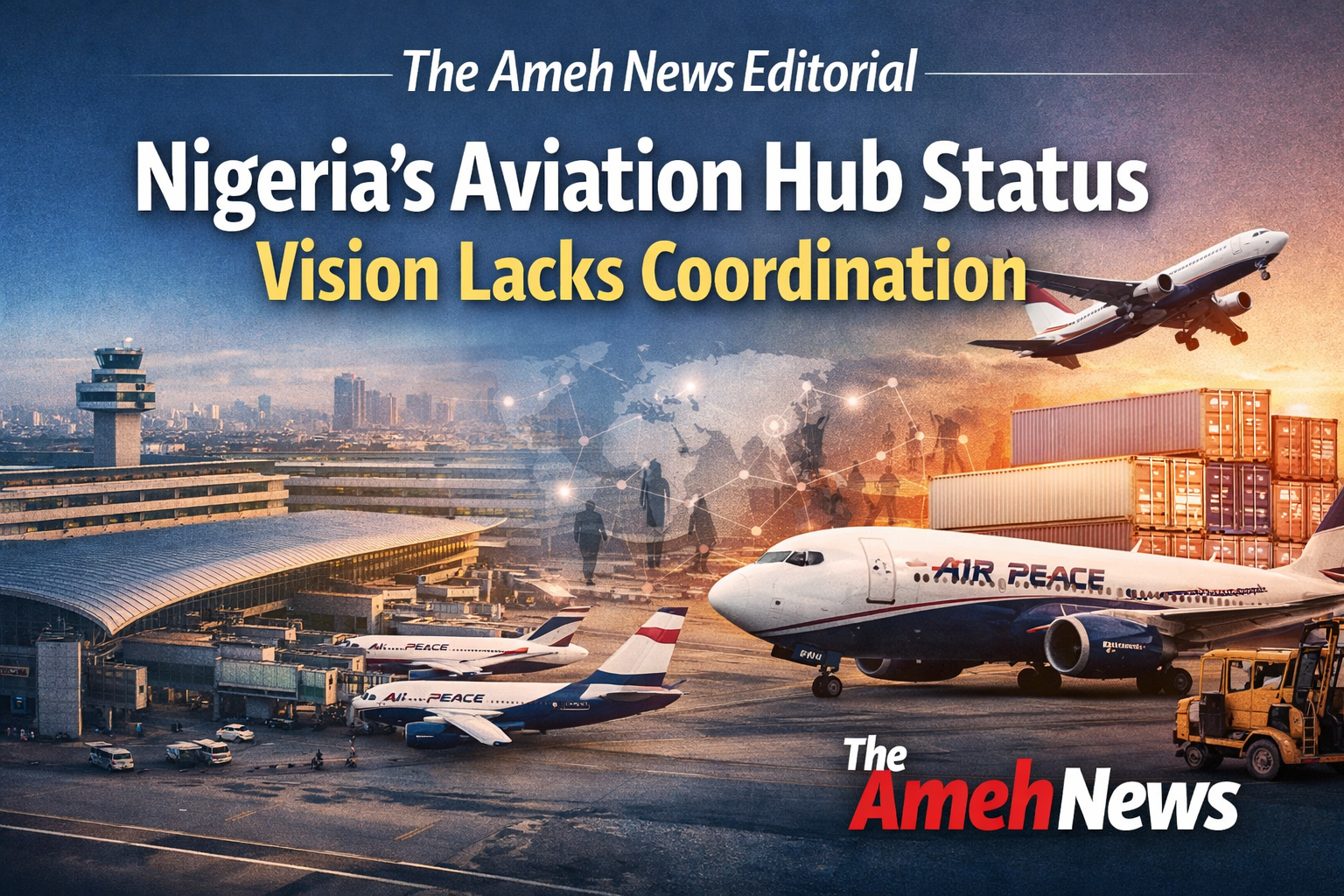
 Nigeria’s aspiration to become West Africa’s aviation hub is both legitimate and long overdue. With its population size, geographic advantage, and economic weight, the country should naturally function as the region’s primary gateway. Yet, despite years of policy pronouncements and infrastructure upgrades, the vision remains largely unrealised—not for lack of potential, but for lack of structure, coordination, and strategic clarity.
From The Ameh News Editorial standpoint, the aviation hub conversation in Nigeria has been over-simplified and under-executed. Too often, it is framed around airport expansion projects, rather than the deeper institutional and economic reforms required to build a true hub ecosystem.
Infrastructure Is Not a Strategy
Flagship facilities such as Murtala Muhammed International Airport, Lagos and Nnamdi Azikiwe International Airport, Abuja are frequently cited as evidence of progress. But modern terminals alone do not create aviation hubs. Globally, hubs are defined by efficient connectivity, seamless passenger transfers, airline concentration, and integrated logistics systems.
The Ameh News Editorial view is clear: Nigeria risks mistaking physical upgrades for systemic transformation. Without aligning infrastructure with policy, operations, and market strategy, these investments will continue to deliver suboptimal returns.
Aviation Without Coordination: The Core Structural Flaw
One of the most critical weaknesses lies in institutional fragmentation. Aviation policy in Nigeria operates in silos, with limited synergy between regulators, immigration authorities, trade institutions, and investment agencies.
While the Nigerian Civil Aviation Authority plays a central regulatory role, regulation alone cannot drive hub development. What is required is a whole-of-government approach, where aviation is deliberately positioned as a catalyst for trade, tourism, and economic diversification.
The Ameh News editorial position is that Nigeria does not lack policies—it lacks coordination and disciplined execution.
The Airline Deficit: A Hub Cannot Exist Without a Champion Carrier
Aviation history offers a consistent lesson: every successful hub is anchored by at least one dominant home carrier. Ethiopia has one. The Gulf states have several. Nigeria, however, is still searching.
Carriers like Air Peace have demonstrated ambition and resilience, expanding into regional and intercontinental routes. But the absence of a well-capitalised, globally competitive national or flag carrier equivalent continues to limit Nigeria’s ability to control traffic flows.
The implication is profound—without strong local airlines feeding and distributing traffic, Nigeria effectively exports its hub potential to foreign carriers and competing destinations.
Policy Contradictions: When Systems Work Against Strategy
The ambition to become an aviation hub is fundamentally incompatible with restrictive visa regimes, high operating costs, and regulatory bottlenecks.
Transit passengers—the lifeblood of any hub—require ease, speed, and predictability. Yet Nigeria’s visa processes remain cumbersome, discouraging the very traffic it seeks to attract. Similarly, the high cost of aviation fuel, forex instability, and multiple taxation layers create an environment where airlines struggle to operate sustainably.
From The Ameh News Editorial perspective, this represents a policy contradiction: a nation cannot aspire to hub status while maintaining barriers that discourage connectivity.
Cargo: Nigeria’s Underestimated Strategic Advantage
While passenger traffic dominates public discourse, cargo presents Nigeria’s most immediate and realistic pathway to hub relevance. With a large agricultural base, a growing manufacturing sector, and increasing demand for e-commerce logistics, Nigeria is well-positioned to become a regional cargo powerhouse.
However, this opportunity remains underdeveloped due to weak cold-chain infrastructure, inefficient cargo handling systems, and poor export coordination.
The Ameh News Editorial argues that cargo aviation should be elevated to a national priority, not treated as a secondary component of the aviation sector.
Beyond Airports: The Missing Ecosystem
Aviation hubs thrive on ecosystems, not isolated assets. Poor road access, inadequate rail links, and inefficient passenger processing systems continue to undermine Nigeria’s competitiveness.
A passenger arriving in Lagos or Abuja should experience seamless connectivity from air to ground transport. Instead, the current reality often involves delays, congestion, and inefficiencies that erode the overall travel experience.
This, in The Ameh News Editorial view, highlights a broader issue: Nigeria is building airports without building systems.
Regional Reality: The Cost of Delay
Across Africa, the race for aviation hub dominance is accelerating. Countries like Ethiopia, Morocco, and even Ghana are implementing deliberate strategies to capture transit traffic and position themselves as regional gateways.
Nigeria’s delay is not neutral—it carries opportunity costs. Every year of inaction strengthens competitors and weakens Nigeria’s relative position.
The Economic Imperative
The stakes extend far beyond aviation. A functional hub would:
Boost tourism inflows
Enhance trade and export capacity
Create thousands of direct and indirect jobs
Improve foreign exchange earnings
Strengthen Nigeria’s global economic integration
Yet these benefits will remain theoretical without deliberate and coordinated action.
The Ameh News Editorial Position: From Rhetoric to Results
The path forward is clear, but it requires political will and strategic discipline. Nigeria must:
Establish a coordinated national aviation hub framework
Strengthen and financially support domestic airlines
Reform visa and immigration systems to enable transit traffic
Reduce operational costs and eliminate multiple taxation
Prioritise cargo infrastructure and export logistics
Integrate aviation planning with transport, trade, and economic policy
A Defining Test of Economic Leadership
Nigeria’s aviation hub ambition is not misplaced—it is essential. But ambition alone will not deliver results.
From The Ameh News editorial lens, the challenge is not whether Nigeria can become a hub, but whether it can transition from fragmented ambition to coordinated execution.
Until that shift occurs, the country risks remaining a high-potential market that others continue to leverage—while its own gateway aspirations remain grounded.
Discover more from Ameh News
Subscribe to get the latest posts sent to your email.