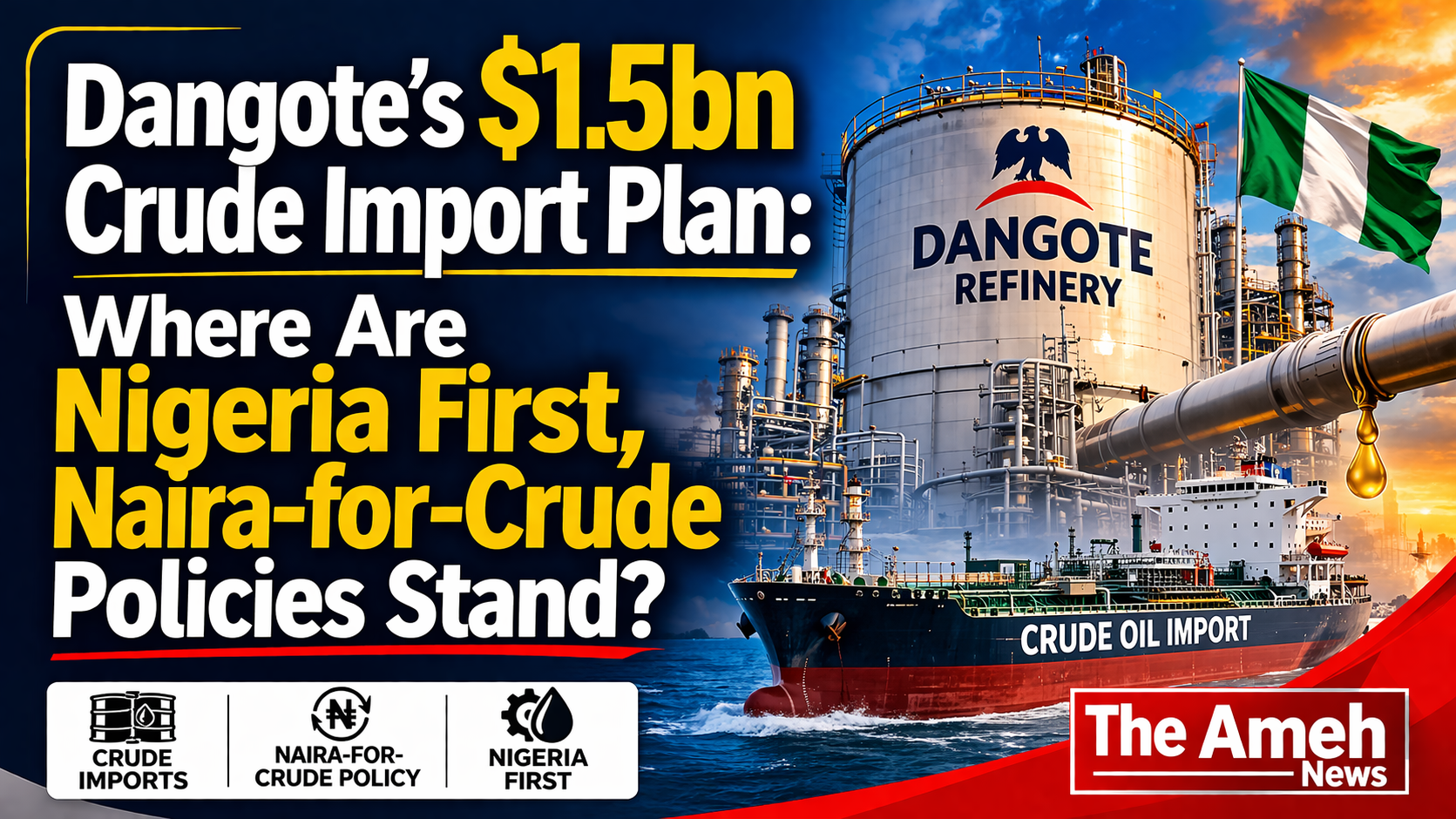
 Nigeria’s ambition to achieve energy self-sufficiency is facing renewed strain as the Dangote Petroleum Refinery moves to import 13.62 million barrels of crude oil for May 2026, despite the Federal Government’s much-publicised, “naira-for-crude & Nigeria First” policies
The development, which represents about 139.5 per cent of the refinery’s estimated 19 million barrels requirement for the month, has triggered fresh concerns among economists and industry analysts over the sustainability of Nigeria’s domestic crude supply framework.
Available data shows that the Federal Government is expected to supply only 6.15 million barrels to the 650,000 barrels-per-day facility, leaving a significant shortfall that must be covered through imports.
At an average price of $110 per barrel, the refinery’s import bill is projected at $1.498 billion—approximately N2.07 trillion at the prevailing exchange rate—raising fears of renewed pressure on Nigeria’s foreign exchange reserves and the naira.
Stakeholders warn that the reliance on imported crude could keep petrol prices elevated, with Premium Motor Spirit (PMS) likely to remain above N1,300 per litre, further squeezing households and businesses.
A senior member of the Petroleum Products Retail Outlets Owners Association of Nigeria, cautioned that price volatility is inevitable under the current conditions.
“Speculation and price hikes in refined petroleum products will become inevitable. Once prices rise, transportation costs will increase, and this will cascade into higher food prices and general inflation,” he said.
Similarly, Mazi Colman Obasi, President of the Oil and Gas Service Providers Association of Nigeria, argued that crude importation aligns with the refinery’s commercial model.
“Dangote Refinery was not built to depend solely on Nigerian crude. If it imports crude, it must also export refined products to remain viable. While exports may support foreign exchange inflows, they may not directly improve the welfare of average Nigerians,” he noted.
Experts Raise Broader Economic Concerns
Economist Celestine Ukpong described the situation as a “structural contradiction,” noting that Nigeria’s position as a major crude producer should naturally support its domestic refining capacity.
According to Ukpong, “The continued importation of crude at this scale reflects deeper inefficiencies in upstream production and allocation. It puts pressure on the naira, widens the trade deficit, and undermines the intended benefits of the naira-for-crude policy.”
He added that unless Nigeria significantly boosts crude output and improves supply coordination, the country risks remaining trapped in a cycle of import dependence despite its vast oil resources.
On his part, Dr Ejike Nduilo, a public relations expert and founder of Henryjvaleens, emphasised the reputational and policy perception risks associated with the development.
“This sends mixed signals to both local and international investors. On one hand, the government promotes local capacity and self-reliance; on the other, the largest refinery still depends heavily on imports. Strategic communication and policy clarity are critical to maintaining investor confidence,” he said.
Nduilo further stressed that the narrative must shift toward transparency in crude allocation and measurable milestones for reducing import dependence.
Financial analyst Peter Adebayo, FCA, highlighted the fiscal implications, warning that the scale of imports could significantly impact Nigeria’s macroeconomic stability.
“Importing crude at international prices means higher input costs, tighter refining margins, and ultimately higher fuel prices. It also increases demand for foreign exchange, which could weaken the naira further and strain external reserves,” Adebayo explained.
He added that the trend could complicate government efforts to stabilise inflation and achieve fiscal balance, particularly in a fragile economic environment.
A Paradox in Africa’s Largest Oil Producer
The CEO of the upcoming local refinery, described the development as paradoxical, pointing out that Nigeria’s status as a leading crude oil producer contrasts sharply with its dependence on imported feedstock.
He called for stronger collaboration with NNPC Limited, improved upstream investment, and enhanced security in oil-producing regions to boost output.

Industry insiders also warn that imported crude exposes the refinery to global market volatility, shipping disruptions, and geopolitical risks, all of which could further inflate costs and complicate planning.
Missed Targets, Lingering Doubts
The Federal Government has repeatedly pledged to increase crude supply to domestic refineries, but past performance raises concerns.
In 2025, the Nigerian Upstream Petroleum Regulatory Commission set a target of supplying 770,500 barrels per day to local refineries—about 37 per cent of projected national output—but failed to fully meet the goal.
The shortfall has continued to cast doubt on the effectiveness of supply-side interventions.
Presidency Defends Policy Amid Global Disruptions
Despite these challenges, the Presidency maintains that the naira-for-crude initiative has strengthened Nigeria’s resilience in the face of global energy shocks.
Officials argue that disruptions linked to geopolitical tensions have driven up global oil prices, but Nigeria has been relatively shielded due to increased local refining capacity.
They also highlight the role of the Dangote Refinery in stabilising product supply, eliminating fuel queues, and moderating price increases, including a recent reduction in petrol prices despite rising crude costs.
Nigeria’s First Policy Faces Reality Test
The situation has also brought renewed scrutiny to the “Nigeria First” policy approved by President Bola Ahmed Tinubu, which mandates government agencies to prioritise locally produced goods and reduce import dependence.
While the policy aims to strengthen domestic industry and create jobs, the continued reliance on imported crude by the country’s flagship refinery underscores the structural challenges facing Nigeria’s oil and gas sector. Stakeholders noted that Despite ongoing policy efforts to prioritise domestic utilisation of crude oil, fresh insights indicate that Nigeria continues to export significant volumes of crude even as local refineries struggle with supply shortfalls. According to the report, the Federal Government has been unable to fully meet crude supply quotas to the Dangote Petroleum Refinery, forcing the facility to plan large-scale imports to bridge the gap. This development highlights a growing contradiction within Nigeria’s energy policy framework. While the “Nigeria First” initiative and the naira-for-crude arrangement were designed to strengthen local refining and reduce import dependence, current realities suggest otherwise. Industry observers note that the government’s continued crude exports, alongside its inability to meet domestic refinery obligations, risk undermining these flagship policies. The situation has effectively left the Dangote refinery—Africa’s largest refining project—with no option but to source crude externally to sustain operations. As of early 2026, Nigeria remains one of Africa’s leading crude exporters, with production averaging about 1.53 million barrels per day (bpd) in January. However, analysts argue that without a deliberate rebalancing of crude allocation between exports and domestic refining, the country may struggle to fully realise the benefits of local refining capacity. The evolving landscape, they add, reflects a gradual shift toward increased domestic refining and regional product exports—but one that is still constrained by structural inefficiencies, supply bottlenecks, and policy implementation gaps.
Analysts agree that bridging the gap between policy ambition and operational reality will require urgent reforms in upstream production, improved supply chain coordination, and sustained investment in the sector.
Until then, Nigeria’s energy security aspirations may remain vulnerable to the very global forces it seeks to insulate itself from.
Dangote Refinery plans to import $1.5bn worth of crude oil in May despite the naira-for-crude policy, raising concerns over fuel prices, forex pressure, and Nigeria’s energy security.
In a nutshell, the $1.5bn crude import plan exposes supply gaps in Nigeria’s oil sector as experts warn of sustained high petrol prices, forex strain, and policy contradictions.
Discover more from Ameh News
Subscribe to get the latest posts sent to your email.