 A renewed wave of investor attention has trailed the latest regulatory disclosures of Zenith Bank Plc following a significant rise in insider shareholdings by top executives and directors between December 2024 and December 2025.
The filings, which show consistent accumulation across board and management levels, have been interpreted by analysts as a strong signal of internal confidence in the bank’s long-term earnings outlook—while also igniting broader market debate around what some investors describe as a “green line” opportunity for value positioning.
At the centre of the trend is Chairman Jim Ovia, who increased his holdings from about 3.55 billion shares to 4.14 billion shares within the review period. Group Managing Director and CEO, Dame Dr Adaora Umeoji, also recorded a sharp rise in her stake, moving from roughly 90 million shares to over 285 million shares—an increase of more than 300% in one year.
Other executive directors followed the same pattern of accumulation, including Dr Henry Oroh, Dr Adobi Nwapa, Mr Akindele Ogunranti, Mr Lawani Adamu, and Mr Louis Odom, all of whom significantly expanded their shareholdings during the period under review.
Collectively, the disclosures point to a consistent trend of insider buying rather than profit-taking—an indicator often monitored closely by institutional investors seeking clues about internal sentiment within publicly listed companies.
Expert Reactions
The development has drawn reactions from financial and governance experts, who offered differing perspectives on what the sustained insider accumulation could signal for the market.
Economist Celestine Ukpong described the pattern as a “notable confidence indicator,” explaining that when multiple layers of a bank’s leadership increase their equity exposure simultaneously, it often reflects strong expectations of future earnings stability.
According to him, while insider buying does not eliminate market risks, it can serve as a “psychological anchor” for investors assessing long-term value in a volatile macroeconomic environment.
Dr Ejike Nduilo, PR strategist and founder of Henryjvaleens, highlighted the reputational impact of the disclosure, noting that sustained insider accumulation strengthens public perception of alignment between management and shareholders.
He stated that such moves often reinforce trust in corporate governance, particularly in the financial services sector, where investor confidence is closely tied to leadership credibility and transparency.
Chartered Accountant and financial analyst Peter Adebayo (FCA) offered a more technical perspective, describing the trend as a “material insider confidence signal” that investors typically interpret through the lens of earnings visibility and dividend sustainability.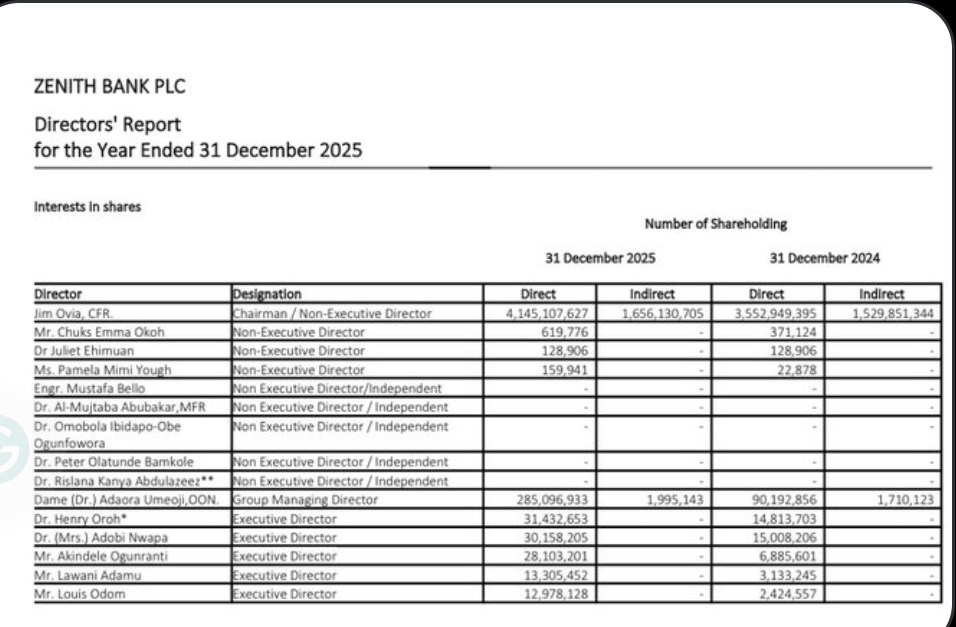
However, he cautioned that while insider accumulation is encouraging, it should be weighed alongside broader valuation metrics, interest rate direction, and sector-wide performance trends before drawing firm investment conclusions.
The “Green Line” Narrative
Market commentators have increasingly referred to sustained insider accumulation as a “green line” indicator—suggesting a zone where informed stakeholders continue to build positions rather than exit.
In the case of Zenith Bank, this narrative has gained traction among retail and institutional investors who view the pattern as a potential signal of undervaluation or long-term upside potential, especially within Nigeria’s evolving equity market landscape.
The banking sector remains a key anchor of the Nigerian Exchange, attracting attention amid inflationary pressures, currency adjustments, and shifting investor sentiment. Against this backdrop, insider buying trends are often scrutinised as supplementary signals to broader fundamental analysis.
Still, experts emphasise that such indicators should not be used in isolation, urging investors to maintain diversified portfolios and adopt disciplined risk management strategies.
While the latest disclosures from Zenith Bank reflect strong internal accumulation by top executives, analysts agree that the broader significance lies in how the market interprets the alignment between leadership confidence and shareholder expectations.
As investor discussions around the “green line” opportunity continue to grow, the development further cements insider activity as a key lens through which market sentiment in Nigeria’s banking sector is increasingly evaluated.
Zenith Bank Plc directors, including Jim Ovia and Adaora Umeoji, significantly increased their shareholdings between 2024 and 2025. Experts Celestine Ukpong, Dr Ejike Nduilo, and Peter Adebayo (FCA) weigh in on insider buying and its “green line” investment implications.
Discover more from Ameh News
Subscribe to get the latest posts sent to your email.