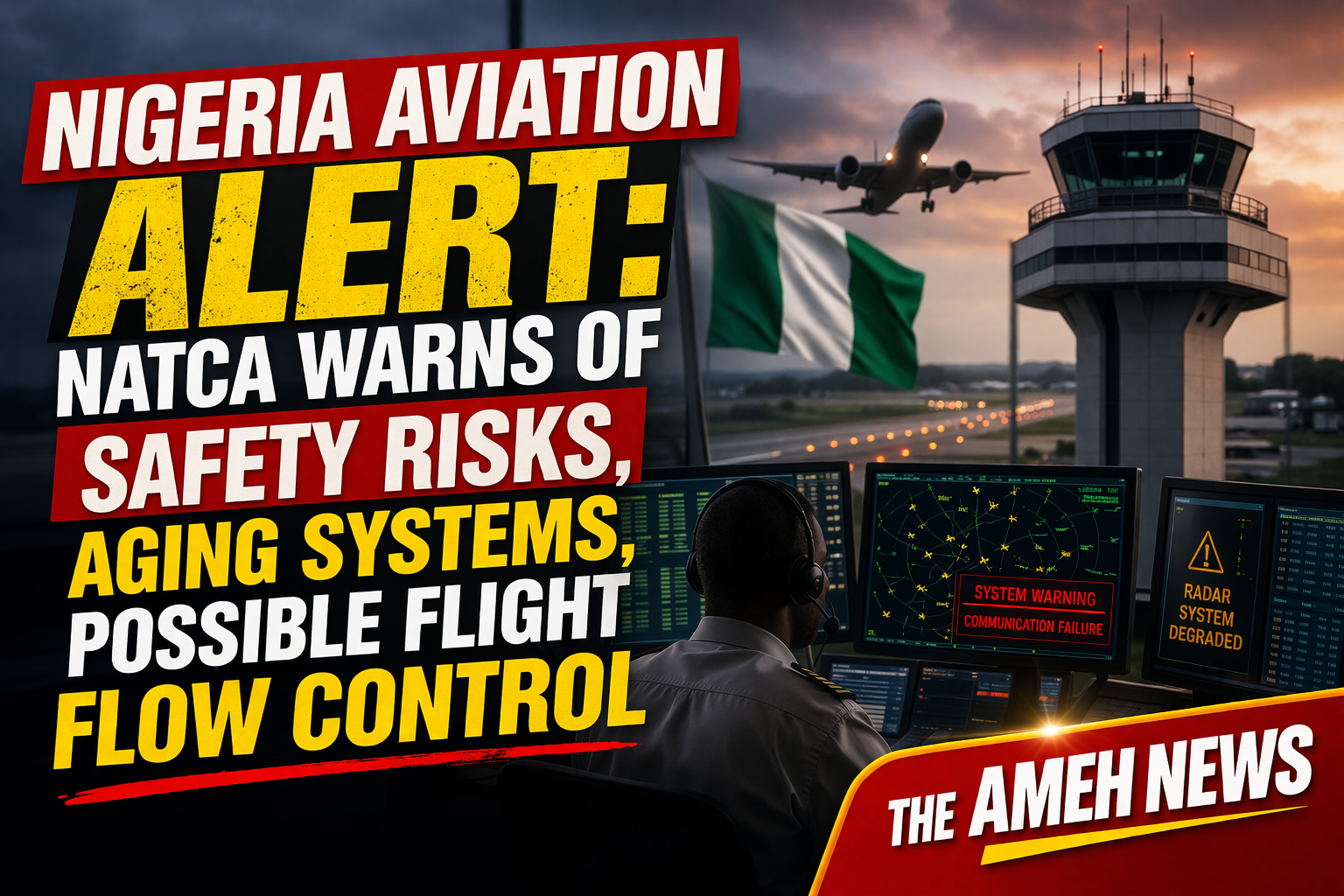
 Mounting concerns over safety, welfare, and infrastructure decay have pushed the Nigerian Air Traffic Controllers’ Association (NATCA) to warn of a possible nationwide flow control regime as a last-resort measure to ease pressure on Nigeria’s overstretched air traffic control system.
The Association says worsening conditions across Communication, Navigation, and Surveillance (CNS) infrastructure, combined with manpower shortages, delayed entitlements, and career stagnation, are placing unprecedented strain on air traffic controllers responsible for managing the nation’s increasingly busy skies.
Leadership Voices Raise Alarm
NATCA President Edino Ilemona Amos and General Secretary Umar Fahad have jointly led the Association’s renewed warning, describing the current state of Nigeria’s air traffic control system as “operationally stretched beyond safe limits.”
They stressed that controllers are working under conditions where system reliability, human capacity, and psychological endurance are simultaneously under pressure.
According to them, the Association’s position is not rooted in agitation but in safety realities observed daily in control towers and radar rooms across the country.
“Air traffic control is not a routine administrative function; it is a precision-based safety responsibility where fatigue, system failure, or delayed response can have serious consequences,” the leadership noted.
Aging Infrastructure and Operational Strain
A central concern remains the deterioration of CNS infrastructure across key aviation facilities. NATCA says outdated communication and surveillance systems continue to expose controllers to avoidable operational risks.
The Association explained that modern air navigation depends on real-time accuracy and redundancy systems, but many of Nigeria’s facilities still operate with ageing equipment that frequently requires manual workaround procedures.
It warned that such conditions increase workload intensity, reduce operational efficiency, and elevate the risk of human error in high-pressure environments.
Manpower Gaps and Weak Training Systems
Beyond infrastructure, NATCA highlighted a widening manpower gap within the air traffic control system. The Association noted that recruitment and succession planning have not kept pace with rising traffic demand.
It further pointed to inadequate recurrent training and limited professional development opportunities, warning that the lack of structured capacity building is weakening operational resilience.
Edino Ilemona Amos and Umar Fahad emphasized that aviation is a constantly evolving field, requiring continuous retraining to align with global standards and emerging technologies.
Safety Risks at Critical Airports
The Association also drew attention to unsafe working environments, particularly at major operational hubs.
It referenced the fire incident at Murtala Muhammed International Airport, where controllers reportedly had to evacuate under hazardous conditions before resuming duty shortly afterward.
NATCA said the incident exposed a deeper structural weakness in emergency preparedness and highlighted the physical risks aviation personnel face while maintaining national airspace safety.
Welfare Challenges and Career Stagnation
NATCA further expressed concern over prolonged career stagnation, stating that many experienced controllers have remained on Grade Level 16 for up to 13 years without advancement.
The Association described this as demoralising and inconsistent with the demands of a high-responsibility profession that requires discipline, expertise, and continuous performance under pressure.
It also criticized the failure to review professional and aeromedical allowances since 2012, despite rising economic pressures.
According to the leadership, these allowances are not optional benefits but essential components of maintaining medical certification and operational readiness.
Financial Strain and Unpaid Claims
The Association disclosed that numerous legitimate duty-related claims submitted by controllers remain unpaid for months, forcing personnel to bear operational costs personally.
It warned that this growing financial burden is contributing to declining morale and increasing stress levels among already overworked staff.
NATCA also pointed out inconsistencies in post-licence remuneration structures, describing them as a source of frustration and uncertainty within the profession.
Proposed System Reforms and Workforce Retention
To address workforce sustainability challenges, NATCA proposed a structured post-retirement engagement framework.
Under the proposal, experienced air traffic controllers would be retained at one grade level below their retirement rank, subject to medical fitness and operational requirements.
The Association said this would help preserve institutional knowledge, strengthen mentoring capacity, and reduce pressure on younger controllers navigating a complex operational environment.
Rising Morale Crisis Within the System
NATCA also highlighted a growing morale crisis, noting that some senior controllers are now placed under junior officers in administrative arrangements.
The Association said this has created resentment, eroded professional dignity, and weakened institutional respect within the system.
It warned that such structural inconsistencies are affecting confidence levels and could further reduce efficiency in a profession where hierarchy and experience are critical to safety.
Warning Over System Overload and Possible Flow Control
While acknowledging efforts by aviation authorities and the Federal Government, NATCA insisted that urgent intervention is required to prevent system overload.
It warned that failure to address infrastructure, welfare, and manpower challenges may force the introduction of nationwide flow control measures to regulate air traffic volumes and reduce controller fatigue.
Such a move, it said, would be aimed at protecting both aviation personnel and passengers from avoidable risks.
Call for Immediate Action
The leadership of NATCA—through Edino Ilemona Amos and Umar Fahad—urged aviation authorities to engage meaningfully with stakeholders and implement long-term reforms.
They stressed that controllers are not demanding luxury but the minimum operational conditions required to safely manage Nigeria’s airspace.
They concluded that safeguarding the aviation system ultimately depends on safeguarding the professionals who control it.
NATCA President Edino Ilemona Amos and General Secretary Umar Fahad warn that Nigeria’s air traffic control system faces safety risks due to aging CNS infrastructure, manpower shortages, unpaid claims, and welfare concerns, with possible nationwide flow control under consideration.
Discover more from Ameh News
Subscribe to get the latest posts sent to your email.