……Say Lagos Is Becoming Africa’s Silicon Valley Despite Infrastructure Challenges
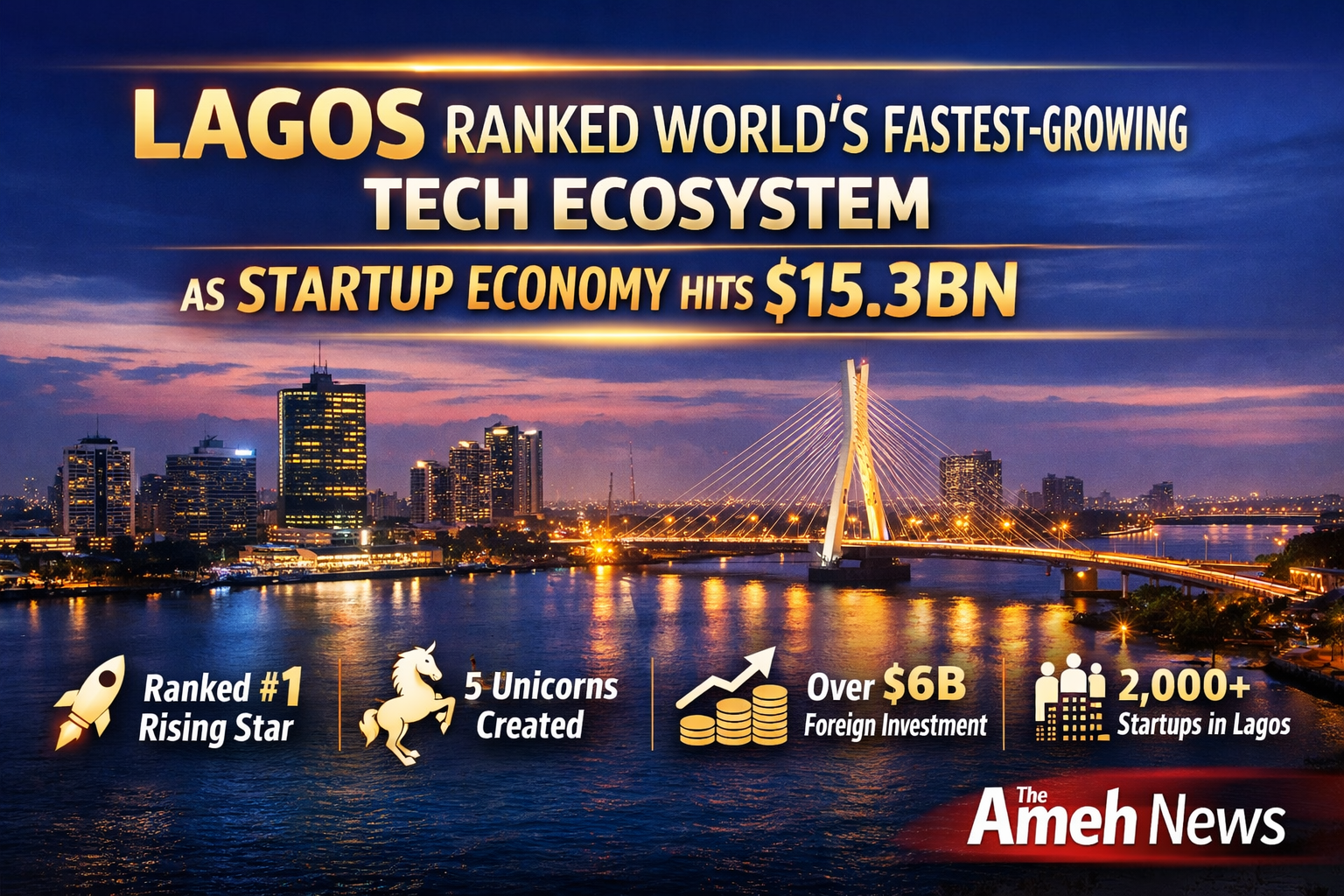 In what analysts describe as one of the most remarkable economic transformations in modern Africa, Lagos has emerged as the world’s fastest-growing technology ecosystem, surpassing major innovation hubs across Europe, Asia and Latin America while operating under some of the most challenging business conditions globally.
The latest Dealroom Global Tech Ecosystem Index 2025 ranked Lagos as the number one “Rising Star” among 288 technology ecosystems across 69 countries, placing Nigeria’s commercial capital ahead of Istanbul, Pune, Mumbai and Belo Horizonte.
The ranking reflects more than a symbolic victory. Behind it lies a technology ecosystem now valued at $15.3 billion, an 11.6-fold increase in startup enterprise value since 2017.
The city has also produced five unicorns — Interswitch, Flutterwave, Jumia, OPay and Moniepoint — while attracting over $6 billion in foreign technology investments between 2019 and 2024.
According to available industry data, Lagos hosts more than 2,000 startups and accounts for between 80 and 90 per cent of Nigeria’s startup ecosystem, making it the undisputed engine room of the country’s digital economy.
A Growth Story Built Against the Odds
What makes Lagos’ rise extraordinary is the environment in which it has occurred.
Entrepreneurs continue to grapple with unreliable electricity supply, expensive alternative energy costs, transportation bottlenecks and infrastructure deficits that would typically discourage investors.
Yet the city has continued attracting international venture capital and producing globally competitive technology companies.
The success story is increasingly drawing comparisons with some of the world’s most celebrated innovation centres.
Lagos Is Becoming Nigeria’s Most Valuable Economic Asset
Responding to questions from The Ameh News, economist Celestine Ukpong described the development as evidence that Nigeria’s future economic growth may be increasingly driven by innovation rather than natural resources.
“Lagos is gradually proving that intellectual capital can create more sustainable wealth than physical resources. The city has become a magnet for young innovators, software engineers, fintech founders and global investors.”
According to Ukpong, the significance of the ranking goes beyond technology.
“What investors are seeing is a resilient ecosystem that continues to grow despite power shortages, foreign exchange volatility and infrastructure limitations. That resilience itself has become an economic asset.”
The economist noted that technology-driven enterprises are increasingly creating high-value jobs and attracting foreign exchange inflows that can help diversify Nigeria’s economy away from oil dependence.
“The fact that more than 70 per cent of Nigeria’s technology investments are flowing into Lagos demonstrates growing confidence in the city’s innovation ecosystem. Policymakers should view this as a blueprint for economic diversification.”
Investors Are Following Value Creation
Also reacting to The Ameh News enquiry, chartered accountant and financial analyst Peter Adebayo FCA said the figures reveal that global investors are responding to measurable value creation rather than mere market optimism.
“The numbers tell a compelling story. An ecosystem valuation of $15.3 billion, five unicorns and over $6 billion in foreign investment indicate that investors are seeing tangible opportunities for growth and returns.”
According to Adebayo, Lagos’ startup success demonstrates how technology businesses can scale rapidly compared to traditional sectors.
“Technology companies have the advantage of scalability. Once the infrastructure and talent are in place, growth can happen exponentially. That is exactly what we are witnessing in Lagos.”
He added that the concentration of startups within Lagos creates a powerful economic multiplier effect.
“When founders, investors, accelerators, software developers and venture capital firms operate within the same ecosystem, innovation accelerates naturally. This clustering effect is one of the reasons Lagos is outperforming many emerging technology cities globally.”
Adebayo however stressed that sustaining the momentum would require strategic investments in power, broadband connectivity, digital infrastructure and regulatory certainty.
The Race for Global Relevance
Industry experts believe the Dealroom ranking signals a shift in global perceptions about African innovation.
For decades, Africa’s economic narrative was largely tied to commodities and natural resources. Lagos is increasingly helping redefine that narrative through software development, financial technology, artificial intelligence, digital commerce and innovation-driven entrepreneurship.
The city’s affordability also plays a critical role. Research indicates that average living costs in Lagos are approximately 22 per cent of those in New York City, enabling startups to operate with significantly lower costs while accessing a large and youthful consumer market.
What Comes Next?
While Lagos celebrates its global recognition, analysts say the challenge now is sustainability.
Maintaining growth will require stronger infrastructure, increased access to funding, talent development, improved broadband penetration and policy consistency.
Yet the latest figures suggest Lagos has already crossed an important threshold.
What was once viewed primarily as Nigeria’s commercial capital is now being recognised as one of the world’s fastest-rising innovation capitals — a city whose startups are increasingly shaping the future of African technology and attracting attention from investors across the globe.
For a city often associated with traffic congestion, population pressure and power shortages, the latest ranking offers a different narrative: Lagos is proving that innovation can flourish even in imperfect conditions, and that Africa’s next wave of economic growth may well be written in code rather than crude oil.
Lagos has been ranked the world’s fastest-growing tech ecosystem by Dealroom 2025. Economists Celestine Ukpong and Peter Adebayo FCA explain how a $15.3 billion startup economy, five unicorns and over $6 billion in foreign investment are transforming Nigeria’s future.
Focus Keywords
Lagos tech ecosystem, Dealroom 2025, Lagos startups, Nigeria technology industry, Flutterwave, Moniepoint, OPay, Interswitch, Jumia, foreign investment Nigeria, African startups, Lagos innovation hub, tech economy Africa
Discover more from Ameh News
Subscribe to get the latest posts sent to your email.