 Frank U Esanubi, FCA, FCCA, and FCTI
The Nigeria Tax Reform conversation gained significant traction yesterday during a robust discussion anchored by Oseni Rufai via his X platform, @ruffydfire. Among the notable contributions was an incisive analysis by Frank Esanubi, FCA, FCCA, and FCTI, who reviewed the Personal Income Tax sections of the 2024 Nigeria Tax Bill. This particular section has far-reaching implications for Nigerian workers as it determines the Pay-As-You-Earn (PAYE) tax deducted from their salaries.
Esanubi shed light on key changes under the proposed law. He highlighted that workers earning below ₦1,000,000 annually (₦83,333 monthly) will benefit from a zero-tax rate under the new bill. While this appears favorable, Esanubi noted that the actual savings for this category is modest—₦44,760 yearly or ₦3,730 monthly, as their prior effective tax rate was only 4%.
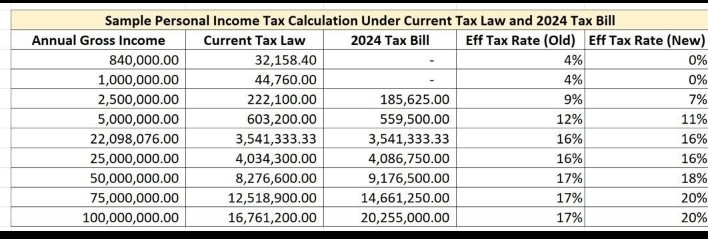 Conversely, higher earners—those with annual incomes exceeding ₦22 million (₦1,833,000 monthly)—will face steeper tax obligations. The effective tax rate for these individuals, previously between 16% and 17%, will rise to as high as 20%.
Esanubi attributed this shift to the removal of the Consolidated Relief Allowance (CRA) in the new bill. Previously, CRA allowed 21% of income or 20% of income plus ₦200,000 to be tax-free. The reform replaces this with a Rent Relief provision, capped at the lower of ₦200,000 or 20% of rent paid (with proof). Esanubi argued that this is a meager replacement compared to the benefits of the CRA under the current regime.
Critically, Esanubi called out the bill’s proponents for their selective emphasis on the zero-tax benefits for lower earners while remaining silent about its implications for the middle class. “The removal of the consolidated relief allowance for workers has been conspicuously understated,” he remarked, emphasizing that many middle-income earners would see an increase in their tax burden.
The ongoing discourse underscores the dual realities of tax reform: the attempt to ease the burden on lower-income earners while addressing perceived inequalities among high-income earners. However, Esanubi’s reflections caution against unintended consequences, particularly for Nigeria’s middle class, as the conversation about equitable tax policy continues.
Discover more from Ameh News
Subscribe to get the latest posts sent to your email.