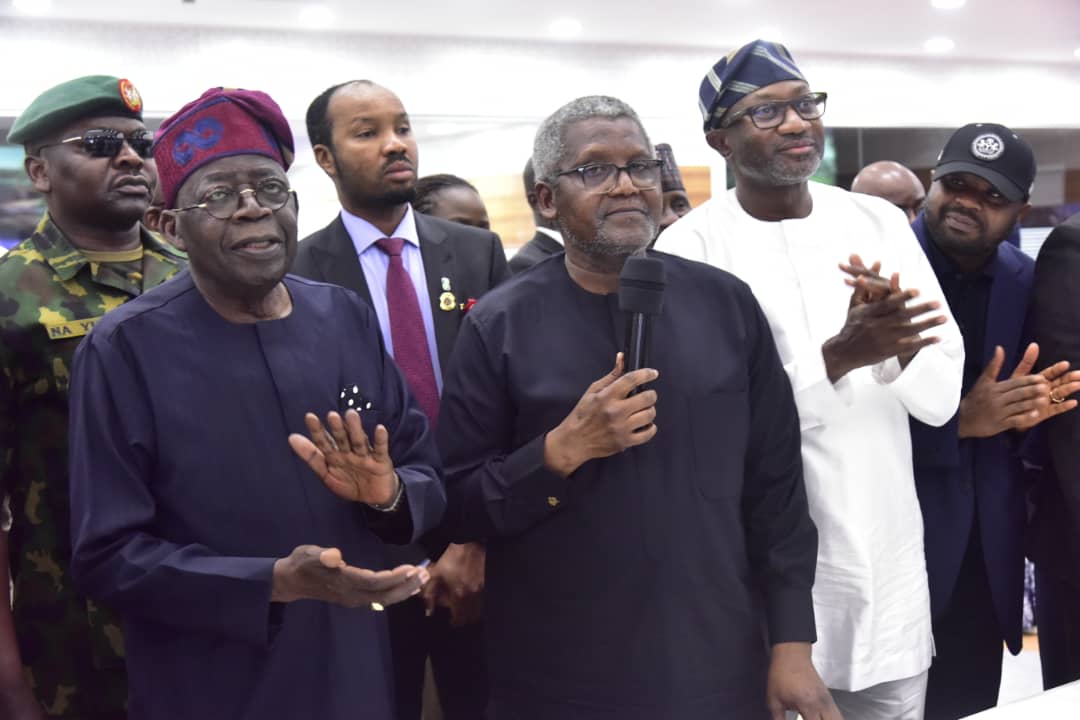
 His Excellency, President Bola Tinubu; Chairman, Dangote Group, Aliko Dangote; Chairman, Geregu Power PLC, Femi Otedola and Executive Chairman, Federal Inland Revenue Service (FIRS), Zacch Adedeji, at the state-of-the-art Main Control Room of the Dangote Petroleum Refinery & Petrochemicals, during the President’s tour of the facility, on Thursday, June 5, 2025.
A fresh wave of controversy has erupted following the President of Dangote Group, Alhaji Aliko Dangote, naming of Refinery Road after Tinubu as a sign reaffirming that his company paid $100million for the land and received no incentives or free allocations from the Federal Government or Lagos State for the construction of its $20 billion refinery located in the Lekki Free Trade Zone.
Dangote made the remarks last year during a visit to the refinery by the leadership of the House of Representatives, led by Speaker Tajudeen Abbas and Deputy Speaker Benjamin Kalu. Addressing longstanding public suspicions, Dangote stated emphatically:
“In the refinery, we did not, and I repeat, we did not collect one single incentive from the Federal Government of Nigeria or even Lagos State. Yes, the Lagos State gave us a good deal, but we paid $100 million for the land. It wasn’t a free land; we paid for it.”
His comments are a repeat of similar assertions made last year, amid claims by some Lekki residents and civil society groups that the government had quietly supported the refinery project with hidden incentives or land concessions.
The renewed statement has reignited debates about transparency, land acquisition, and corporate-state relations in the Lekki development corridor.
In what it seems as tensions on the controversial resurfaced on Thursday, June 5, 2025, shortly after during President Bola Ahmed Tinubu’s tour of the facility, when Dangote announced that the main road leading to the refinery would be named Bola Ahmed Tinubu Road in honour of the President. The announcement was met with applause as President Tinubu rose to shake hands with Dangote in a moment many described as symbolic.
However, since then, the gesture has sparked mixed reactions among the lagosians particularly Lekki Indigenous. Critics have questioned why a private individual should be in a position to name public infrastructure, suggesting that such actions blur the line between public authority and private influence.
“Why should Dangote be the one to name the road after the President? Shouldn’t that decision come from the Lagos State Government?” a stakeholder asked.
Another observer, who requested anonymity, described the gesture as “a quiet confirmation of ownership by action,” pointing to broader concerns about accountability and public oversight in megaprojects sited on public land.
While the Dangote Refinery is widely regarded as a transformative project for Nigeria’s energy sector, expected to reduce reliance on imported fuel, create jobs, and boost exports, concerns persist about how such large-scale developments intersect with public interest and urban governance.
Lekki residents, already wary over displacement, access restrictions, and infrastructure strain, view the latest developments as evidence of unequal decision-making power between private developers and the communities affected by their operations.
As work progresses at the state-of-the-art facility, and the new Bola Ahmed Tinubu Road sign goes up, the lingering question remains: who determines the symbols and substance of Nigeria’s development, the government, the people, or the corporations investing in its future?
Stay informed, stay ahead with The Ameh News
Discover more from Ameh News
Subscribe to get the latest posts sent to your email.