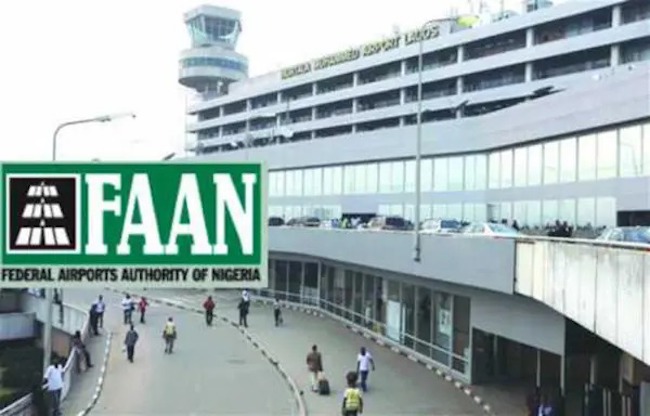
 With rising operational costs, shrinking margins, and mounting economic pressures, the Federal Airports Authority of Nigeria (FAAN) has announced plans to review and increase tariffs for service providers at airports across the country.
The move, which comes as Nigeria grapples with inflationary spikes, foreign exchange instability, and broader economic headwinds, is aimed at helping the Authority stay financially afloat while enhancing the efficiency and sustainability of airport operations.
At the heart of the new policy direction is FAAN’s growing concern over its lopsided revenue structure. Currently, 92 percent of its income comes from aeronautical sources—landing fees, parking charges, and terminal usage—while only 8 percent is generated from non-aeronautical sources such as retail concessions, car parks, and advertising. This is a stark contrast to international best practices, where airports generate up to 40 percent of revenue from non-aeronautical avenues.
“We’re not here to place an extra burden on businesses, but we also have to keep the lights on,” said Mrs. Adebola Joy Agunbiade, FAAN’s Director of Commercial and Business Development, during a stakeholders’ forum hosted by the Directorate of Commercial and Business Development (DCBD) in Lagos. “The reality is that our operating costs are rising fast, and we must find a balance.”
She noted that FAAN will ensure stakeholders are given adequate notice before any tariff increases take effect. “We are committed to transparency. These adjustments will be fair and communicated early to allow businesses to plan,” Agunbiade assured.

For many service providers at Nigerian airports, the looming tariff hike presents new uncertainties. Operators, already struggling with thin margins due to high fuel costs, import duties, and an unstable naira, say any added cost could impact their operations and the services passengers receive.
“I’ve been running a food outlet at the airport for over a decade,” said Nnamdi Obiora, an airport concessionaire in Lagos. “Every year, we battle to break even. If tariffs go up again, something has to give—it could be prices or jobs.”
FAAN is also tackling internal inefficiencies that have hampered its revenue growth. Agunbiade revealed that many concessionaires fail to understand or comply with lease agreements, leading to legal and financial disputes. To address this, FAAN has worked with its legal department to restructure and clarify lease terms.
“We’ve had repeated issues where people simply didn’t read or understand their lease terms,” she said. “We’ve revised those agreements to make them more user-friendly and enforceable. If you’re coming for a renewal or fresh application, expect changes that reflect clarity and fairness.”
FAAN is also embracing technology to modernize operations. Plans are underway to roll out automated, contactless payment systems across airport terminals, beginning with the Murtala Muhammed International Airport in Lagos. Under the new system, users will make payments using airport-issued smart cards.
“All transactions—parking, tolls, concessions—will be fully automated. No more cash. It’s seamless, transparent, and efficient,” Agunbiade said. She added that non-traditional revenue sources generated ₦2 billion in the last fiscal year, a figure FAAN believes can be doubled if new business models and digital platforms are fully implemented.
Managing Director of FAAN, Mrs. Olubunmi Kuku, stressed the need for accountability and modernization as the country faces a tough economic climate.
“Automation is our future. It ensures transparency and plugs revenue leakages,” she said. “We’re investing heavily in infrastructure upgrades and digital systems, from e-payment terminals to automated tollgates and parking lots. These changes are not cosmetic—they’re essential for survival.”
Kuku also warned of a clampdown on misconduct by certain airport operators. She said licenses of car hire services and Bureau de Change operators engaging in touting or unauthorized activities will be revoked.
In addressing congestion at Lagos airport, Kuku issued a stern warning against the indiscriminate parking of tankers and commercial vehicles along airport access roads.
“This is not what an international gateway should look like,” she said. “We’ve issued orders to clear the tankers. They are a security threat and a blight on our airport image. Drastic action is coming.”
For FAAN, the challenges ahead are steep. But with a new revenue strategy, tech-driven reforms, and a push for compliance and order, the agency says it is ready to reposition Nigerian airports for long-term viability—even in the face of economic adversity.
Stay informed, stay ahead with The Ameh News
Discover more from Ameh News
Subscribe to get the latest posts sent to your email.