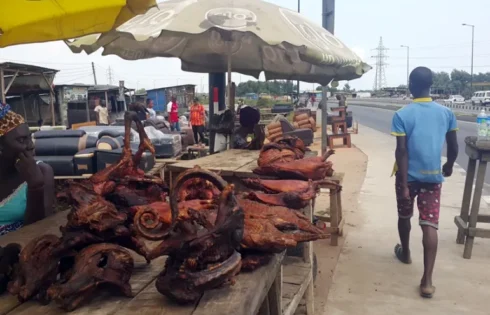
Beneath a makeshift shelter of old boards and corrugated tin, Justina Sunday piles dried corncobs into the rusting bathtub that serves as her grill. Squinting through wisps of white smoke scented with charcoal and spice, she flips strips of meat blistering over the hot coals. Her roadside stall, along a busy highway leading to Nigeria’s capital Abuja, is crowded with regulars awaiting steaks, chops and kebabs served with pap—a local porridge—and doused in pepper sauce.
But the meat isn’t the fare you’d find in New York, London or Tokyo. There’s no beef, pork or chicken in sight. Instead, Sunday’s menu features alligator, bat, antelope, porcupine or python—whatever Hausa and Fulani hunters have trapped or shot. She insists her products are healthier than farmed livestock. “Bushmeat has no fat; it’s natural,” she says. “Our ancestors ate it and lived long lives. Even during Ebola, my customers still came.”
Bushmeat has long been part of Nigerian culinary culture, largely in rural areas. Lately, though, demand has surged in cities, where both street vendors and professionals seek it out—for its distinctive flavour, its perceived nutritional value, or simply as a reminder of home.
A recent survey by the Wildlife Conservation Society found that more than two-fifths of urban Nigerians had eaten bushmeat in the past year—almost double the share in 2018. Although the sale of bushmeat is officially banned, it is openly displayed alongside conventional livestock in city markets. Globally, the World Bank estimates the illegal bushmeat trade to be worth between $7.8 billion and $10 billion annually, making it the fourth-most profitable criminal enterprise after drugs, human trafficking and arms.
Doctors warn that the trend poses a serious public-health threat. The World Health Organization reports that three-quarters of emerging infectious diseases in the past decade originated in animals. The 2014 Ebola outbreak in West Africa, for instance, likely began in Guinea after a family ate bats carrying the virus. Some researchers believe the coronavirus behind Covid-19 also jumped to humans from wild animals at a market in Wuhan, China. “This isn’t just a local health issue—it’s a potential public-health emergency,” says Ushakuma Anemga, vice-president of the Nigerian Medical Association.
Unsafe practices make the risks even higher. Open-air butchering, a lack of protective equipment and the absence of veterinary checks all create “silent pathways for emerging infections,” says Nusirat Elelu, a zoonotic-disease researcher at the University of Ilorin. While Nigeria has made some progress in outbreak response, she warns that its surveillance systems still can’t reliably detect illnesses linked to bushmeat. “We are sitting on a ticking time bomb if this trade continues unregulated.”
The appetite for bushmeat is also devastating Nigeria’s wildlife. From rabbits to crocodiles to elephants, animals are being hunted indiscriminately, says Edem Eniang, a professor of biodiversity conservation at the University of Uyo. “If nothing changes, we’re looking at a future where some species will vanish,” he says. The financial incentives are high: a rare animal can fetch more than 1 million naira ($651), which encourages reckless hunting with little regard for survival.
Driven by demand, hunters now kill virtually every wild creature they encounter—pregnant females, juveniles and endangered species alike. Although Nigerian law prohibits the killing of certain animals, enforcement is weak. Traders often disguise the meat of protected species to resemble that of legal game, deceiving buyers and outwitting regulators. “Even law enforcement officers often can’t tell the difference,” Eniang says. “They lack the training and tools to identify species, which leaves conservation laws toothless.”
For hunters, the trade remains a lifeline. Oladosu Adelani, a hunter in southern Nigeria, sees nothing wrong with it. In 2016, the government increased fines for hunting or selling endangered species such as pangolins, sea turtles, civets, monkeys and pythons—from 1,000 naira ($1.30) to as much as 500,000 naira plus five years in prison. But Adelani shrugs. “I have sold to everyone—even police and customs officers,” he says. “They talk about the laws, but they are also my customers.”
Discover more from Ameh News
Subscribe to get the latest posts sent to your email.