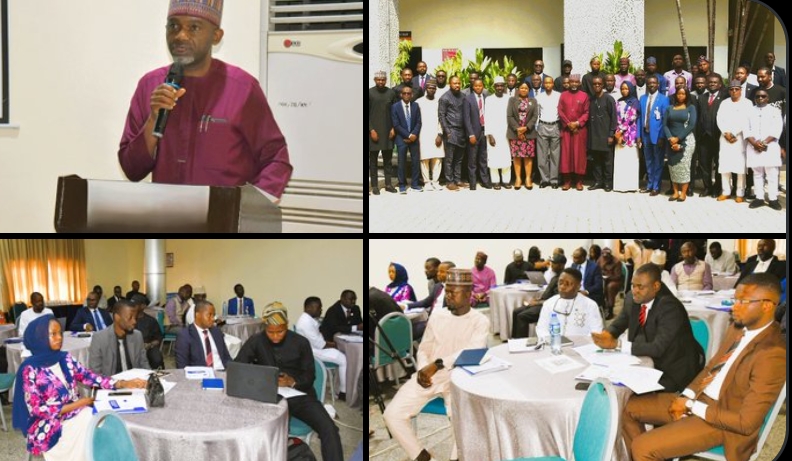
 As Nigeria’s digital economy continues to expand and its citizens increasingly embrace cryptocurrency and blockchain technologies, the Nigerian Financial Intelligence Unit (NFIU) is intensifying its efforts to safeguard the nation’s financial system from emerging cyber and digital threats.
In a strategic move to bolster institutional capacity, the NFIU, in collaboration with the Rule of Law and Anti-Corruption (RoLAC) Programme, organized a two-day intensive training workshop for security and law enforcement officers on October 29–30, 2025, in Abuja. The workshop focused on combating financial crimes arising from the misuse of virtual assets, blockchain platforms, and the dark web.
Speaking at the event, Hafsat Abubakar Bakari, Director/CEO of NFIU, represented by Dr. Muhammed Jiya, Chief Operating Officer, Emerging Technology and Innovations, revealed striking statistics on the rise of digital transactions. According to her, Nigeria recorded $59 billion in virtual asset transactions between July 2023 and June 2024, which surged dramatically to $92 billion between July 2024 and June 2025.
“This sharp increase underscores Nigeria’s growing digital participation and the need for stronger policy responses to ensure innovation progresses hand-in-hand with compliance and security,” Bakari stated.
She further noted that virtual assets, blockchain, and dark web economies have become the new frontier of global financial crime and terrorism financing, necessitating proactive, intelligence-driven responses. The workshop, she said, aligns with the Financial Action Task Force (FATF) Recommendations 15 and 16, which provide global standards for mitigating risks linked to new technologies.
Participants drawn from multiple law enforcement agencies engaged in advanced sessions on dark web investigations, trade-based money laundering, and virtual asset misuse. Experts emphasized the importance of data-driven intelligence-sharing, inter-agency collaboration, and the adoption of regulatory technology (RegTech) to improve the tracking and prosecution of digital financial crimes.
Dr. Jiya highlighted that the NFIU’s focus extends beyond enforcement to capacity building, policy coordination, and international partnerships. “Our goal is to make Nigeria’s financial ecosystem resilient against evolving cyber-enabled threats, while supporting innovation that drives economic growth,” he explained.
Observers at the event, including financial analysts and digital security experts, commended the NFIU and RoLAC partnership as a timely and strategic intervention in an era where financial crimes are increasingly sophisticated and borderless.
Economic analyst Celestine Ukpong noted that the scale of Nigeria’s crypto activity reflects both opportunity and risk.
“Nigeria’s young, tech-savvy population has embraced digital finance faster than regulation can adapt,” Ukpong said. “Workshops like this ensure law enforcement keeps pace with innovation, securing the ecosystem for legitimate users.”
Similarly, Peter Adebayo, a chartered accountant and compliance specialist, applauded the NFIU’s proactive approach.
“This initiative shows Nigeria is not waiting for global agencies to dictate the pace. By building internal expertise, we’re positioning the country to lead in financial intelligence across Africa,” Adebayo observed.
As the world transitions to an increasingly digital economy, Nigeria’s commitment to training, intelligence coordination, and cross-sector collaboration will play a defining role in maintaining financial stability and public trust.
The workshop concluded with a call to action for agencies to institutionalize learnings from the sessions, strengthen data-sharing frameworks, and enhance early-warning systems to detect and disrupt illicit digital transactions before they escalate.
The Nigerian Financial Intelligence Unit (NFIU) and RoLAC have trained law enforcement officers on combating digital financial crimes as Nigeria’s virtual asset transactions soar to $92 billion. Experts commend the initiative as vital for securing Nigeria’s fast-growing digital economy.
Discover more from Ameh News
Subscribe to get the latest posts sent to your email.