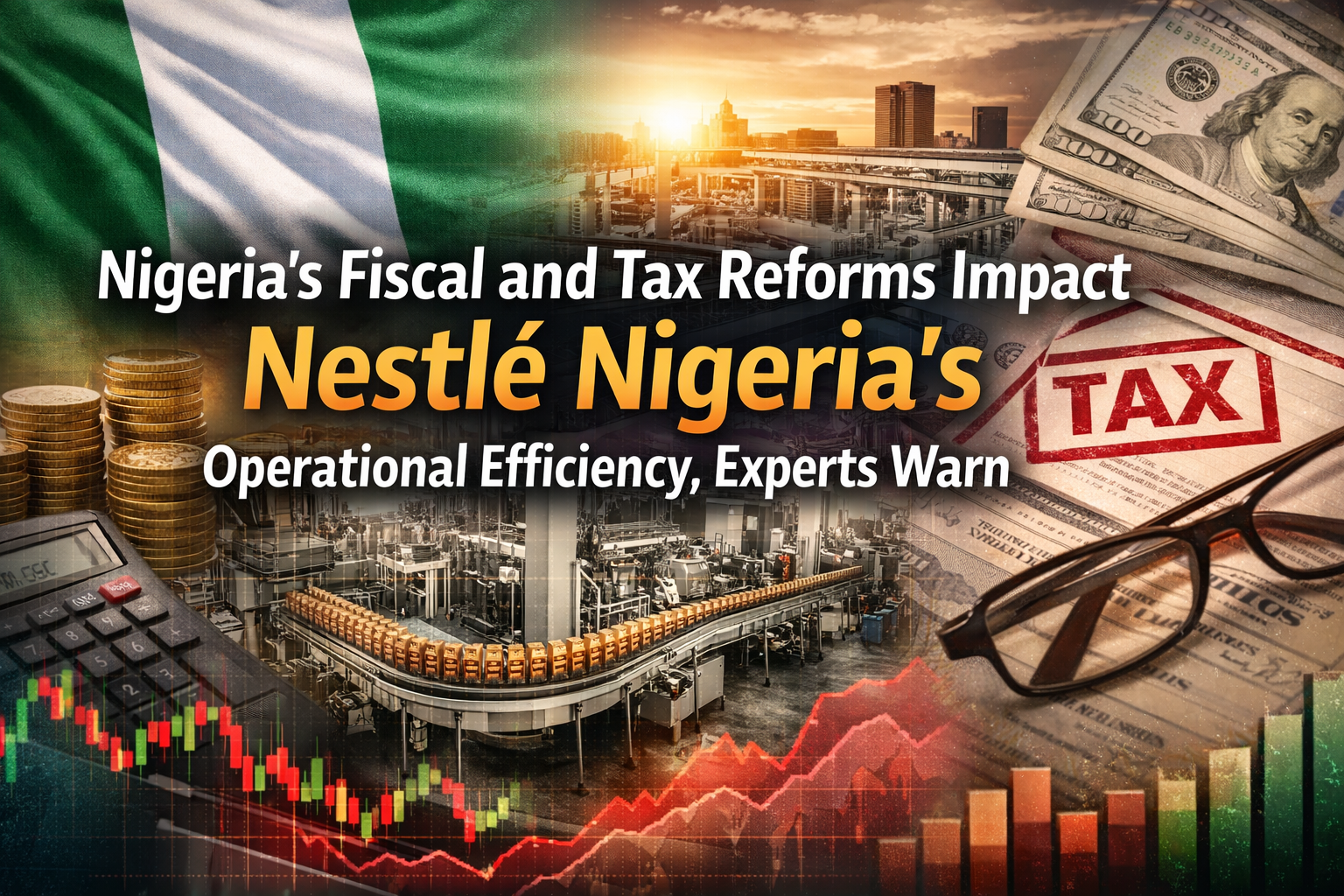
 As Nigeria recalibrates its fiscal architecture in pursuit of revenue stability and macroeconomic consolidation, the ripple effects are being felt across boardrooms and factory floors alike. For Nestlé Nigeria Plc, one of the country’s leading food and beverage manufacturers, the evolving tax and fiscal framework is not merely a policy shift—it is a structural force redefining operational efficiency, investment strategy, and long-term competitiveness.
At the heart of the reform agenda lies a delicate balance: the government’s need to strengthen revenue mobilization against industry’s demand for stability, predictability, and cost sustainability. For manufacturers operating in a price-sensitive economy, that balance is critical.
The Rising Cost Equation
Adjustments in corporate taxation, Value-Added Tax (VAT), import duties, and compliance protocols have reshaped the production economics of Nigeria’s FMCG sector. For Nestlé Nigeria, whose operations span procurement, manufacturing, packaging, and nationwide distribution, even marginal fiscal shifts can reverberate across the value chain.
Increased duties on imported inputs and machinery elevate production costs. Higher compliance obligations add administrative overhead. Combined, these pressures test operational efficiency—the ability to produce more at lower cost while maintaining quality and market share.
Manufacturers often respond with internal restructuring: optimizing supply chains, renegotiating vendor contracts, enhancing energy efficiency, and accelerating automation. Yet, these adaptive strategies require capital—and capital depends on policy confidence.
Investment Under Fiscal Uncertainty
Economist Celestine Ukpong describes the current environment as a pivotal moment for industrial policy.
“Fiscal reform is necessary for economic stabilization, but its design must recognize the strategic role of manufacturing. When reforms increase costs without complementary incentives, companies may defer investments in technology and capacity expansion. That ultimately affects productivity and competitiveness,” Ukpong said.
Operational efficiency thrives on modernization—digital systems, automated production lines, and energy-efficient infrastructure. However, when tax burdens rise or policies appear unpredictable, firms may prioritize short-term survival over long-term efficiency gains.
Ukpong argues that a stable fiscal roadmap encourages capital deepening.
“Predictability is as important as the rate itself. Investors can adjust to tax levels if they are certain and consistent. What disrupts operational planning is volatility,” he added.
Pricing Pressures and Market Sensitivity
Nigeria’s consumer market remains highly price elastic. When rising production costs compel manufacturers to adjust product prices, demand volumes may soften. Reduced volumes weaken economies of scale, increasing per-unit production costs and further tightening margins.
For Nestlé Nigeria, a brand deeply embedded in household consumption, strategic pricing becomes a balancing act between affordability and sustainability. Passing costs directly to consumers risks eroding market share; absorbing them compresses profitability.
The Hidden Cost of Compliance
Beyond direct taxation, compliance complexity has emerged as a silent drain on efficiency.
Chartered accountant Peter Adebayo, FCA, notes that administrative burdens often escape public scrutiny.
“The impact of fiscal reform is not limited to tax payments. Companies must invest in systems, consultants, and personnel to meet evolving compliance standards. These are indirect costs that affect operational margins,” Adebayo explained.
He emphasized the importance of digitized and harmonized tax administration to reduce friction.
“A streamlined, technology-driven framework reduces duplication and uncertainty. That enhances transparency for government and operational clarity for business,” he said.
According to Adebayo, simplifying compliance procedures could unlock efficiency gains without compromising revenue objectives.
Cash Flow and Capital Discipline
Fiscal reforms often intersect with broader monetary tightening measures. Higher interest rates and accelerated tax remittance schedules can constrain liquidity, affecting working capital management.
For manufacturers managing raw material imports, logistics expenses, and nationwide distribution networks, cash flow flexibility is essential. Reduced liquidity narrows operational agility, making firms more vulnerable to currency volatility and supply chain disruptions.
The Local Sourcing Imperative
One emerging response to fiscal pressure is deeper backward integration and local sourcing. By reducing reliance on imported inputs, manufacturers can mitigate exposure to import duties and foreign exchange fluctuations.
Industry analysts suggest that aligning fiscal reforms with incentives for local production could generate multiplier effects—enhancing industrial resilience while expanding the tax base organically.
The Broader Economic Equation
Nigeria’s fiscal reset is driven by legitimate macroeconomic goals: revenue diversification, deficit reduction, and institutional strengthening. Yet the sustainability of these reforms depends on how effectively they preserve industrial momentum.
Nestlé Nigeria’s experience underscores a broader truth: operational efficiency is not shaped solely by internal management decisions. It is profoundly influenced by the external policy environment.
For reforms to deliver long-term dividends, experts argue they must combine revenue discipline with industrial foresight—supporting productivity, encouraging innovation, and maintaining policy consistency.
As the reform era unfolds, the interplay between fiscal authority and corporate adaptability will define the trajectory of Nigeria’s manufacturing sector. For Nestlé Nigeria, efficiency is no longer just an operational target—it is a strategic response to a transforming economic landscape.
Nigeria’s fiscal and tax reforms are reshaping Nestlé Nigeria’s operational efficiency, with economists Celestine Ukpong and Peter Adebayo, FCA, highlighting cost pressures, compliance burdens, and investment implications for the manufacturing sector.
An in-depth analysis of how Nigeria’s fiscal and tax reforms are impacting Nestlé Nigeria’s operational efficiency, with expert insights from economist Celestine Ukpong and Peter Adebayo, FCA, on cost pressures, compliance challenges, and industrial sustainability.
Discover more from Ameh News
Subscribe to get the latest posts sent to your email.