By Ameh News Editorial Board
Opening Reflection: When Applause Fades, Reality Begins
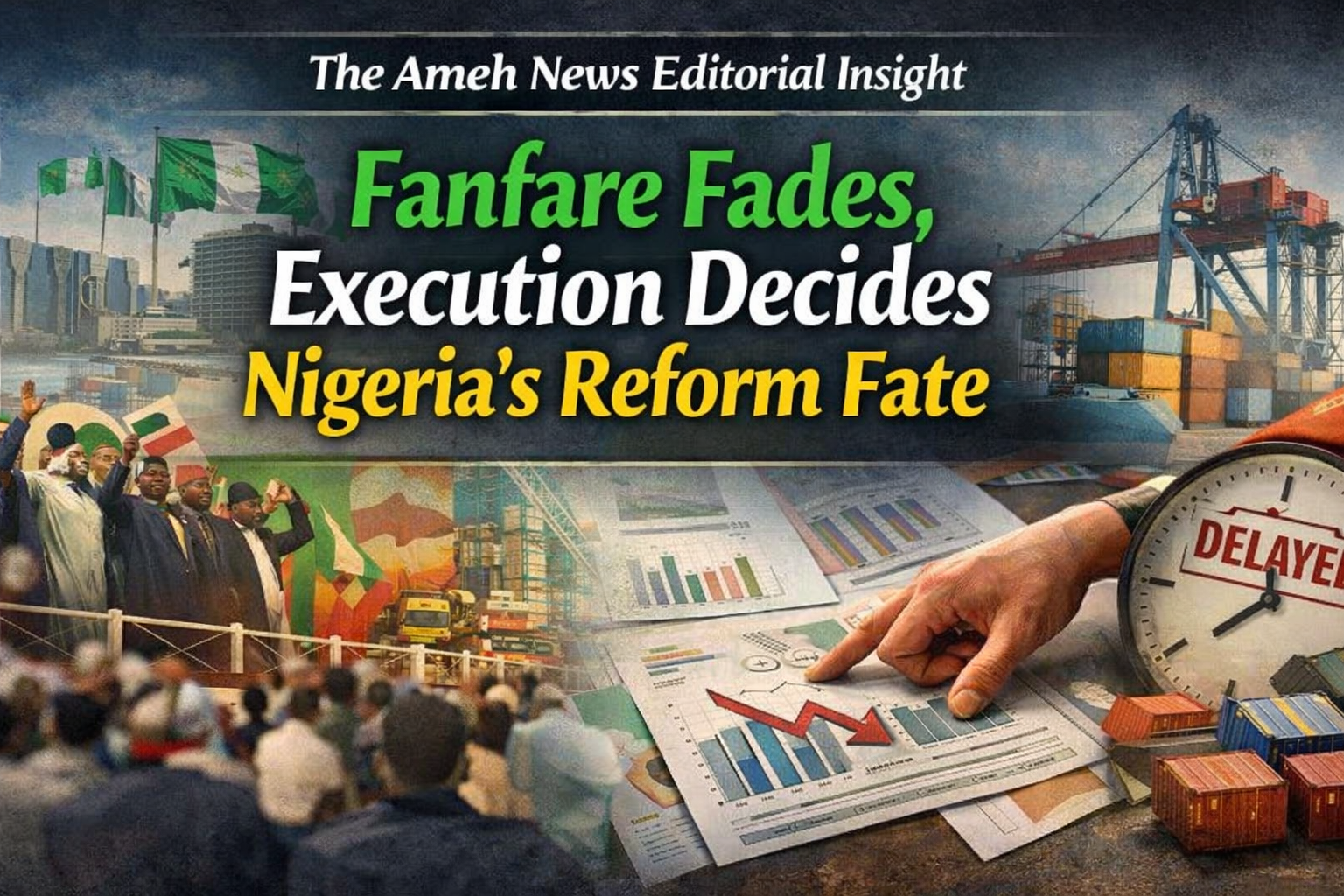 In Nigeria, policy launches are rarely quiet affairs. They arrive with bold declarations, ambitious projections, and a sense of historic turning points. Yet, as the applause fades and the dignitaries exit the stage, a more critical phase begins—one that determines whether reforms will reshape the economy or simply join a long list of unrealized ambitions.
The Ameh News Editorial Board asserts that the real story is not in the fanfare. It lies in what happens next: execution, institutional resistance, and the ability to produce measurable, verifiable outcomes.
Recent initiatives, including the National Single Window (NSW), capital market reforms such as T+1 settlement, and broader fiscal restructuring under President Bola Ahmed Tinubu, reflect a renewed appetite for transformation. However, history suggests that ambition alone is not enough.
The Optics of Reform: A Familiar Cycle
Nigeria’s reform landscape has long been characterized by high-visibility launches. These events often signal intent and political will, but they also risk creating a false sense of progress.
The National Single Window initiative, for example, has been introduced as a game-changer for trade facilitation. Projections indicate it could:
Generate between $2 billion and $4 billion annually in additional revenue
Reduce cargo clearance time from 20–30 days to under 7 days
Cut trade-related costs by up to 30%
While these projections are compelling, the Ameh News Editorial notes that similar promises have accompanied past reforms in ports, taxation, and digital governance.
Data from policy monitoring groups reveal:
More than 60% of major reforms between 2010 and 2023 experienced implementation delays
Only about 35–40% achieved their stated objectives within five years
This recurring gap between promise and performance underscores a systemic issue: Nigeria excels at launching reforms but struggles to sustain them.
Execution Deficit: Where Policies Are Tested
Execution is the crucible in which policy success is determined. It requires more than strategy—it demands coordination, infrastructure, funding, and discipline.
Nigeria’s trade ecosystem provides a telling example:
The country handles over 1.5 million TEUs annually
Average cargo dwell time remains above 20 days
In contrast, leading global ports operate at a 3–5 day clearance time
The introduction of a unified digital platform like the NSW is intended to bridge this gap. However, execution challenges are deeply rooted:
Fragmented digital systems across government agencies
Limited interoperability and data sharing
Inconsistent regulatory frameworks
Capacity constraints among personnel
The Ameh News Editorial emphasizes that unless these structural weaknesses are addressed, the NSW risks becoming another underperforming reform despite its strong conceptual foundation.
Resistance: The Reform Within the Reform
Perhaps the most underestimated factor in Nigeria’s reform journey is institutional resistance.
Reforms often disrupt established systems that benefit certain actors—both formal and informal. In sectors like ports and customs, inefficiencies can create economic rents that stakeholders are reluctant to lose.
Forms of resistance typically include:
Administrative delays disguised as procedural compliance
Jurisdictional conflicts among agencies
Partial or selective implementation of reforms
Technological pushback due to fear of transparency
The NSW, which requires integration across more than 15 government agencies, will inevitably confront these challenges.
Historical patterns suggest:
Multi-agency reforms in Nigeria often face delays of 12–24 months
Compliance rates in early phases can fall below 70%
Budget overruns may exceed 30%
The Editorial Board argues that managing resistance is as important as designing the reform itself.
Data and Outcomes: The Only Metrics That Matter
For reforms to move beyond symbolism, they must be measured against clear, transparent indicators.
The Ameh News Editorial proposes a results-based framework for evaluating initiatives like the NSW:
1. Efficiency Gains
Has the cargo clearance time reduced significantly?
Benchmark: Under 7 days within 24 months
2. Revenue Impact
Are government earnings increasing sustainably?
Baseline: Nigeria Customs generated over ₦3 trillion annually in recent years
3. Cost of Doing Business
Are logistics and compliance costs decreasing for businesses?
Target: 20–30% cost reduction
4. Transparency and Accountability
Has digitization reduced corruption and manual interventions?
Increase in traceable transactions and audit trails
5. Investment Response
Is there a measurable increase in foreign and domestic investment?
Nigeria’s FDI remains below $2 billion annually, far behind peer economies
Without consistent public reporting on these indicators, reforms risk being judged by intentions rather than impact.
Global Lessons: Execution as a Competitive Advantage
Countries that have successfully implemented similar reforms offer a clear lesson: execution is everything.
Singapore’s TradeNet reduced clearance time to less than 24 hours
South Korea achieved near-total digital integration of trade processes
Rwanda cut cargo clearance time by over 50% within three years
These successes were driven by:
Strong central coordination
Clear accountability structures
Continuous monitoring and evaluation
Stakeholder buy-in
Nigeria’s challenge is not a lack of vision, but sustaining the discipline required to execute that vision.
The Political Economy Dimension
Reforms are inherently political. They redistribute power, alter incentives, and challenge entrenched interests.
Under the current administration, economic reforms are critical to:
Expanding government revenue
Stabilizing the currency
Improving investor confidence
Enhancing Nigeria’s global competitiveness
However, the Ameh News Editorial cautions that without transparency and accountability, reforms may deliver short-term political optics without long-term economic substance.
Media and Public Accountability: A Missing Link
The role of the media must evolve alongside reforms.
Too often, coverage is concentrated on launch events, leaving a gap in:
Monitoring implementation progress
Investigating delays and inefficiencies
Reporting performance data
Holding institutions accountable
The Ameh News Editorial calls for a shift toward data-driven journalism, where the success of reforms is tracked over time, not just announced at inception.
Editorial Conclusion: From Promises to Proof
Nigeria stands at a critical juncture. The ambition to reform key sectors is evident, and the policy frameworks are increasingly sophisticated.
But ambition must now give way to execution.
The Ameh News Editorial reiterates:
Fanfare is not progress
Announcements are not achievements
Intentions are not outcomes
The true measure of reform lies in:
Reduced inefficiencies
Increased revenues
Improved investor confidence
Tangible benefits for businesses and citizens
Until these outcomes are visible and measurable, the story remains unfinished. Ameh News Editorial analysis examines why Nigeria’s reform success depends not on policy fanfare but on execution, institutional resistance, and measurable economic outcomes.
Discover more from Ameh News
Subscribe to get the latest posts sent to your email.